

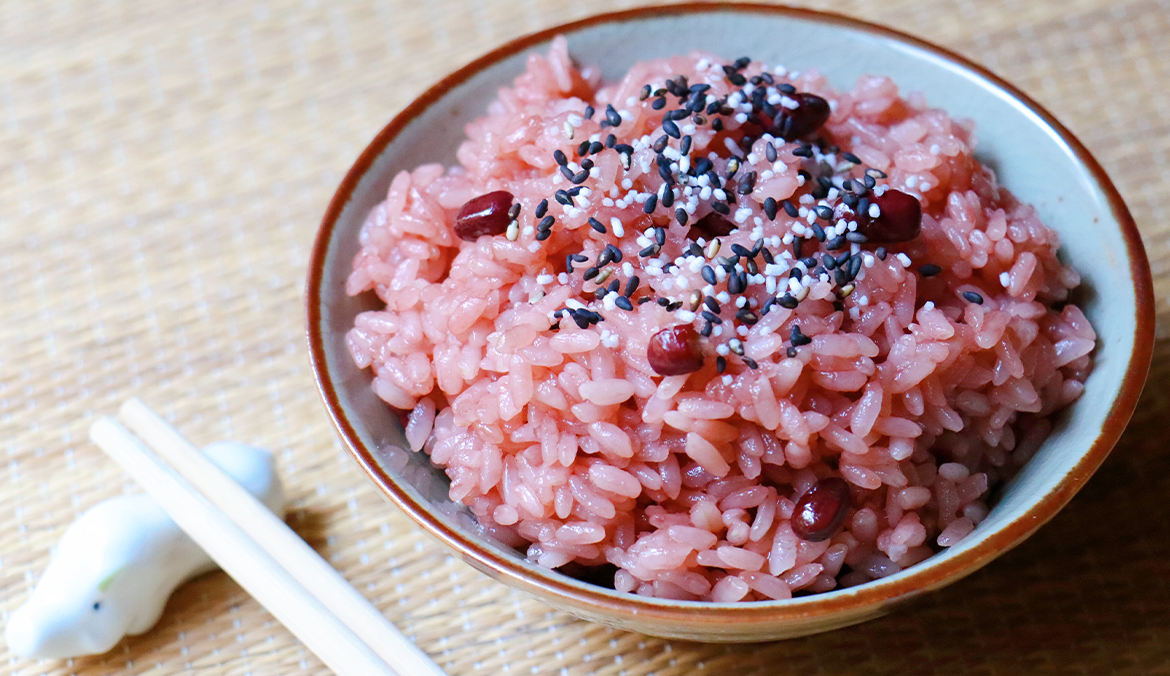
Indeed, Buettner notes that beans are a central component of meals consumed in all five Blue Zones. This includes Okinawa, Japan, where you’ll find a wide variety of beans, including soybeans, fermented beans (nattō), and mung beans, to name a few. Another highly popular choice? Red beans, otherwise known as azuki (or adzuki) beans.
To learn more about this popular Japanese staple, its cultural significance, and one of the best ways to eat ‘em, we caught up with Namiko Chen, a Yokohama, Japan native and the founder of the widely acclaimed Japanese cooking platform, Just One Cookbook, who shared her go-to, two-ingredient, red bean-rice dish packed with longevity boosting benefits.
What’s the significance of red beans in Japanese culture?
According to Chen, red beans (aka azuki beans) have been a part of Japanese cuisine for centuries. “Azuki beans are said to have been introduced from China around the third century, 300 B.C. to 201 B.C. There’s also another theory that azuki beans were grown in Japan in the Jōmon period, 14,000 to 300 B.C.,” Chen says. (Read: Red beans have been around for a very long time.)
Although, these days, many value azuki beans for their nutritional value and delicious taste, Chen notes that they also once carried additional cultural significance. “They were deemed a beneficial talisman as the red color of the azuki beans was thought to help ward off evil spirits—and were also seen as a form of medicine due to their high nutritional value,” Chen says. What’s more, she explains that as Buddhism spread to Japan, eating animals did not align with this religious belief. As such, azuki beans were used in place of meat in many instances.
Nowadays, you can find azuki beans in many different Japanese dishes. “Red beans, or what we call azuki beans, are primarily used in various sweets in Japanese cuisine,” says Chen. “These traditional sweets called wagashi are mostly filled with or accompanied by sweet azuki bean paste called anko or an. The azuki beans are boiled, mashed, sweetened with sugar, and then used as fillings in daifuku mochi [red bean-filled mochi], manju [red bean steamed cake], and dorayaki [red bean pancakes].”
And although you’ll find azuki mostly in sweet preparations, there’s one popular savory dish Chen loves to make: a red bean rice called sekihan.
What is sekihan (Japanese red bean rice)?
It’s true: You’ll typically find red beans in Japanese sweets for the most part. However, Chen notes that sekihan is one exception. “In Japan, we make red bean rice called sekihan—or osekihan—on auspicious occasions,” she says. “The red color of the rice symbolizes happiness and prosperity. It’s a traditional dish served on many happy and celebratory occasions, such as Japanese New Year and Children’s Day, the birth of a baby, birthdays, graduations, and weddings.”
To make this simple dish, you only need two ingredients: Rice and red beans. And although the ingredient list sounds simple, the process of making the dish is slightly more complex. “For the rice, it’s very important to use Japanese short-grain glutinous rice called mochigome when you make sekihan; do not use other Asian long-grain glutinous rice varieties,” Chen says. According to her, using mochigome will ensure the most “authentic outcome” in the final dish, as this is the variety that’s most widely used in Japanese cooking. “Remember that long-grain and short-grain varieties have different flavors, textures, and shapes when cooked,” she says.
Fortunately, this type of rice is also widely available in the United States. “You can find mochigome at Japanese grocery stores, other Asian grocery stores, and some well-stocked supermarkets. I usually get local, California-grown, organic mochigome at my local Japanese supermarket called Nijiya. You can also find Koda Farms and Hakubai brands at online retailers like Amazon and ,” Chen says.
Another key point is to rinse any excess starch and impurities in three to four changes of water until the water runs clear, according to Chen. “When you do this, you must be very gentle, as mochigome is fragile and can break easily,” she says. “Using a large bowl and not a sieve helps to keep the grains from breaking as you rinse them.” For a step-by-step rinsing rice tutorial, you can check out Chen’s in-depth guide.
But for a quick overview, you’ll want to use your finger to agitate the wet rice using circular motions and use minimal amounts of water to allow the grains to rub against each other for better cleaning. “Using very little water while washing also keeps the rice from absorbing the impurities found in the cloudy rinsing water,” Chen says. With a little patience (and a few rinses later), the cloudy water will eventually run clear. “After the final rinse, you’ll drain the rice well in a fine-mesh strainer and shake off the remaining water,” she says.
For even easier rice rinsing, Chen recommends investing in a Japanese-style bowl specialized for this task. They have a gentle and rounded bowl shape but with side and bottom drainers. “You can use one if you’re worried about losing rice grains when pouring off the rinsing water from a regular bowl,” she says.
At this point, Chen says you’ll need to pre-soak the glutinous rice (for about 8–12 hours) only if you’ll be steaming it—not when cooking it in a pot stovetop or an electric rice cooker. To prep the rice to soak, you can use any type of bowl. The key is simply to ensure the rice is covered with plenty of water so it can absorb it while remaining submerged at the end of the soaking period. “This ensures an even soak for all the rice grains,” Chen says.
As for the beans, Chen says it’s not necessary to soak beans hours before cooking them despite what the packaging may say. “While soaking the beans for several hours or overnight does help reduce the cooking time slightly, it doesn’t make a significant difference. Therefore, my sekihan recipe does not call for soaking the beans ahead of time,” she says.
However, what does make a difference is how fresh the beans are. “Look for dried azuki beans that are fresh so they will become tender when you cook them. Old beans won’t become tender no matter how long you cook them,” Chen says. According to her, the best way to check if the beans are fresh (or old) is by inspecting the expiration date on the packaging. “Buy azuki beans that are recently packaged and far off from their expiration date,” she says.
What’s more, Chen suggests buying azuki beans imported from Hokkaido, Japan—the largest producer of this type of bean—whenever possible. “Japanese grocery stores sell different brands of azuki bean packages, and they are typically all from Hokkaido. If you are shopping for azuki beans elsewhere, it‘s good to check where the azuki beans are from,” she says. That said, if you can’t find Hokkaido beans, azuki from Tamba in Hyogo prefecture (which are known to be premium varieties according to Chen) are a great option, too.
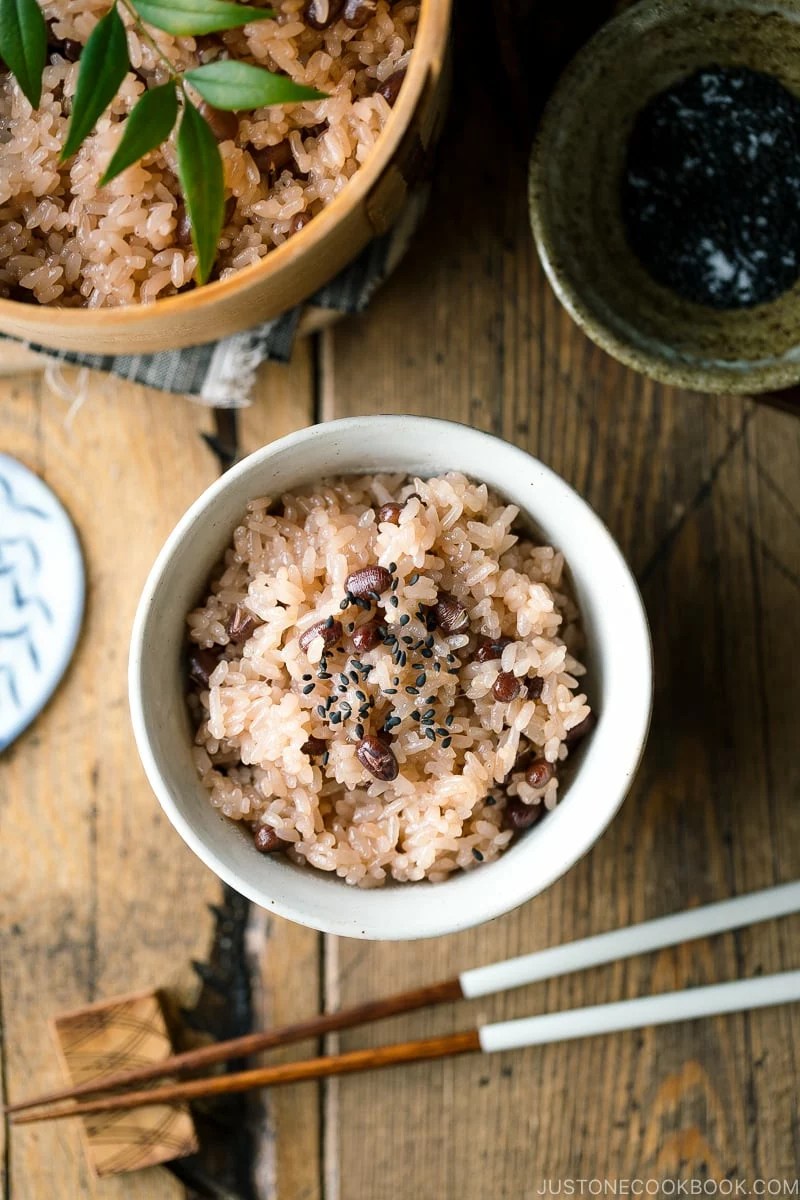
Sekihan (red bean rice) recipe
Yields 5 servings
Ingredients
1/3 cup azuki beans
1 1/2 cup water (for cooking beans #1)
3 1/2 cup water (for cooking beans #2)
2 1/4 cups sweet rice/glutinous rice (mochigome)
1/2 Tsp Diamond Crystal kosher salt (use half as much for table salt and two-thirds for sea salt by volume)
1 Tbsp toasted black sesame seeds (or use gomashio, which is a combination of black sesame seeds and salt)
1/2 Tsp Diamond Crystal kosher salt for serving
To make the beans:
- Rinse azuki beans in the strainer under cold running water and drain well.
- Put the azuki beans in a large pot (with a tight-fitting lid) and 1 1/2 cup water.
- Bring it to a boil over medium heat. Once boiling, turn off the heat and drain the beans over the strainer.
- Put the beans back in the pot and add 3 1/2 cup water. Bring it to a boil.
- Once it’s boiling, turn down the heat to low/simmer. Cover and cook for 25–30 minutes. (Note: The beans will continue to cook with glutinous rice, so they should be tender but don’t have to be 100-percent cooked at this stage. I personally prefer the beans to have some texture instead of mushy. Please adjust the cooking time for the beans accordingly.)
- Check the doneness of the beans by mashing one bean between your fingers. (As I prefer the beans to have some texture, when I test the bean, the texture should still be somewhat firm, not completely soft. Remove from the heat and let cool to room temperature for roughly one hour. Beans will continue to cook with the remaining heat.)
To measure the rice cooking liquid:
- Once the azuki beans and azuki-cooking liquid come to room temperature, separate them. You must have 540 milliliters (about two-and-a-quarter cups) of cooking liquid. If you don’t have enough, add water to have exactly 540 milliliters.
To make the rice on the stovetop:
- In a large bowl, place the sweet rice (glutinous rice). Add water to submerge it and quickly discard the water.
- Add water and gently rinse the rice three to four more times until the water is clear. Unlike regular white rice, sweet rice breaks easily, so be gentle when you rinse.
- For one last time, add water to the bowl and drain the rice into the strainer. Drain and shake off the water well.
- Add the drained rice and 540 milliliters of the azuki-cooking liquid to the pot or donabe (Japanese cooking pot).
- Add salt and mix well together.
- Add the beans on top and evenly distribute but try not to mix with rice. Rice cooks evenly when it’s not mixed with other ingredients.
- Cover the lid and start cooking on medium-high heat until boiling roughly eight to 10 minutes.
- Once boiling, reduce the heat to low/simmer and cook for 10-12 minutes. Remove from the heat (so the bottom doesn’t get burnt) and let it steam for additional 20 minutes.
To serve:
- Mix black sesame seeds and salt. This is called gomashio.
- Stir the rice gently. Insert the rice scooper perpendicularly, lifting up the rice from the bottom.
- Then break it up with the rice scooper perpendicularly, as if you’re cutting it. Repeat the same process until all the bottom of the pot is mixed. Serve in individual rice bowls and sprinkle gomashio on top. Enjoy!
Can’t get enough beans? Try these black bean brownies:
Our editors independently select these products. Making a purchase through our links may earn Well+Good a commission.
