


Bone loss begins to accelerate for all women in their mid-30s, so if you’re under 50 and think DEXA scans and bone density concerns don’t apply to you—hold up.
This is information you’ll want under your belt sooner rather than later. Let’s talk about why.
What is a DEXA Scan?
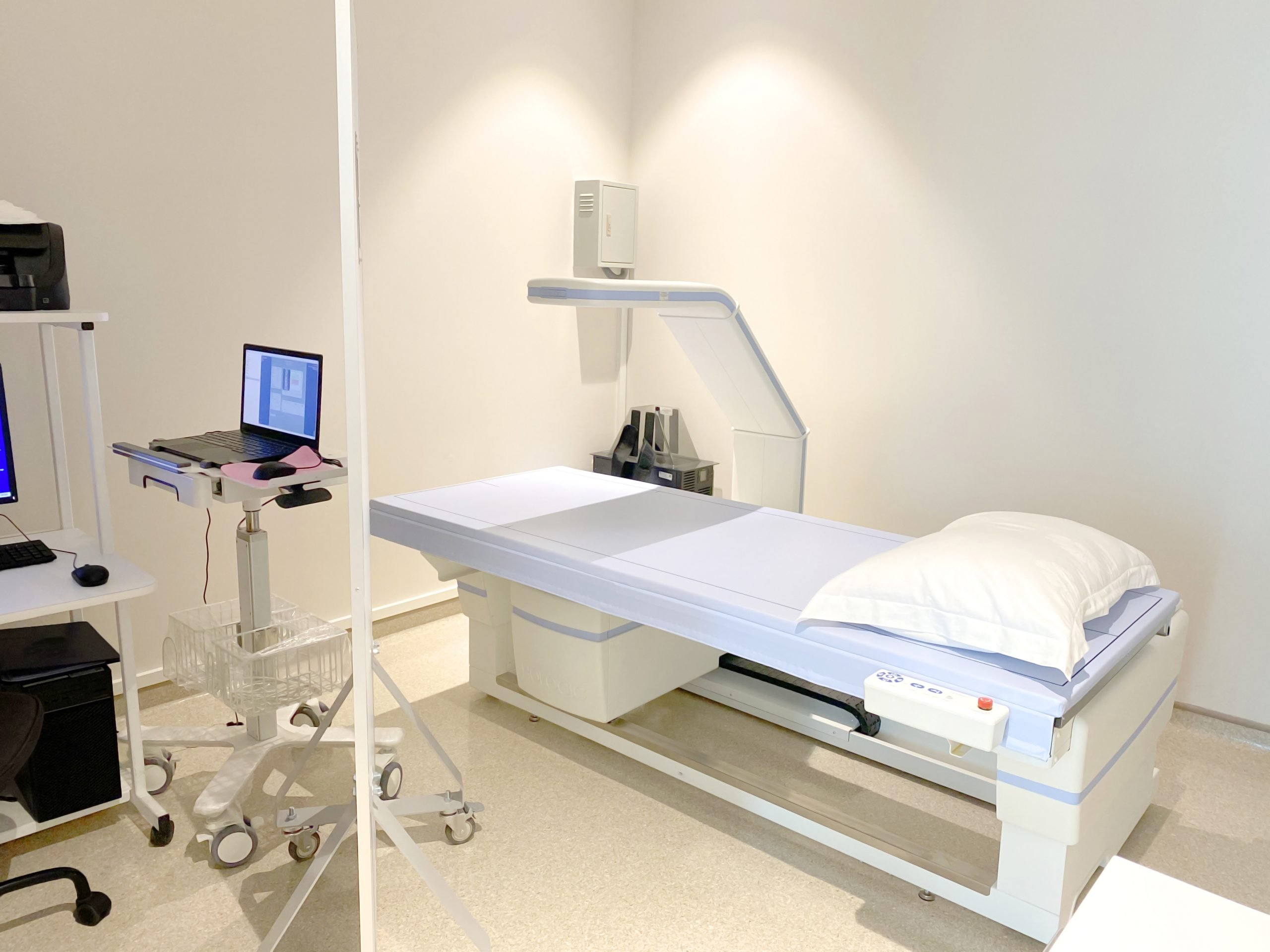
A DEXA scan (short for dual-energy x-ray absorptiometry) is a quick, non-invasive test that measures the mineral content of your bones to assess bone density and monitor changes over time.
While it uses a small amount of radiation, exposure is minimal—about one-tenth that of a chest x-ray and less than what you’d get from a single day of background radiation.
The scan takes about 10 minutes. You’ll lie on a table while an imaging arm passes over key sites—most commonly the lumbar spine, hip, femoral neck, and wrist.
Why You Might Need a DEXA Scan Sooner Than You Think
At this year’s BHOF Interdisciplinary Symposium on Osteoporosis, women’s health researcher Dr. Amanda Clark said plainly: “Waiting until age 65 to evaluate skeletal health is too late.”
Why? Because women begin to lose bone rapidly in the year before their final menstrual period (the official marker of menopause), and that increased rate of loss continues for about two years after. In this short window, women lose an average of 10% of their total bone mass.
Since the average age of menopause is between 45 and 55, a woman could be losing bone for 10 to 20 years without any awareness or intervention.
Bone remodeling—a healthy, lifelong process in which old or damaged bone is broken down and replaced by new tissue—slows over time. By our mid-30s, bone resorption begins to outpace bone formation, resulting in a gradual but steady decline in bone mass.
This loss accelerates during the menopausal transition, when estrogen—a key driver of bone formation—declines.
While the CDC and the Bone Health & Osteoporosis Foundation (BHOF) still recommend a first DEXA scan at age 65, many experts are calling for updated guidelines that reflect growing evidence: Women benefit from having a baseline scan much earlier. Numerous risk factors already qualify many women for early screening—and insurance will typically cover the scan with a doctor’s prescription indicating just one.
How to Get a Baseline DEXA Sooner
Insurance typically covers a DEXA scan when osteoporosis risk is medically justified. With so many risk factors—ranging from body composition to medications—most women are likely covered for early testing.
Below is a non-exhaustive list of risk categories to help you begin a conversation with your healthcare provider:
Body Composition & Demographic Risk Factors
-
Low Body Weight / Slender Build – Less bone mass increases vulnerability to loss.
-
Race – White and Asian women face a higher risk of osteoporosis.
-
Family History – A parent with osteoporosis or a fragility fracture raises your risk.*
-
Fall History – A tendency to fall increases fracture risk.*
Even minor falls (from standing height or less) that result in fractures should be considered red flags. For example, if your mom broke her wrist tripping over a rug, that’s considered a fragility fracture—even if she wasn’t formally diagnosed with osteoporosis.
Hormonal & Reproductive Factors
-
Menopause-Related Hormone Decline
-
Early Menopause (natural or surgical)
-
Amenorrhea / Irregular Menstrual Cycles
Dietary & Eating Behavior Factors
Lifestyle Factors
Disease-Related Factors
-
Endocrine & Hormonal Disorders (e.g., hyperthyroidism, Cushing’s)
-
Gastrointestinal Diseases (e.g., celiac, Crohn’s)
-
Autoimmune Conditions (e.g., rheumatoid arthritis)
-
Cancer
-
HIV/AIDS
-
Anorexia Nervosa
-
Vertebral Abnormalities (e.g., scoliosis, unexplained height loss)
Medication-Related Factors
-
Glucocorticoids / ACTH
-
Antiepileptic Drugs
-
Cancer Hormonal Therapies
-
Proton Pump Inhibitors (PPIs)
-
SSRIs (Antidepressants)
-
Thiazolidinediones (for Type 2 Diabetes)
In addition to this list, online tools such as the International Osteoporosis Foundation Risk Check, FRAX Fracture Risk Assessment Tool, and Garvan Fracture Risk Calculator can help estimate your osteoporosis and fracture risks.
Can I Get a DEXA Scan if I Don’t Have Any Risk Factors?
Yes—you can still choose to get one. Out-of-pocket costs typically range from $100–$250, and you can often use HSA/FSA funds. While it’s an upfront expense, consider it an investment in prevention.
A baseline scan gives you knowledge. And knowledge gives you power.
Be sure to call ahead—not all imaging centers offer self-pay DEXA scans without a referral.
What Do My DEXA Results Mean?
DEXA scan results are typically reported as T-scores and Z-scores.
- The T-score compares your bone mineral density (BMD) to that of a healthy 30-year-old adult of the same biological sex (considered peak bone mass).
- The Z-score compares your BMD to the average of people your age and sex.
Osteoporosis is diagnosed using the T-score. A lower (more negative) score indicates greater bone loss:
Note: Z-scores may be more useful for identifying secondary causes of bone loss in younger women and premenopausal populations.
- A T-score between -1.0 and -2.5 indicates low bone mass (osteopenia).
- A T-score of -2.5 or lower indicates osteoporosis.
Each T-score point roughly correlates with a percentage of bone loss. For example:
- A T-score of -1.0 reflects about 10% bone loss
- A T-score of -2.5 reflects approximately 25% bone loss
The Bottom Line
Given the wide range of risk factors, most women are eligible—and wise—to get an early DEXA scan. Don’t assume your bones are healthy just because you feel healthy.
Talk with your doctor about your personal risk profile and ask for a prescription to get a baseline scan. From your mid-30s on, bone loss is happening whether you see it or not.
The good news? You can slow it down and even build bone by engaging in proven, proactive strategies like progressive strength training and impact training. And since peak bone mass is mostly achieved by early adulthood, we also need to encourage the next generation—our kids and teens—to engage in bone-building activities now, so they’ll have a stronger foundation for decades to come.
Keep lifting, leaping, and looking out for strong bones at every age. —Karin
References:
- Centers for Disease Control and Prevention (CDC).(2024). DEXA Scans: Facts and Stats. Retrieved from https://www.cdc.gov/radiation-health/data-research/facts-stats/dexa-scan.html
- National Institute of Arthritis and Musculoskeletal and Skin Diseases (NIAMS).(n.d.). Osteoporosis. National Institutes of Health. Retrieved from https://www.niams.nih.gov/health-topics/osteoporosis
- Cosman, F. et al.(2024). Proceedings of the 2024 Santa Fe Bone Symposium: Update on the Management of Osteoporosis and Rare Bone Diseases. Bone Reports. https://www.sciencedirect.com/science/article/pii/S1094695024000921
- International Osteoporosis Foundation (IOF).(n.d.). Osteoporosis Resources and Risk Tools. Retrieved from https://www.osteoporosis.foundation
- Study of Women’s Health Across the Nation (SWAN).(2023). Bone Health Fact Sheet. Retrieved from https://www.swanstudy.org/wps/wp-content/uploads/2023/04/SWAN-Fact-Sheets-Bone.pdf
- University of Alabama at Birmingham.(n.d.). Step 2: Bone Density Testing – Cost. UAB Tone Your Bones. Retrieved from https://www.uab.edu/shp/toneyourbones/step-2-bone-density-testing/cost
- Sidecar Health.(n.d.). DEXA Scan Cost: Cost Lookup Tool. Retrieved from https://cost.sidecarhealth.com/c/dexa-scan-cost
- Florencio-Silva, R., et al.(2015). Biology of Bone Tissue: Structure, Function, and Factors That Influence Bone Cells. BioMed Research International, 2015, Article ID 421746. https://doi.org/10.1155/2015/421746
- NIH Consensus Development Panel.(2001). Osteoporosis Prevention, Diagnosis, and Therapy. JAMA, 285(6), 785–795. https://doi.org/10.1001/jama.285.6.785
- Nieves, J. W.(2005). Skeletal Effects of Nutrients and Nutraceuticals, Beyond Calcium and Vitamin D. Osteoporosis International, 16(7), 773–782. https://doi.org/10.1007/s00198-005-1919-7
- Riggs, B. L., & Melton, L. J.(1986). Involutional Osteoporosis. New England Journal of Medicine, 314(26), 1676–1686. https://doi.org/10.1056/NEJM198606263142605
- Krabbe, S., & Christiansen, C.(1984). Bone Turnover in Postmenopausal Women. Journal of Clinical Endocrinology & Metabolism, 59(2), 373–379. https://doi.org/10.1210/jcem-59-2-373
