


Starting your own venture can feel beautifully idealistic. You might imagine yourself solving a major corporate issue through services or creating a killer product that gets feature after feature in the press. But in reality, starting a business can feel cumbersome—there’s a lot of planning that goes into running your own show.
To help, we’ve created the ultimate checklist for starting a business, where we review major steps such as initial planning and legal structure decisions all the way to running your business each day. New to entrepreneurship and don’t know where to start? Begin by reading our checklist.
Why a Business Startup Checklist Matters
There’s a lot of work that goes into making a business run smoothly, and there’s arguably just as much work required to start a business off on the right foot. I work in corporate law as a paralegal. Often, I work with clients that have healthy businesses but sometimes miss small startup steps like properly documenting business transactions.
While seemingly small, these mishaps can cause large bumps in the road that is entrepreneurship—especially if you decide to seek out a successful exit. That’s why having a business startup checklist is important: it helps you stay organized and prevents mistakes from happening from the get-go. Starting a business checklist takes some time, but the payoff is worth it.
Step-by-Step Checklist for Starting a Business
The best startup checklist guides you from the unearthing of an idea to a successful launch. Here are some of the most important first steps to starting a business for every new entrepreneur. You’ll also find helpful comments and external resources you can use for further assistance.
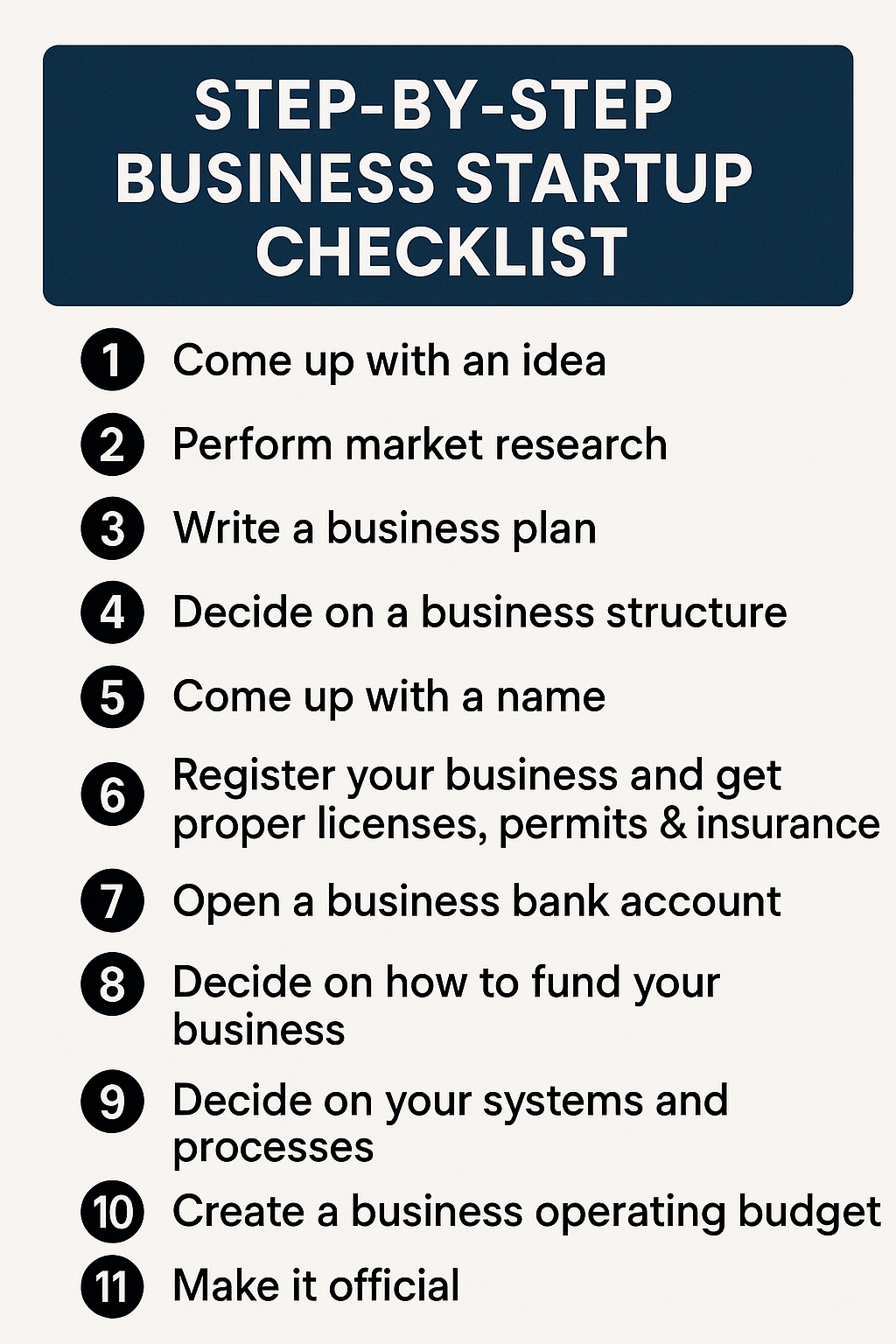
1. Come Up With an Idea
Coming up with an idea is the first step on your checklist for opening a business—your ground zero entrepreneurial hypothesis, if you will. The rest of the steps that follow help confirm or disconfirm that idea, leading up to launch.
Part of defining your business idea is deciding what you want to offer. Do you want a service-based business or a product-based one? What kinds of skills and interests do you have that put you in a position to help others? Asking questions like these can help you find areas where you are uniquely qualified to offer something to the market. From here, you can work on business validation to adequately support your idea.
2. Perform Market Research
Once you have an idea, it needs to show signs of fulfilling a market need to be further considered. To determine that degree of fulfillment, you need to research the market. This means analyzing both potential customers and competitors.
To research potential customers, you can use a variety of strategies, including:
- Surveys
- Focus groups
- Friend and family discussions
- Interviews
- Discussion panels
From these methods you want to determine the type of people your product or service could connect with. You can also perform market research on potential customers to answer key questions about your idea:
- Is there a need or desire for my offering?
- What percentage of the population in a given area would be interested in my business?
- Where do my potential customers live?
- What are my potential customers like?
- What kinds of similar options are available to customers already?
- What are prices for similar items or services in my area?
You could also create a minimum viable product (or service) to test the market before you complete a major launch.
Competitor Analysis
On the other side of the proverbial market research coin is competitor analysis. Essentially, this is the process of reviewing your competition to see what kinds of barriers exist to entering into the market your business would cater to. You need to know what you’re up against to validate your idea, in a sense. If the competition has already cornered the market your business needs to survive, it might be time to head back to the drawing board.
Helpful resource: Market research doesn’t have to be costly. Here are some free resources to get you started:
3. Write a Business Plan
A business plan is another critical step, as it helps you structure a road map for your business goals. It may also be required for your business to receive funding from banks and investors. A proper business plan is a document that suits your needs.
As a general rule, a helpful business plan covers:
- Your business’s value proposition
- The key partners it may work with (if any)
- How you plan to interact with customers
- What customer communication channels you will use
- How the company will make money and what you expect your financials to look like in the coming months/years
It’s important to remember that a business plan is a living document that changes as your business does. It will require revisions when your goals and objectives change.
Helpful resource: Not sure what a good business plan looks like? The U.S. Small Business Administration has multiple business plan templates you can use to get started right away.
4. Decide on a Business Structure
Businesses can operate in a variety of legal ways, from a one-person operation (sole proprietorship) to a full-fledged limited liability company (LLC) or S corp. You need to decide on a business structure that suits your needs.
For example, I run a freelance writing and journalism business in my spare time. Because that business has little liability, I work on my own and don’t need to raise capital, I run it as a sole proprietorship. It makes my life less complicated than it already is juggling a family, a career and a successful side hustle.
While deciding on a business structure is important, remember that you can change it at some point in the future, though that will take a bit of work.
As a brief overview, here’s a breakdown of the different types of structures:
| Structure Type | Overview | Complexity |
| Sole proprietorship | A simple structure that involves only a single person as owner | Low |
| Partnership | A structure involving two or more individuals working together that usually share profits and liability | Medium/High |
| Limited liability company (LLC) | A company model that offers flexible tax strategies for more complex businesses and limits liability for owners | Med/High |
| Corporation | The most complex model that provides ample asset protection in case issues arise and makes it easier for a business to raise capital | High |
Helpful tip: If you have questions about what kind of business structure is best for you from a legal or tax perspective, getting in touch with a designated professional is almost always a prudent choice.
5. Come Up With a Name
Though it sounds like a small detail, choosing a name for your business is a major step in creating a brand—it’s how customers and competition will perceive you. Most importantly, choose a name that accurately reflects that type of products you sell or the services you provide. Customers need to know what you can help them with in seconds.
Think about the perception of your company. Do you want a name that reflects a trendy product business? Or maybe a solid, trustworthy service business? The words we use are powerful, so pick them wisely.
Remember that if you are registering your business as a legal entity (e.g., LLC) the name will need to be checked to see if it is in conflict with other entities already created. It’s best to have multiple options ready just in case your favorite is already taken.
6. Register Your Business and Get Proper Licenses, Permits & Insurance
If you decide to operate as a legal entity or a sole proprietor with a “doing business as” (DBA) name, you’ll need to register it with your state. For corporations and other more complex entities, you’ll also have to fill out paperwork including articles of incorporation and articles of organization.
As part of this process, you also need to apply for the various business licenses and permits you need to legally operate in your state, which vary across the country. It’s also wise to apply for business insurance if you need the protection.
Important point: As part of this step, you should look into applying for an employer identification number (EIN), also known as a federal tax identification number. LLCs, corporations and partnerships are required to get one and they are required for sole proprietors that have employees. Most banks may not let you open an account unless you aren’t required to have one.
7. Open a Business Bank Account
Congratulations, you are now the proud owner of a registered business! But the work doesn’t stop here. You also need to open a business bank account. Keeping your personal and business finances separate helps you accurately track your income generated by your business—especially if you work full time, too.
Helpful tip: I have a separate bank account for my business and I personally attest to how easy it is to track my finances. I also keep separate accounts for setting aside revenue for when it’s time to pay my taxes. Organization is the name of the game.
8. Decide How to Fund Your Business
Now that you have a solid business structure in place, it’s time to determine how you’re going to cover your startup costs. Many businesses go through a self-funded route and support themselves by pulling money out of savings or relying on friends and family for financial help. This gives you the most control over your business, but you need to be careful not to spend more than you can afford.
Another avenue for funding is through investors. High-net-worth individuals may offer funding to your business in the form of a venture capital investment. This is normally given in exchange for a share in a company and potentially an active role as a director or other type of partner. Finding venture funding can be quite complex and time consuming, so be prepared for it to take time.
9. Decide on Your Systems and Processes
Creating efficient systems for your business by using technology such as AI tools for businesses is helpful in this day of technological growth. You can use technology to:
- Manage customer interactions
- Track inventory
- Manage projects, schedules and time keeping
- Manage financials
In some cases, technology might not be a game changer for your business model, and that’s OK as well. However, remember that using technology to make your business more efficient frees up time for you to work on generating more revenue and growing your client base.
10. Create a Business Operating Budget
Knowing how much cash your business expects to generate and use is important to measure success. If you don’t know if you’re turning a profit, how can you expect to stay in business long term? Developing an operating budget might sound a bit like corporate speak, but it doesn’t have to be complicated.
Simply take a record of your expected income and expenses, how much you expect to pay yourself, and other expenditures. Then use a spreadsheet or other type of accounting software to track your projections and see how your business is measuring up.
When creating an operating budget, remember to start with your business’s goals in mind. Your operating budget needs to reflect your overall objectives. For example, say you’re running a lean startup with minimal to no investor help. You want to go the path of entrepreneurship alone. Because that’s your goal, you might end up having a few months in the red—you’re bootstrapping after all. Goals help put your budget into perspective.
11. Make It Official
Now that you’ve finally put in all this work to complete these 10 steps, you’re ready to announce you’re open for business. Activate your social media accounts, launch your product, publish your landing page or even start knocking on some doors to get the word out. Now it’s time to start making some money and solving people’s problems.
Basics of Starting a Business Every Entrepreneur Should Know
In addition to following the above checklist, here are some principles about starting a business every entrepreneur needs to understand.
- Understand yourself. You’re the key driver in your business, so understanding your own tendencies is crucial to creating a business that you want to grow in the long term. For instance, are you a risk-tolerant or risk-averse person? If you don’t favor risk, you might end up creating a larger financial runway for yourself rather than investing it back into the business to grow. Knowing how you operate allows you to work with your strengths and preferences instead of against them.
- Recognize the level of commitment required. Starting a business is not a walk in the park. There may be times you are faced with financial difficulties, mounting stress of dealing with unhappy customers and finding ways to grow your client base in the looming shadow of competitors. Make sure you understand what the pros, cons, risks and rewards of entrepreneurship are before diving in—even if you’re simply turning a passion into a profit project.
- Be patient. While your passion for an idea or service might be blazing a new trail in your mind, your profits are likely to lag behind. Remember that starting any endeavor takes time, especially if you’re new to startup life. Be patient with the process and don’t rush scaling your business if you don’t have to. It’s better to build slow than build fast and bust.
Final Thoughts on Starting Your Business the Right Way
What do you need to start a company? It takes hard work and effort. Starting a business, in fact, might take hours and hours of research, development, sweat and tears, but it comes with a profound sense of accomplishment. I know—i’ve felt it. But getting the ball rolling can take time.
While no plan is foolproof, this checklist for starting a business can give your startup experience more structure and organization. If you’re feeling overwhelmed throughout the process, we recommend you return to your checklist for inspiration.
Some images used in this article were created using digital media generation tools, including ChatGPT. Photo by Drazen Zigic/Shutterstock
