

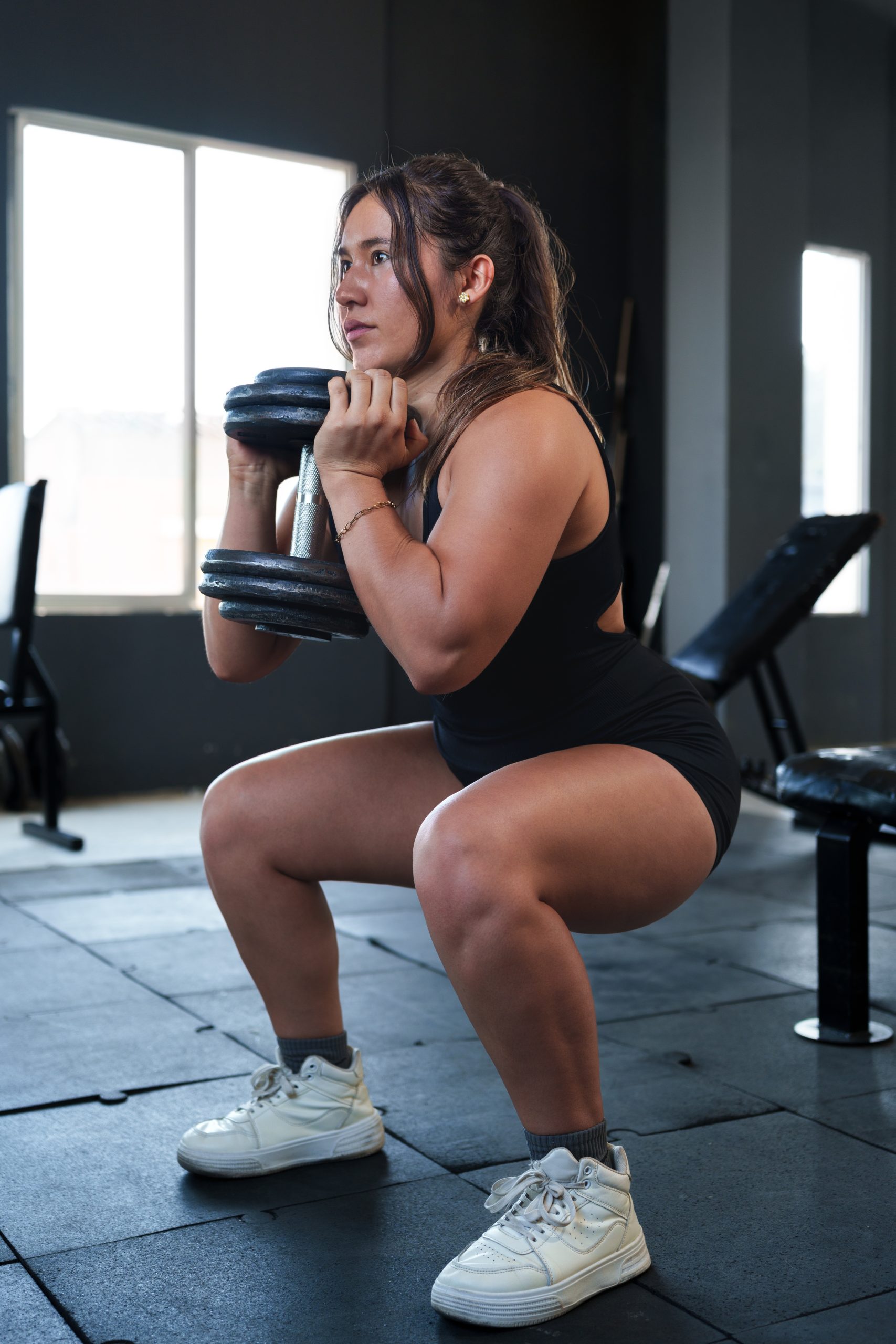

Let’s talk about squats!
Love them or hate them, squats are an essential exercise for building strength in your lower body.
Why Squats Are a Powerful Lower Body Strength Exercise
Squats are a compound strength exercise. This means that unlike isolation exercises, which target one muscle group, like biceps curls, squats engage multiple muscle groups and two or more joints simultaneously.
What makes compound exercises so great is that they are incredibly efficient, both in terms of muscular engagement and use of time. Compound exercises allow for heavier lifting because you’re spreading the work across muscle groups and joints. This means you can do more for your body with fewer exercises.
Squats target your quads, glutes, and adductor muscles, while engaging your hip, knee, and ankle joints. Squats require additional support from your core, hamstrings, and calves. There’s even some spinal and upper body engagement, depending on how you are holding the weights you’re working with.
Whether you do them with hand weights, kettlebells, or barbells, squats are a fantastic way to not only build strength in your legs, but also support joint mobility and health.
There are many ways to do squats, and we’re going to walk through them all, from the most fundamental to more complex options.
Because squats are such a versatile exercise, nearly everyone can have a great place to start learning squats, as well as a clear progression for increasing challenge.
Basic Squat Form: How to Do Squats Safely
Squat mechanics are essentially the same as you move through different variations. These are the basics: Your feet should be hip-width apart or slightly wider, with your feet pointing straight out from your hips. As you bend your knees, you also lower your hips back and down toward the floor. Push through your heels to lift your hips back up and straighten your legs.
When your hips lower down, it’s as though you’re sitting in a chair with your upper body at a slight angle and your shoulders reaching forward of your hips.
You really want your knees to move in the same direction as your feet and avoid letting the knees knock inward.
To create a little more core support, you can tense your core muscles by bracing as though you are trying to keep yourself from falling over in the wind. Or like how you’d protect yourself if you got punched in the stomach, which is quite possibly my least favorite metaphor, but the easiest way to feel this sensation. This action happens on the squat descent.
For the different squat variations, let’s start from the most foundational and build from there.
Sit-to-Stands: The Best Beginner Squat Variation
If you are very new to strength training or have some physical limitations in your ankles, knees, or hips, sit-to-stands are a great place to begin.
A sit-to-stand is exactly what it sounds like. Watch me demonstrate here.
Using a sturdy chair, your goal is to sit down and stand back up.
Congratulations! You’ve done a squat.
Applying the basic squat mechanics detailed above, you’d sit down and land fully on the chair seat. Then push to stand back up.
You don’t want to aim for the tip of the edge of the chair. Really sit down, so your whole butt makes contact with the chair.
Bodyweight Squats
Stepping away from the chair so there’s nothing to catch your hips, apply the basic squat mechanics as detailed above. Bend your knees, lower your hips toward the floor, then push back up to stand. Follow along with me in this tutorial.
Your goal is to get your hips to knee height. Typically, sit-to-stands are not quite knee height, with hips just slightly higher than the knee.
With a bodyweight squat, you’re aiming to get just a little bit lower — without compromising the alignment of your feet and knees or rounding your spine.
If you’re nervous about going slightly lower, you can bring the chair back. Instead of aiming to sit fully, try grazing the edge of the seat and pushing back up to stand. This can help build confidence in bodyweight squats because it shows you that you might not actually need to land on the seat in order to push back up.
How to Add Hand Weights to Squats
Once you’re feeling more comfortable with bodyweight squats, you can increase the load your squats are carrying by holding a hand weight or two.
If you’re uncertain about adding weight to chair-free squats, you can always do weighted sit-to-stands (shown here).
There are two ways to hold hand weights which I demonstrate here. You can hold one hand weight in front of your body in both hands. You can either hold the hand weight vertically with your hands wrapped around the center bar, or you can hold it horizontally across your chest with a hand on each end.
You can also hold two hand weights above your shoulders with elbows bent, one weight in each hand.
One weight might feel more manageable at first, so you can start there if that feels best for your body.
Regardless of how you hold the weights, if you start with a sit-to-stand, the mechanics are the same and you’re still aiming to land fully on the chair seat before pushing back to stand.
Alternatively, you can start directly with no-chair squats and a hand weight or two. The mechanics are the same and you’re aiming for hips at knee height.
How to Make Squats More Challenging With Depth and Holds
As you become more confident with chair-free, weighted squats, you can increase the challenge by increasing the range of motion for your hips, knees, and ankles. That means you’re aiming to get your hips lower than your knees. I walk through that here.
If you want to try this with more support first, you can grab a few yoga blocks, a low stool, or even a staircase, aiming to land carefully on the stacked blocks, stool, or stairs.
You can test out what the landing feels like, or if it’s too low, by using your hands to help you land the first time. This can also help make sure your feet are at the correct, comfortable distance to lower down and land.
If landing with help and then without help feels doable with bodyweight, then you can try the same thing with hand weights — same mechanics as detailed above and same options for holding the hand weights.
In addition to working with depth, you can also play with holding at the lowest part of your squat. This might be with hips at knee height, but it also might be lower.
The reason this squat challenge is so great is that you increase time under tension (TUT). When you increase time under tension in a squat, you’re asking your muscles to work harder as you resist against gravity and refuse the momentum that would usually push you more quickly from the bottom of a squat back to standing.
Same rules and mechanics apply from squat basics. Keep in mind you’re not aiming for failure and falling over; you want it to feel hard to push back up, but not impossible.
Begin with two- or three-count holds and build from there.
Barbell Squats
Eventually, hand weights won’t really cut it anymore. Squats with hand weights will be limited by what you’re able to lift from the floor to your chest or shoulders. Your legs are much stronger than your arms.
This is when it’s useful to start working with barbells.
There are lots of ways to squat with barbells and I’m sharing the back squat with you here.
Back squats are an accessible barbell option, with a simpler and more natural position of the arms, while also asking a lot less of the wrists, shoulders, and core than some other barbell squat variations.
The basic mechanics are the same, but entry into the movement is different since you’re starting beneath the bar you’re squatting with.
The bar should be placed at roughly armpit height, maybe slightly higher. You start behind the bar and duck under, resting the bar on your traps or upper back, at the base of your neck or slightly lower, with your hands wrapped around the bar.
You lift the bar from the rack and step back carefully, planting your feet once you step away. You’re still lowering your hips down and back, then pushing back to stand upright.
Once you start working with a barbell, you do want to be sure that you’re bracing your core muscles on the way down.
You also want to be sure you’re not rounding through your back or overextending it, while maintaining the integrity of your knees and not letting them knock in.
What’s great about squatting with barbells is that there isn’t the same limit as there is with hand weights, so you can continue to increase as much weight as you’re able.
Squats are one of the most adaptable strength exercises out there, which means there’s no single “right” place to start. Start where you are, build gradually, and let your squat grow stronger right along with you. —Naomi
