

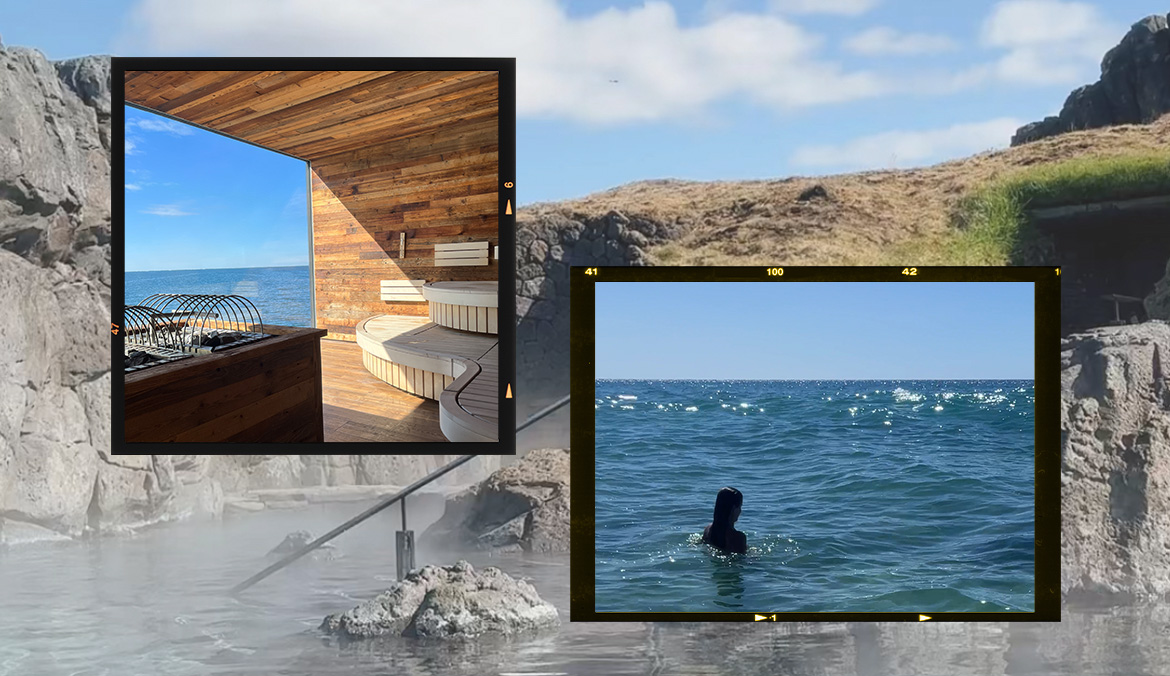
As a born and bred Floridian, I’ve always felt most at home around water. Starting at the age of eight or so, I welcomed the exhaustion of competitive swimming, red-rimmed chlorine eyes becoming my norm. Though I quit before high school, something happened during all those practices that connected me to the feeling of being in or near water—so much so that I felt noticeably less at ease when I moved inland for college.
What I’d later learn is that it’s not just a “me” thing: Studies show that regular exposure to blue spaces—which encompass waterscapes and their surroundings—can boost your well-being. In fact, that’s the impetus behind “blue mind theory,” which recently blew up on TikTok but was conceptualized in 2015 by marine biologist Wallace J. Nichols in his titular book Blue Mind (the subtitle of which says it all: The Surprising Science That Shows How Being Near, In, On, or Under Water Can Make You Happier, Healthier, More Connected, and Better at What You Do).
When you’re in or around water, you enter what marine biologist Wallace J. Nichols calls the blue mind, a mildly meditative state of peacefulness and satisfaction.
The idea behind blue mind theory? When you’re in or around water, you enter what Nichols calls the blue mind, a mildly meditative state of peacefulness and satisfaction. You’re calmer, more at ease, and feel more connected to yourself and others.
Blue Mind became a bible of sorts for me in college, as it defined and explained the science behind a feeling that I’d always suspected to be true: I’m just a happier version of myself when I’m near water. It’s why I moved to Honolulu, Hawaii, post-graduation, where I would be surrounded by the ocean. And after short stints in places like New York City and Park City, it’s what also brought me back to Honolulu this year.
Throughout my time in Hawaii, I’ve always assumed the proximity to the shoreline would be enough for me to feel at ease—that hours spent walking or lying on the sandy beach would do the trick. (And certainly, my mental state has been better while I’ve had easy access to the coast than it was when I lived in land-locked places.) But it wasn’t until a trip to Iceland this past spring inspired me to try immersing myself in the ocean every day that I experienced the most profound well-being effects of the blue mind.
How Icelanders reap the benefits of blue mind theory
In Iceland, the sunlight depends on the season thanks to the country’s proximity to the Arctic Circle. During the summer, it’s bright for most of the day, and blackout curtains are aplenty. During the other seasons, however, the sun might only emerge for a few hours a day. But while you might expect Icelanders to experience seasonal affective disorder (SAD) at a relatively high rate, studies show the exact opposite: Rates of SAD are markedly lower in Icelanders than they are in other populations. In fact, Iceland was even ranked the third happiest country in the world in the 2023 World Happiness Report, slotting in just behind Finland and Denmark.
While some of this Icelandic resilience to the harsh climate may be due to a genetic heartiness forged over generations, University of Iceland professor of folkloristics and ethnology Hafstein Valdimar Tryggvi, PhD, has widely contested that the reason Icelanders experience such high levels of well-being in light of the gloomy circumstances is their affinity for bathing in geothermally heated pools year-round.
In Iceland, every town has an outdoor public pool (of which there are more than 120), which studies show to be the most-frequented gathering places nationwide. Since 1934, swimming instruction has been required in all Icelandic schools, so the practice is ingrained early, and Icelanders are known to layer swimming into their daily lives.
“Your heart rate can decrease, and you can feel less stressed [when in or near water].” —Olivia McAnirlin, PhD, co-director of Clemson University’s Virtual Reality & Nature Lab
Such ample exposure to water may have soothing powers for Icelanders, as it helps to dial down the “fight-or-flight” (aka sympathetic) nervous system and turn up the “rest-and-digest” (parasympathetic) nervous system in its stead. “Your heart rate can decrease, and you can feel less stressed [when in or near water],” says Olivia McAnirlin, PhD, co-director of the Clemson University Virtual Reality & Nature Lab, an interdisciplinary program which studies people’s connections to the natural world.
Research has also found that the sensory inputs of natural settings (like blue spaces)—say, the contrast of blue ocean against the horizon or the lapping of waves—have a way of passively centering your attention, leading to greater clarity of mind. And there’s also the potential for experiencing awe while submerged in a natural body of water; this can put the brain in a “self-transcendent” state, meaning it’s focused less on itself and more on your existence as one part of a larger whole. The result: a more positive mood and stronger feelings of connection with others.
Though Dr. McAnirlin notes that some of these benefits encompassed by blue mind theory can be channeled by experiences such as watching waves lap the shore or even listening to a recording of beachy sounds, she contends that the Icelandic practice of regularly dipping in the water can maximize the wellness-boosting effects.
Indeed, Dr. McAnirlin’s co-director at the Clemson Virtual Reality & Nature Lab, Matthew Browning, PhD, says that the advantages of being in the water go far beyond what is seen and heard. “They also encompass engaging in physical activity, experiencing beneficial changes in the cardiovascular system [during cold immersion], and soaking up vitamin D from sunlight.” It’s no wonder Icelanders have taken to the water so readily.
Experiencing Icelandic bathing culture firsthand
When I had the opportunity to visit Reykjavík, Iceland on the inaugural flight of a low-cost airline route from Washington, D.C. this spring, I couldn’t wait to take a dip in the beloved Sky Lagoon. This particular pool is filled with hot geothermal water pumped from beneath the Earth’s surface and mixed with cool freshwater, and it’s built into cliffs overlooking the ocean in a way that immerses its visitors in nature.
Wading into the water of the Sky Lagoon for the first time, I quickly entered a state of awe, feeling a growing sense of oneness with the world around me—and the friend who’d come with me. As we alternated between deep conversation and comfortable silence, I found that I felt freer in talking to her than I have in other settings, like we were bonding over the shared experience of beauty and comfort.
For as long as I moved languidly through the pool, my thoughts took on a dreamy texture. Everything from the jagged rocks to the grassy hills to the other people swimming around me seemed soft and welcoming. And the warmth of the water (a toasty 100 to 104° Fahrenheit) was deeply relaxing.
It’s customary to pair a dip in the Sky Lagoon with a multi-step spa ritual, but my friend and I lingered for close to an hour before moving through the other steps: a cold plunge, warm sauna, cold mist, body scrub, cloudy steam room, and shower.
What really got me was the feeling of being immersed in the warm water of the lagoon, effortlessly buoyant.
What really got me, though, was the feeling of being immersed in the warm water of the lagoon, effortlessly buoyant. The water both lulled and refreshed me—and by the time our slot was over, my fingers had pruned, our taxi was outside waiting for us, and we were still in the lagoon making the most of every second we had left.
All I could think was: What if I, like so many Icelanders, made a dip in the water a part of my daily ritual, too? After all, I had no excuse not to try: I live within a few minutes’ drive of the ocean, in Honolulu, which meant it would take only minimal effort to see what might come of feeling that buoyant sensation every day. So, I decided to challenge myself to get into the water each day for 30 days straight this summer.
My experiment with blue mind theory: Getting into a body of water every day for a month
Week 1
During the first week of my blue-mind challenge, my enthusiasm often made it easy for me to hop into my car in the afternoon and head to the ocean (a 15-minute drive, though sometimes longer with Honolulu traffic). Then there were the days I simply wanted to float there and be still, people-watching the shore or bobbing in the waves. I’d always been bad at meditation, and this felt like a functional replacement.
Week 2
During the second week, my dips in the ocean had more variety. Some days, my challenge meant wading into the water fully clothed after a sweaty run. Other days, I took my workout to the water in a full-on swim, tracing laps in the shallow surf until I’d hit a certain time threshold.
A book I love, Why We Swim by Bonnie Tsui, says that we can experience a unique state of flow—the sensation of being “in the zone,” in which you are both absorbed by and solely focused on something—while submerged in water, and that an evolutionary desire for survival maximizes the potential for entering a flow state while swimming.
As I swam for short bursts during this second week of my challenge, I developed a new appreciation for the flow state of swimming. I focused on the sensation of water cradling my body and waves lapping at my heels, of endorphins coursing through my system while I worked my muscles. Unable to listen to music or otherwise distract myself, I was suddenly, startlingly present, but often lost my grip on time: completely in the zone.
Week 3
By this point, admittedly, I started getting tired of my drive, more specifically finding parking near the beach. I found myself thinking: Wouldn’t a shower have a similar effect as wading into the ocean? Didn’t that count as being in water?
While this blue-mind challenge was new to me, upon sharing it with a few friends, several of them mentioned having made a similar bet with themselves when they’d first moved to Honolulu. But things got in the way. Traffic down the boulevard was a disaster after work. Wouldn’t it be so much easier to just—not?
As I convinced myself to continue with my newfound ritual regardless, the benefits became more about the personal nature of the challenge and less about the water. I was blocking off specific time to be away from my phone and distractions, for one. It was also a conscious time I’d mapped out to listen to my body. I always felt small and quiet and part of the natural flow of things during my ocean dips, even if I could only spare thirty seconds or so.
Week 4
The fourth and final week of my challenge felt particularly significant because I was traveling to a lakeside cottage on the east coast and therefore jet-lagged. And it was also my busiest work week of the year, a time when I knew I’d be glued to my computer, feeling unable to devote any time or attention to hopping in the lake.
But, luckily, that lake was only steps away, which made staying committed to my challenge even less time-consuming than it had been at home. And the change of scenery infused my daily dips with new meaning—though one night, I nearly forgot and had to jump into the lake close to midnight, which turned into a giggly skinny dip.
The takeaway from my experiment with blue mind theory
My daily blue-mind-inspired routine provided a potent state change—a calming, mind-clearing interruption to the monotony of working from home. If there’s one thing I hate, it’s realizing I’ve been inside all day, and the sun’s about to go down. Daily water immersion became a remarkably efficient way to do all the things that make me feel immediately refreshed: getting outside, being consistent, and perhaps most poignantly, channeling the awe of the natural beauty around me.
Plus, something about toweling off after each dip gave me that same satisfying feeling of wrapping up a quick workout—that full-body exhale of committing to being damp (except with salty sea water, in the case of my challenge, instead of perspiration). Maybe that’s what made my muscles unclench and my limbs feel loose and comfortable for the rest of the day, even if my ocean dip had lasted just a few seconds.
While I did sign up for a membership at a pool close to my home when the 30 days ended, and I still spend most days hurtling down to the shore when I have a spare second, I haven’t made it out to swim every day since (though the thought is even more appealing since completing the challenge). Despite months of being a tragically bad surfer, I’ve also resolved to venture out on my board nearly daily, even when that means getting humbled by the whitewash. Just don’t ask me to cold plunge regularly (yet).
Well+Good articles reference scientific, reliable, recent, robust studies to back up the information we share. You can trust us along your wellness journey.
- Georgiou, Michail et al. “Mechanisms of Impact of Blue Spaces on Human Health: A Systematic Literature Review and Meta-Analysis.” International journal of environmental research and public health vol. 18,5 2486. 3 Mar. 2021, doi:10.3390/ijerph18052486
- Axelsson, Jóhann et al. “Seasonal affective disorders: relevance of Icelandic and Icelandic-Canadian evidence to etiologic hypotheses.” Canadian journal of psychiatry. Revue canadienne de psychiatrie vol. 47,2 (2002): 153-8. doi:10.1177/070674370204700205
- Jónsson, Örn, and Ólafur Rastrick. “Enjoying the Outdoor Pool in a Cold Climate: Appropriate Technology, Utilisation of Geothermal Resources and the Socialisation of Everyday Practices in Iceland.” Geothermal Energy, vol. 5, 12 2017, https://doi.org10.1186/s40517-017-0060-5.
- Coss, Richard, and Craig Keller. “Transient Decreases in Blood Pressure and Heart Rate with Increased Subjective Level of Relaxation While Viewing Water Compared with Adjacent Ground.” Journal of Environmental Psychology, vol. 81, 03 2022, p. 101794, https://doi.org10.1016/j.jenvp.2022.101794.
- Stenfors, Cecilia U D et al. “Positive Effects of Nature on Cognitive Performance Across Multiple Experiments: Test Order but Not Affect Modulates the Cognitive Effects.” Frontiers in psychology vol. 10 1413. 3 Jul. 2019, doi:10.3389/fpsyg.2019.01413
- Ballew, Matthew T., and Allen M. Omoto. “Absorption: How Nature Experiences Promote Awe and Other Positive Emotions.” Ecopsychology, vol. 10, no. 1, Mary Ann Liebert, Inc., publishers, Mar. 2018, pp. 26–35. https://doi.org10.1089/eco.2017.0044.
- Monroy, Maria, and Dacher Keltner. “Awe as a Pathway to Mental and Physical Health.” Perspectives on psychological science : a journal of the Association for Psychological Science vol. 18,2 (2023): 309-320. doi:10.1177/17456916221094856
Our editors independently select these products. Making a purchase through our links may earn Well+Good a commission.
