

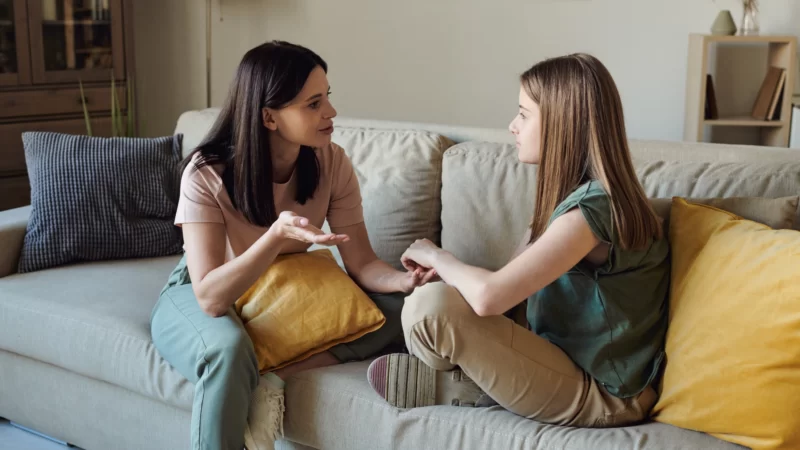
As children, talking with our parents about sex (or more like them talking at us) was probably super awkward, if it happened at all. Maybe you remember an adult fumbling through funny phrases, handing you something to read, or blurting out “wait until you’re older!” They meant well, but the whole interaction was not helpful, which is why so many parents today want to do it differently.
The traditional sex talk with kids is a myth that needs debunking. Research shows that one awkward conversation isn’t enough to prepare children for the complex world of relationships, bodies, and sexuality they’ll navigate throughout their lives.
Parenting has changed from the do-as-I-say days that most of us grew up with. Now, kids and adolescents are exposed to more sexualization in the media, have more unfettered access to sexual information, and receive less sex education in schools. Did you know some schools do not even require medically accurate sex education? That is a terrifying combination, but there is some good news.
For all of these reasons, the traditional sex talk with kids needs a serious makeover. Instead of one uncomfortable conversation, parents need to embrace ongoing dialogue that evolves with their child’s development.
Sex Education Used to Be About Checking a Box
This important topic can feel super uncomfortable, which is why so many parents want the relief that comes from “getting it over with.” However, breaking the conversation into smaller parts is actually better for parents and kids. Spreading conversations across different stages of a child’s development helps:
- ✓
Normalize the topic so children don’t view sexuality as taboo or shameful - ✓
Decrease pressure on parents who feel overwhelmed by covering everything at once - ✓
Increase everyone’s comfort level through repeated, low-stakes conversations - ✓
Share more age-appropriate information at your child’s developmental pace - ✓
Strengthen your relationship with your child through open communication
Initiating conversations about sex and incorporating those conversations into the relationship you have with your child puts you in the driver’s seat. You become their go-to person. It also increases the trust they have for you and creates a safety net around them.
Shifting the focus away from the physical act of sex and more toward human development plus healthy relationships can make the whole concept of “the talk” more appealing. Not that parents will look forward to it all of a sudden, but they will likely feel more prepared.
That moment of readiness parents long for is more like a soft whisper than a bull horn at the start of a race. It is not so much about being 100% ready; it is more like being ready-ish.
Meet Kid Curiosity With Conversations… Plural
Kids are naturally curious. If their initial questions are met with awkward silence, stumbling over words, or a quick topic switch, they get the message that certain topics are off limits.
⚠️ The Digital Reality
When parents avoid conversations about bodies, boundaries, and sex out of fear or uncertainty, it does not stop a child’s curiosity, it just shifts who kids learn the information from. In today’s world, that source is more likely to be the internet than a friend or older peer.
Even a developmentally appropriate, very innocent search could have long-lasting consequences. According to the 2025 Common Sense Census, children ages 0-8 spend an average of 2.5 hours per day on screens. That number jumps to 7.5 hours each day for school-age kids. Meanwhile, 90% of kids ages 12-18 have been exposed to online pornography.
Although porn exposure is usually accidental, kids cannot unsee it once it happens, and their developing brains are not mature enough to fully understand what they saw. That is where you come in.
When parents talk with their children early and often about sexually-related topics, their kids are more likely to delay sexual activity, have fewer partners, and make safer choices.
This is not about one big conversation but many small conversations. The need to step into these conversations sooner rather than later is important because your involvement makes a difference.
“Even if you do not feel fully prepared, even if your kid rolls their eyes, even if you wish you started years ago, it is never too late to begin having ongoing conversations about sex with kids.”
How to Start the Sex Talk with Kids: Begin Right Where You Are
If your child is between preschool and high school, chances are they already began picking up messages about sex, directly and indirectly. Beginning these conversations now means you are choosing to be a steady voice in their over-sexualized world.
Remember: you do not have to tackle everything all at once. A few short, honest conversations over time are more effective (and less intimidating) than a one-time, high-pressure talk.
4 Quick-Start Tips for Sex Talk with Kids
1 Use Everyday Moments
Use everyday things like a song lyric, magazine cover, movie image, billboard, or social media post to gently lead into conversations. These teachable moments feel less forced than sitting down for a formal talk.
2 Use Proper Terminology
Familiarize yourself with proper names for body parts to avoid slang terms. Using correct anatomical language normalizes body talk and helps children communicate clearly if they ever need to report inappropriate behavior.
3 Answer Honestly
Answer honestly to build trust. If you don’t know the answer to a question, say so and commit to finding the information together. This models lifelong learning and shows your child that curiosity is valued.
4 Satisfy Their Curiosity
Tell them just enough to satisfy their curiosity at their developmental level. You don’t need to overwhelm a 5-year-old with information meant for a teenager. Follow their lead and answer what they’re actually asking.

Common Parent Concerns About the Sex Talk with Kids
If you are unsure what to say without saying too much, that’s super common.
If you simply want to get it right, you are in good company.
If you worry about freezing when your kid asks a question you did not expect, you are not alone.
So many parents want the exact same things and have the same concerns. The good news? It is absolutely possible to make your relationship with your child a safe space where they can ask sex-related questions and get honest answers without discomfort for either of you.
The Bottom Line on Sex Talk with Kids
The myth of “the sex talk” has done more harm than good for generations. By embracing ongoing, age-appropriate conversations about sex, bodies, relationships, and boundaries, you give your child the gift of informed decision-making and emotional security.
You don’t need to be perfect. You just need to be present, honest, and willing to keep the conversation going. Your involvement matters more than you might think, and it’s never too late to start building this foundation of trust and openness with your child.
Get Professional Support for Your Parenting Journey
Parenting in today’s world comes with unique challenges. A therapist can help you navigate difficult conversations, strengthen family communication, and build the confident parenting skills you deserve.
References
- Blake, S., Simkin, L., Ledsky, R., Perkins, C., & Calabrese, J. (2001). Effects of a Parent-Child Communications Intervention on Young Adolescents’ Risk for Early Onset of Sexual Intercourse. Perspectives on Sexual and Reproductive Health, 33(2), 52-61. https://www.guttmacher.org/journals/psrh/2001/03/effects-parent-child-communications-intervention-young-adolescents-risk-early
- Faverio, M., & Sidoti, O. (2024, December 12). Teens, Social Media and Technology 2024. Pew Research Center. https://www.pewresearch.org/internet/2024/12/12/teens-social-media-and-technology-2024/
- Goldfarb, Eva S. & Lieberman, Lisa D. (2021). Three Decades of Research: The Case for Comprehensive Sex Education. Journal of Adolescent Health, 68(1), 13-27. https://www.jahonline.org/article/S1054-139X%2820%2930456-0/fulltext
- Guttmacher Institute. (2025, April). Federally funded sex education: Strengthening and expanding evidence-based programs. https://www.guttmacher.org/fact-sheet/sex-education
- Mann, S., Calvin, A., Lenhart, A., and Robb, M.B. (2025). The Common Sense census: Media use by kids zero to eight, 2025. San Francisco, CA: Common Sense Media.
- Planned Parenthood. (n.d.). How do I talk with my elementary school aged child about sex and sexuality? https://www.plannedparenthood.org/learn/parents/elementary-school
- Ritchie, M. (2016). How Are Our Children Learning about Sex? The Responsibility of Parents and Schools to Teach Kids about Human Development and How to Form Caring Relationships. Children’s Rights & Well-being. Child Research Net. https://www.childresearch.net/papers/rights/2016_02.html
- Screen Time and Children. (2025). American Academy of Child & Adolescent Psychiatry, 54. Facts for Families. https://www.aacap.org/AACAP/Families_and_Youth/Facts_for_Families
- Ybarra, M., & Mitchell, K. J. (2005). Exposure to Internet Pornography among Children and Adolescents: A National Survey. Cyberpsychology & Behavior, 8(5), 473-486. https://doi.org/10.1089/cpb.2005.8.473

The preceding article was solely written by the author named above. Any views and opinions expressed are not necessarily shared by GoodTherapy.org. Questions or concerns about the preceding article can be directed to the author or posted as a comment below.
