

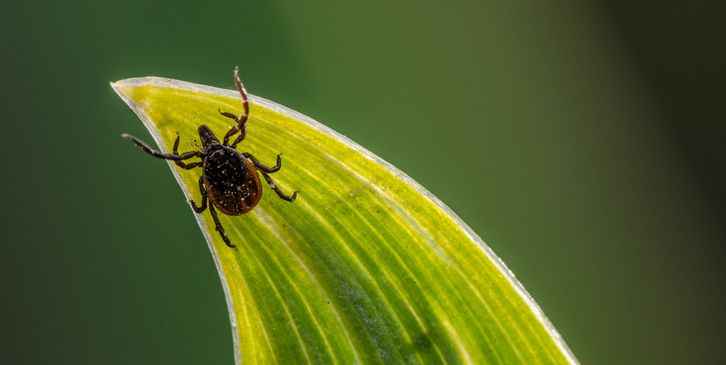
While your hot girl walks, hikes, and trail runs are important for your overall well-being, heading into nature means you (and your pet) may encounter ticks—no matter where you live.
Different species of ticks can be found in every region of the country, so no state is exactly immune to these little critters. They live in brushy, grassy, and wooded areas in particular and could make your neighborhood—or even your own backyard—their home. They’re most active during the warmer months of April through September (#same), as noted by the CDC, but you could be exposed to ‘em year-round.
Why you should care: In 2019, local and state health departments reported 50,865 cases of tickborne illnesses, according to the CDC. Two of the most widely known are Lyme disease and Rocky Mountain Spotted Fever (RMSF). These should not be taken lightly as they could have long-term effects if not treated properly.
The good news: A tick bite doesn’t guarantee you’ll get sick. “The tick bite itself is not dangerous and does not cause any symptoms or rash unless it is carrying one of the major diseases we worry about,” says Walter Schrading, MD, director of the Office of Wilderness Medicine at the University of Alabama at Birmingham. “Otherwise, the tick can just be removed with tweezers, [with nothing but] local irritation around the bite.”
Still, you’ll want to take precautions to avoid getting bit, and know what to look for if you do get bit, before heading outside. Below, experts share all that info and more (such as photos for our visual people!).
Walter Schrading, MD, is the director of the Office of Wilderness Medicine at the University of Alabama at Birmingham.
Qurat Mudassar, MD, is an infectious disease specialist and primary care physician at Norwalk Hospital in Connecticut.
Keri Peterson, MD, is an internal medicine physician based in New York City.
Gina Charles, MD, is a family physician based in Pennsylvania.
Nathan Shaw, MD, is a family medicine physician and clinical assistant professor at The University of Iowa Hospitals and Clinics.
What does a tick bite typically look like?
The tick bite itself will likely be so small and painless (just a little red dot, if anything) that you won’t actually notice it, says Qurat Mudassar, MD, an infectious disease specialist and primary care physician at Norwalk Hospital in Connecticut. You’ll likely only become aware that one of those little buggers has latched onto you if you actually find the tick attached to your skin, or if you develop one of the tell-tale rashes (or other symptoms) that signals you’ve been infected with a tickborne illness.
The hallmark sign of Lyme infection is a rash that resembles a bullseye. “[With Lyme disease], the rash is a localized infection,” Dr. Mudassar says. “The center may be clear with a red, circular margin outside.” This rash may also become itchy or swollen for some people.
Here’s where it gets a little more complicated: Not everyone who develops Lyme disease gets a rash, and even the people that do often don’t notice it, Dr. Mudassar says. Plus, the rash can show up on other areas of the body away from the bite site, so it might not raise any red flags.
Are all tick bites bad?
“Essentially, all tick bites carry the potential for disease transmission,” says Nathan Shaw, MD, family medicine physician and clinical assistant professor at The University of Iowa Hospitals and Clinics. “However, there are harmless tick bites in the sense that the tick bite occurs and the tick falls off or is removed without incident, including disease transmission.”
The bites still may itch though. This is because ticks have evolved to attach to a host (the person they are biting) and feed on a blood meal while avoiding detection, says Dr. Shaw. They do this in part by secreting multiple proteins and chemicals in their saliva to dampen the immune response and associated pain and itching in the host. The longer the tick can go unnoticed, the better meal they can have, but eventually the immune system detects the intruder, which results in that annoying itch.
“Despite a tick’s attempts to go unnoticed, the human body often still generates a response to the tick bite that can show up as itching, pain, redness, or swelling at the site of the bite, which looks similar to other insect or arthropod bites or stings,” says Dr. Shaw.
It is also possible to form nodules (bumps), granulomas, and even hair loss at the site of the bite. While not a typical reaction, the breach in skin integrity from the tick bite can result in a bacterial skin infection called cellulitis, which can cause spreading redness, swelling, and pain from the site of the bite.
Even harmless tick bites can mimic the same skin symptoms of other more serious tick bites. The good news is those tick bites will not include the more severe symptoms that resemble the flu (think: chills, fatigue, fever, headache, muscle aches, and nausea/vomiting).
What if I don’t get a rash but still feel sick?
Since you can’t always rely on a rash to clue you in, pay attention to other signs of illness you experience after possible exposure. Dr. Mudassar says that tickborne illnesses can cause fever, fatigue, loss of appetite, headache, muscle pain, and regional lymph node swelling in the early stages of the disease.
Dr. Schrading adds that you might simply have nonspecific viral illness symptoms, like malaise and myalgia—so it helps to consider the time of year you’re feeling sick. “More people are outside and around ticks in the summer, which isn’t flu season,” he says. “So if you’re feeling like you have the flu in the middle of summer, think about whether you could have been exposed to a tick.” Noted.
What are the complications and risks of a tick bite?
Experiencing a life-threatening illness from a tick bite is pretty uncommon, but it doesn’t hurt to be informed on the possible complications and risks. As you know, certain species of ticks are capable of transmitting infections, the most troubling being tickborne diseases, explains Keri Peterson, MD, an internal medicine physician based in New York City. “The risk of developing these infections depends on where you live, the type of tick, and how long the tick was attached to the skin,” Dr. Peterson says.
The flu-like symptoms (headaches, fever, pains) you might feel post-tick bite can mean a number of different things about your medical situation. “The timing of these symptoms vary depending on the type of tick and length of time it was attached to the skin,” says Gina Charles, MD, a family physician based in Pennsylvania. For this reason, no matter what kind of symptoms you’re feeling, the safest bet is always to visit your healthcare provider as soon as possible post-bite to determine if you’ve contracted any of the following.
- Lyme disease. First, know that a tick would have to be in your body for hours in order for your to develop most illnesses, including Lyme disease. The deer tick that transmits Lyme disease must feed for more than 36 hours before transmission of the infection, Dr. Peterson says. That said, if left untreated, symptoms like neck stiffness, facial palsy, joint and nerve pain can develop, says Manisha Relan, MD, a board-certified allergist.
- Anaplasmosis. With side effects such as fever and chills, Dr. Peterson says, anaplasmosis illness is known for even worse-felt flu-like symptoms than Lyme. In the long term, developing anaplasmosis can cause issues such as neurological damage and kidney failure, according to the CDC, which is yet another reason why if you’ve been exposed to a tick you need a doctor’s visit ASAP.
- Babesiosis. Another complication to look out for is babesiosis, a red blood cell infection resulting from the tick’s bite, notes the CDC. Babesiosis is when a microscopic parasite is injected from the tick’s mouth into your blood stream, and those who contract the illness usually show no outward symptoms. (This makes prevention of all the more importance when you prepare for possible tick-exposing adventures.)
- Rocky Mountain spotted fever. Typically characterized by fevers and obvious rashes that turn up after and around the tick bite, Rocky Mountain spotted fever (RMSF) tends to be one of the most lethal tickborne illness in the U.S., Dr. Charles explains. This bacterial infection causes a rash on your palms, ankles, and soles of your feet, which then migrate toward the center of your body, per Dr. Schrading.
Does it matter what kind of tick bit me?
There are many different species of ticks, but the detail that matters is whether you were bitten by a deer tick (a.k.a. a black-legged tick) or dog tick, which are known to transmit these two major diseases to humans.
“The only two major diseases we see reside in deer and dog ticks—if you’re bitten by a random tick that doesn’t transmit disease, you’ll be fine,” says Dr. Schrading, who clarifies that deer ticks transmit Lyme disease and dog ticks transmit Rocky Mountain Spotted Fever. Other ticks, like the Lone Star tick, for example, also transmit diseases. But infections from Lone Star ticks make up a small percentage of all tickborne illnesses, per the CDC.
The tricky thing is that there’s no way to tell from the actual bite itself which tick nabbed you. That said, if you develop the classic bullseye rash or a spotted rash spreading across your body, it’s pretty clear which tick was the culprit. At that point, you should definitely hightail it to your doctor’s office for evaluation, which Dr. Mudassar says is worth doing for *any* tick bite, even one that isn’t causing symptoms yet.
“It’s better if you go to the doctor right away when you know you’ve had a tick bite,” says Dr. Mudassar. “If you go within 36 hours of the bite, you can be treated with a lesser dose of antibiotics [if your doctor determines that’s necessary].”
Your doctor may be able to test you for illness with blood work to identify the pathogen. But Dr. Schrading warns it can take a while for results to come back, and false negatives can occur.
How long does it take for symptoms to appear with a tickborne disease?
A tick will spend the first 12 to 24 hours on your body looking for a place to settle in, Dr. Mudassar says. Once it finds a desirable spot—like your armpit, groin, or the back of your neck—it will latch on.
From there, it takes a few days for the tick to actually transmit any illness it might be carrying; Dr. Schrading notes that it could be about four to seven days before a rash or symptoms appear.
How can I prevent tick bites?
If your yard is on the wild side or you’ve got plans to go hiking, camping, or walking through the forest or mountains, you’re in prime tick territory, per the CDC, and you’ll find ticks in highly wooded, humid areas like forests and trails. Headed somewhere you know might be tick-heavy? Spray your clothing, shoes, and camping gear with insecticides that contain 0.5 percent permethrin, Thomas Mather, PhD, director of the Center for Vector-Borne Disease at the University of Rhode Island in Kingston, previously told WH.
You should also try wearing colorful clothing (it’s easier to see ticks), long-sleeves, and full-length pants, being sure to tuck your hanging sleeves into your gloves and shoes. Reapply your tick repellent throughout your day, and do careful tick checks after you’ve been outside for a significant amount of time. You can also keep tabs on local tick activity in your area by contacting your state’s health department (or visiting their web site).
Sarah Bradley is a freelancer writer from Connecticut, where she lives with her husband and three sons. Her reported features and personal essays on parenting and women’s health have appeared at On Parenting from The Washington Post, Real Simple, Women’s Health, The Writer, Today’s Parent, and Romper, among others. In her so-called “free time,” Sarah is an amateur baker, homeschooler, and aspiring novelist.
Writer
Ashley Martens is a Wellness Writer based in Chicago, Illinois. With a digital marketing background and her knowledge of general nutrition and a lifelong passion for all things health and wellness, Ashley covers topics that can help people live happier and healthier lives.
