

Balance is one of those things we don’t notice until it starts to go, and for most people that begins somewhere after 50. Testing it matters because a simple self-check can show you where you stand now and gives you a marker to improve against.
The good news is that balance responds well to practice at any age. I’ve been a personal trainer for almost 40 years, and for over 25 of those I’ve been director and co-founder of TRAINFITNESS, the UK’s leading provider of in-person and online personal training courses. Here are three yoga poses that work as a graded balance test, from most accessible to hardest, along with what your results actually tell you about where you stand.
After 50, several things change at once. Muscle mass declines, especially in your legs and ankles, and your proprioceptors, the sensors in your joints that tell your brain where your body is in space, become less responsive. Reaction time slows a little and the vestibular system in your inner ear, which governs your sense of balance, becomes less precise.
Testing matters because balance is a use-it-or-lose-it skill. If you don’t know where you stand, you can’t target the right work. Yoga poses make good tests because they’re simple, need no equipment, and you can grade them from easy to hard, which gives you a clear picture of your current level rather than a vague sense that you’re fine.
One note of honesty: this is a self-test, not a medical diagnosis. If you feel dizzy, have inner-ear problems, or have had falls before, hold onto support when you try these poses and talk to a professional first.
RELATED: 5 Daily Exercises That Restore Walking Strength Faster Than Treadmills After 65
Tree Pose (Vrksasana)
This one measures your static single-leg balance, the foundation everything else is built on.
How to Do It:
- Stand tall and shift your weight onto one leg
- Place the sole of your other foot against your inner calf or inner thigh, never against the side of your knee
- Bring your hands together at your chest or overhead
- Fix your eyes on a point ahead
Avoid These Mistakes:
- Don’t hold onto a wall or furniture, or rest your foot against the side of your knee. Either one means the test doesn’t count.
Target Hold: 30 seconds on each leg.
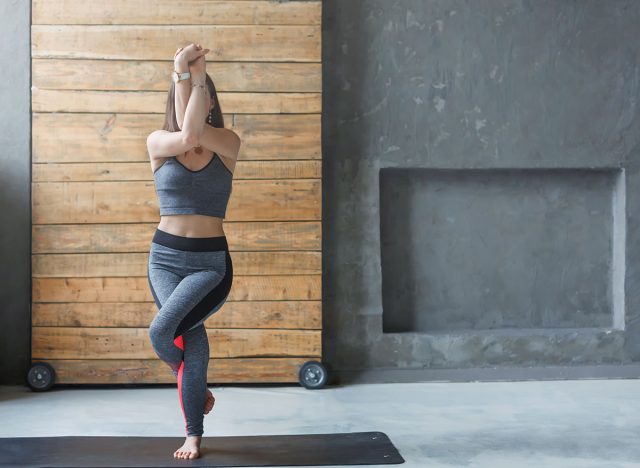
Eagle Pose (Garudasana)
This one tests your balance on a narrowed base while your limbs are wrapped and your vision is slightly disrupted, a harder demand on your ankle and your balance system.
How to Do It:
- Bend your knees slightly
- Cross one thigh over the other
- Hook your top foot behind your standing calf if you can
- Cross your arms at the elbows and press your palms together
- Sink down a little and hold
Avoid These Mistakes:
- Don’t tap your wrapped foot down to the floor for support, or unhook your leg early.
Target Hold: 20 seconds on each side.
RELATED: The 6 Best Exercises to Stay Lean and Strong After 60
Warrior III (Virabhadrasana III)
This is the most demanding of the three, combining single-leg balance with a forward hinge and control through the whole back of your body.
How to Do It:
- Stand on one leg
- Hinge forward from your hip and reach your chest forward
- Lift your other leg behind you, working toward a straight line from your raised heel to your head at roughly hip height
- Reach your arms forward or keep them by your sides
Avoid These Mistakes:
- Don’t stay upright instead of hinging to near horizontal. That removes the challenge.
- Don’t rest a hand on a chair.
Target Hold: 15 seconds on each leg.
What Your Scores Mean
If you hold Tree Pose for the full 30 seconds on both legs but can’t manage Eagle or Warrior III, that’s normal and nothing to worry about for many people over 55. Tree is the foundation and tells you your basic single-leg balance is in place. Missing the harder poses suggests your balance system struggles when the base narrows or your body moves into a hinge, a common pattern at this age.
If you hold all three for the target times on both sides, you’re genuinely better than most people your age. That’s worth knowing, because you can maintain it with a little regular practice.
Read the pattern like this. Tree shows your baseline. Eagle shows how you cope with a narrower base and wrapped limbs. Warrior III shows how you handle balance while your torso moves. If you pass Tree but fail the other two, your priority is work on the harder demands. If you fail Tree itself, start there, because everything else builds on it.
RELATED: 4 Morning Exercises That Restore Leg Strength Faster Than Lunges After 65
How to Improve Your Balance
Start by practicing the pose you failed next to a wall or a sturdy worktop, with just two fingers resting on it for support. That small touch is enough to take the wobble out without doing the work for you. Do it a little each day, five minutes is plenty, and gradually reduce the support as you feel steadier. You might go from two fingers to one, then to a fingertip, then to nothing.
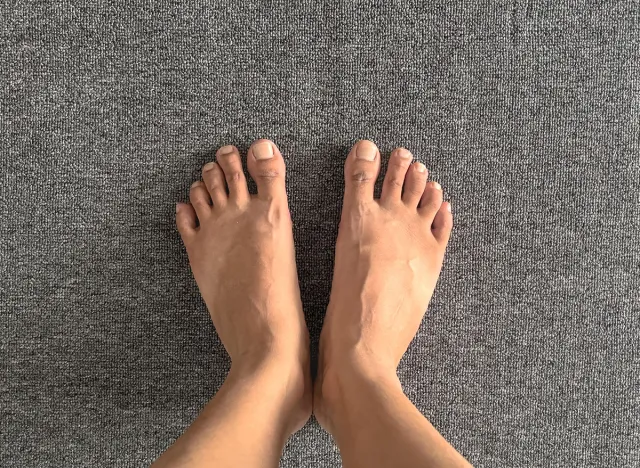
Wear bare feet or flat shoes with a thin sole. Thick, cushioned trainers dull the feedback from the floor, and your feet are your first line of balance information. The daily practice matters more than the length of each session, so keep it short and consistent rather than long and occasional.
The post If You Can Hold These 3 Yoga Poses After 55, Your Balance Is Better Than Most appeared first on Eat This Not That.
