

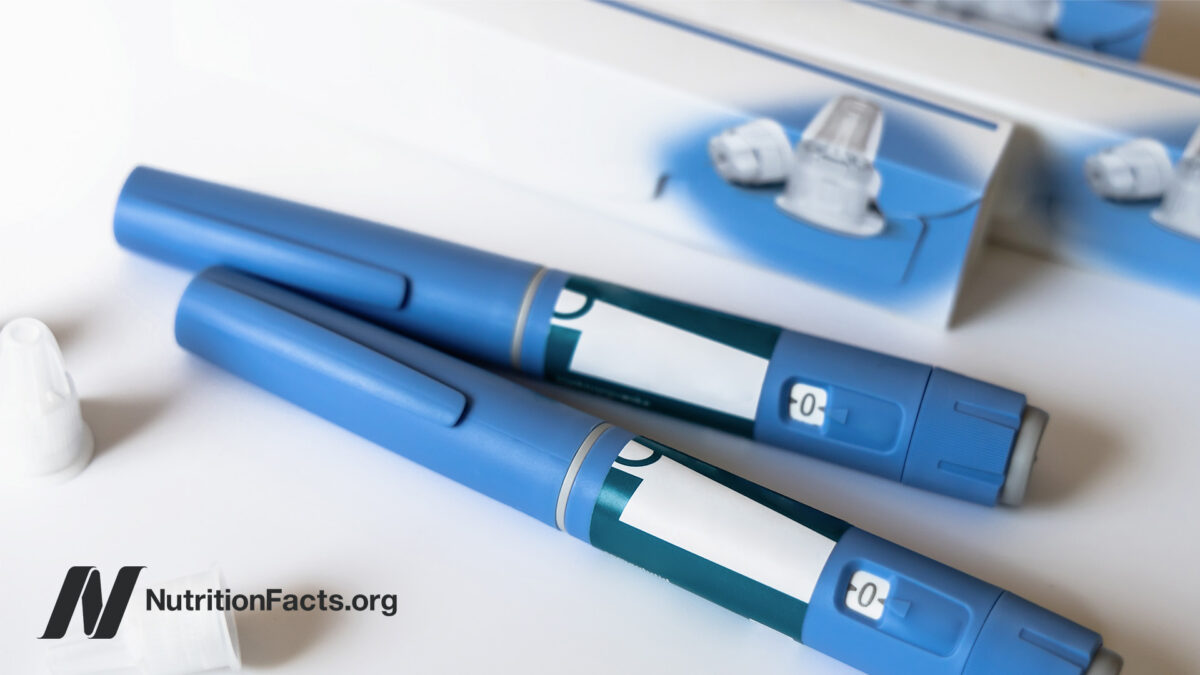
Below is an approximation of this video’s audio content. To see any graphs, charts, graphics, images, and quotes to which Dr. Greger may be referring, watch the above video.
The new class of weight-loss drugs, GLP-1 agonists like Ozempic, have received enormous, almost unprecedented attention in the mainstream media. They’ve been called “the medical sensation of the decade.” The business press was practically giddy, declaring the end of the obesity epidemic.
The enthusiasm is shared in the medical literature, with headlines suggesting they are game-changing revolutions in the treatment of obesity: therapeutic-wizard miracle drugs that are hugely effective in the treatment of obesity.
But history is littered with failed weight-loss wonder drugs. Every other year or so, an anti-obesity medication that had-been-approved to be safe and effective has had to be withdrawn from the market after serious side effects emerged. See my video on the subject for the whole sordid history of how these so-called medical magic bullets have turned out to be blanks, or worse.
To date, most weight-loss drugs, despite their initial approval, have since been pulled from the market for unforeseen side effects that turned them into a public threat. From “rainbow diet pills” packed with amphetamines that were marketed to women, to the rise and fall of fen-phen (which triggered catastrophic heart and lung conditions), history is beset by failures to find safe, successful weight-loss drugs.
Aminorex was a widely-prescribed appetite suppressant before it was pulled for causing lung damage. Eighteen million Americans were on fen-phen before it was pulled for causing severe damage to heart valves. Meridia was pulled for heart attacks and strokes, and Acomplia for psychiatric side effects, including suicide. Belviq was withdrawn in 2020 after it was recognized that it may have been causing cancer for the eight years it had been on the market. The U.S Food and Drug Administration initially rejected it after it appeared to cause several types of tumors in rats, but when a one-year human trial showed no apparent cancer, it was approved, and went on to become one of the most frequently prescribed weight-loss drugs. But when people were actually on it for a few years, notably high rates of colorectal cancer, pancreatic cancer, and lung cancer popped up; so, oopsey, it was pulled from the market. The news was met with surprise and confusion among obesity medicine specialists, who had been prescribing the drug to help patients achieve and sustain the health benefits of weight loss. It was particularly jarring, because this drug was generally regarded as being so safe, until it wasn’t.
Or take Benfluorex, like Ozempic, another diabetes drug repurposed as an appetite suppressant. It caused hundreds of deaths, but didn’t get pulled for 33 years. The drug company knew about the risks, but covered them up. Judges concluded that the drug company’s priority was systematically given to “preserving its own economic interests over the safety of the drug’s consumers.”
So, historically, anti-obesity drugs have been kind of like cigarettes. Like smoking, popping these pills can cause you to lose weight, but at what cost? The goal of weight loss is not to fit into a skinnier casket. But they don’t even work very well.
The current crop of approved meds includes Qsymia, a combination of phentermine, the phen in fen-phen, and topiramate, a drug that can cause seizures if you abruptly stop taking it. This drug combination was explicitly rejected multiple times for safety reasons in Europe, but remains for sale in the United States. Contrave is another option if you choose to ignore its own black box warning about a potential increase in suicidal thoughts. Alli, also sold as Xenical, is the final choice. That’s the drug that blocks fat absorption, and causes side effects such as “flatus with discharge.” The drug evidently “forces the patient to use diapers and to know the location of all the bathrooms in the neighborhood in an attempt to limit the consequences of urgent leakage of oily fecal matter.” All for a grand total of just three percent weight loss. All that mess to go from like 300 pounds (135 kg) down to 291 pounds (130 kg). As you can see, older weight-loss medications only achieved about five percent weight loss, whereas the new-fangled GLP-1 agonists like Ozempic can cause an average of… six percent weight loss!
Now, this is because they are averaging the effects of some of the older GLP-1 agonists like Saxenda or Byetta. Semaglutide, sold as Ozempic for diabetes or Wegovy for weight loss, causes about twice that. And now, there’s tirzepatide, sold as Mounjaro or Zepbound, which gets you closer to what you see with bariatric surgery. So, while the older obesity medications achieve weight loss in the five to 10 percent range, the new generation of agents are more in the 15 to 20 percent range––about triple what we saw in many of the older drugs.
So, for about half a century, there’s been healthy skepticism about new-kid-on-the-block obesity drugs promising profound weight loss, only to see one after another fail and flop. But today, this historical narrative could be in flux.
How well do these new GLP-1 agonist drugs really work? How do they work? How long do they work? What are the short-term side effects? What are the long-term side effects? Are there safer, cheaper, natural alternatives to boost GLP-1 with diet and lifestyle? What even is GLP-1?
Even over just the last decade or so, obesity rates have spiraled out of control.
Are GLP-1 receptor activators the long-sought-after panacea for obesity? Well, first of all, what is GLP-1?
The gastrointestinal tract is known as the largest hormone-secreting gland in the human body, releasing more than 20 peptide hormones. About one out of every 100 cells lining our entire digestive tract acts as a nutrient sensor, and can secrete hormones accordingly, including GLP-1, glucagon-like peptide-1. The primary stimuli for GLP-1 secretion are meals rich in fats and carbohydrates, and the main action of GLP-1 is to signal nutritional abundance to the brain, reducing our appetite so we don’t eat too many doughnuts.
GLP-1 also slows things down, allowing us more time to digest, and the slowing of the rate at which food leaves our stomach helps with blood sugar control after a meal. So, GLP-1 hormone-mimicking drugs were actually first developed to treat type 2 diabetes. The reason you can’t just give people GLP-1 directly is because it’s broken down so quickly, it hardly even makes it one time around the circulation, thanks to inactivation by an enzyme in our body.
But then a compound was discovered that activates GLP-1 activity, but was resistant to enzyme breakdown. And it was found in a lizard. It’s a constituent of Gila Monster venom. And the first drug was born. Using that as a template, the first GLP-1 agonist was created and approved for the treatment of diabetes about 20 years ago. Instead of half lasting 2.5 minutes in the body, it lasted about 2.5 hours, but still had to be injected twice a day. Then, came liraglutide, which lasts all day, but even once-a-day injections can be a pain. Enter semaglutide, branded as Ozempic, which could be injected just once a week.
It was approved to treat diabetes in 2017. Within a few years, a daily oral version had been developed, again for diabetes, but researchers running those clinical trials noticed a surprising side effect: people’s appetites diminished. Indeed, if you drip the hormone GLP-1 into people’s veins, it reduces their appetite, leading to decreased food intake. And not just a little. We’re talking about a decrease in caloric intake by as much as 25 to 50 percent.
The GLP-1 hormone not only slows stomach emptying—so you feel fuller longer after eating—but it also works as an appetite suppressant by targeting parts of the brain responsible for hunger and cravings. GLP-1-secreting cells don’t only line our intestines; they’re also in our brains.
So, GLP-1 agonist drugs, meaning GLP-1 mimicking drugs, work kind of like the way birth control pills do. Birth control pills mimic placental hormones, thereby tricking our body into thinking we’re pregnant all the time. Ozempic-type drugs mimic GLP-1, thereby tricking our body into thinking we’re eating all the time; so, it dials down our hunger drive.
In 2021, semaglutide, originally approved as Ozempic to treat diabetes, was rebranded at a higher dose as Wegovy to treat obesity, and the weight loss industry changed overnight, shifting away from meal replacements and portion control plans to the new world of private equity-funded telemedicine entities set up to offer these injectable weight-loss drugs. Even Weight Watchers has openly embraced these types of drugs as the future of weight loss. They were even approved for kids as young as age 12—tweens, not even teens. Is that a good idea? What are the pros and cons of these new weight-loss medications?
Older weight-loss medications achieve approximately five percent reduction in body weight over placebo, whereas these new GLP-1 agonists, like Ozempic, produce about triple the effect, about 15 percent. But what does that mean in terms of numbers on the scale?
In an analysis of more than 100 clinical trials of earlier anti-obesity medications, in studies lasting up to 76 weeks, drug-induced weight loss never exceeded more than nine pounds (4 kg). If you put all the GLP-1 drug trials together, over an average of about a year, they led to about nineteen pounds (8 kg) of weight loss. And that folded in some of the older GLP-1 drugs, like liraglutide, that don’t work as well. If you just look at semaglutide, the high-dose Ozempic sold as Wegovy for weight loss, we’re looking at more like 27 pounds (12 kg) lost, which translates into about three and a half inches (9 cm) off the waist.
Which GLP-1 drug works best? An oral version of Ozempic has been developed. Though it hasn’t yet been approved for weight loss, preliminary evidence suggests it causes similar weight loss to the injectable version. The latest GLP-1 drug approved for weight loss, tirzepatide, sold as Zepbound, appears to beat out semaglutide with nearly 19 percent of body weight lost, over 40 pounds (18 kg), with more like five and a half inches (14 cm) off the waist.
How does that compare to bariatric surgery? It’s actually not that far off from long-term surgical weight loss. Now, remember, these are averages. Bariatric surgery doesn’t always work. The failure rate for the gold standard procedure is approximately 20 percent, but not everyone responds to the GLP-1 drugs either.
In the big Ozempic trials, about a third of people were “super responders,” but as many as one in six didn’t lose significant weight at all, even after taking the drug for more than a year. So, despite impressive results at a population level, up to 20 percent of patients fail to achieve significant weight loss with either surgical or drug-based approaches.
Here’s the longest trial to date––four years of high-dose Ozempic for weight loss. Here’s how the spread looked at the end of year two, with each of the thousands of participants lined up from those losing the most weight to the those losing the least. The average weight loss was about 10 percent; so, some lost even more weight, and sometimes a lot more weight. Some lost less, and some even gained weight, as much as maybe 40 pounds (18 kg), even after continuing to inject the drug for years.
Here’s the average weight-loss curve of those getting high-dose Ozempic for four years, versus those getting placebo injections, for an overall weight loss over placebo of about nine percent. Okay, but the most striking thing about this graph is the plateau. They were being injected with the drug the whole four years, but weight loss stalled after only about a year.
This happened in study…after study…after study…after study…with both Ozempic and the newer tirzepatide….
So, even under the best of circumstances, with the most potent GLP-1 drugs taken at the highest allowable dose for at least a year to obtain the full weight loss, we’re only looking at a 34-pound (15 kg) drop before the weight loss stops.
So, if you look at all three of the original placebo-controlled Ozempic weight loss trials, the participants started out obese, and after more than a year on the drug (when it effectively stopped working), they were still obese. They were certainly less obese, but still obese. Then, to keep yourself at that same level of obese, you still have to keep injecting it at like $1,000 a month, or you’ll go back to your original level of obesity. But why does the weight loss plateau, and what exactly happens when you do stop the drugs? I’ll cover both those questions, next.
Please consider volunteering to help out on the site.
