


Brisk walking works wonders for the mind, body, soul—and your cardiovascular fitness.
One of the best ways to show your heart some TLC is by getting your steps in each day. Walking is an aerobic exercise that can improve your cardiovascular health by strengthening your heart and lungs. This low-to-moderate intensity exercise can boost energy, support weight management, build endurance, improve mood, promote better sleep, and alleviate stress and anxiety, according to the Mayo Clinic.
Basically, lacing up your sneakers and heading out for a brisk walk works wonders for your mind, body, and soul. Plus, it’s easy on the joints, making it an excellent workout for older adults to keep up with.
Walking is convenient and an easy way to catch up with a friend or loved one. According to The American Heart Association, 150 minutes each week is all it takes to start reaping benefits.
If you’d like to gauge whether your cardiovascular fitness is deemed exceptional, see if you can walk this far in six minutes after 65.
Can You Walk This Far in 6 Minutes?
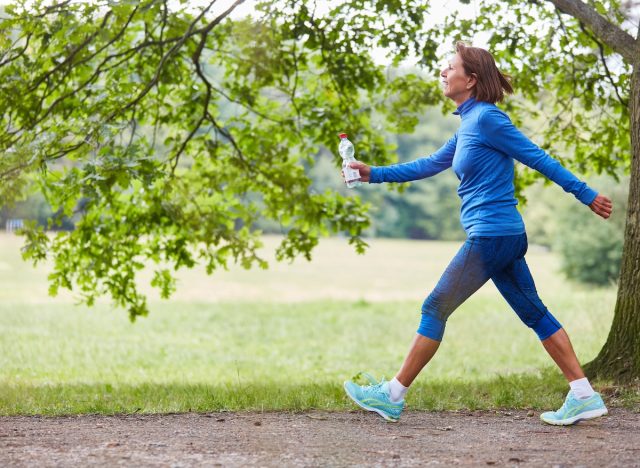
There may not be one universal distance that automatically means “exceptional” cardiovascular fitness for everyone, explains Jacob Siwicki, founder and head coach of Siwicki Fitness, NCSF and AFAA certified, former top 1% globally ranked Equinox group fitness instructor (2019), Dartmouth economics graduate and former Dartmouth football player, fitness expert on FOX 5 DC. Age matters, along with gender, weight, height, health history, and the course setup.
“That said, if a healthy adult over 65 covers around 600 meters in six minutes, I’d call that exceptional. That’s about 1,970 feet or 0.37 miles,” Siwicki adds.
To put things into context, the average is approximately 481 meters (1,578 feet) for adults aged 65 to 69. It declines to about 436 meters (1,430 feet) for those 70 to 74, and then 351 meters (1,152 feet) for adults who are 75 to 79, Siwicki notes. Individuals aged 80 and up average around 326 meters (1,070 feet).
Keep in mind that a below-average result doesn’t necessarily translate to “poor cardiovascular fitness.”
According to Siwicki, “Weakness can lower the score. So can pain, limited mobility, balance problems, medication effects, or starting too fast. I would treat the number as a starting point. Not a diagnosis.”
It’s always wise to check in with your healthcare provider before getting started.
RELATED: This Simple Japanese Walking Trick Could Help You Live Longer
What an Above-Average Test Means

“An above-average result tells me somebody has enough total-body capacity to stay on their feet and keep moving without a bunch of breaks. That should carry over to shopping, traveling, walking around a large store, and getting around the neighborhood. Stairs are a little different because they require more leg strength and power,” Siwicki says.
Keep in mind that this test isn’t solely about cardiovascular fitness; your lungs and heart matter, along with balance, leg strength, mobility, confidence, and walking efficiently.
“Somebody can have a strong heart and still walk a shorter distance because of arthritis or poor balance,” Siwicki stresses.
How To Do It
You can do this walking test outdoors or at home, depending on what’s available and your setup. Start by using a flat, hard surface, and make sure your path is completely clear. Siwicki notes to avoid using a treadmill.
“The clinical test uses a straight 30-meter course. That’s about 98 feet. A shorter course can work. Just know that all the extra turning may lower your distance,” Siwicki says.
Wear comfortable walking shoes and feel free to use your normal walking aid, if necessary.
“The goal is to cover as much distance as you safely can in six minutes. Walk continuously if you can. You are allowed to slow down or stop and rest. Start again when you’re ready. Don’t run,” Siwicki adds, noting, “If you have heart or lung disease, chest pain, unexplained dizziness, or a high fall risk, talk to your healthcare provider before testing yourself. Stop immediately if you feel chest pain, severe shortness of breath, dizziness, or like you may faint.”
Alexa Mellardo
