

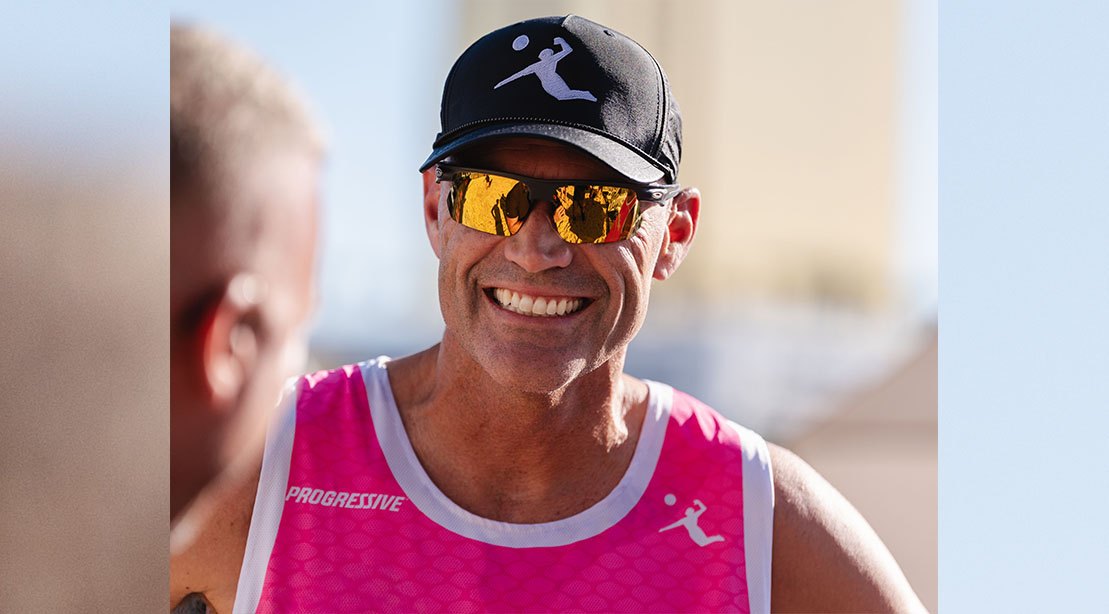
After nearly 25 years competing against the best beach volleyball players in the world, Olympic gold medalist Phil Dalhausser has discovered a truth that many athletes spend entire careers chasing: longevity isn’t about constantly doing more. It’s about knowing exactly what matters and letting go of what doesn’t.
At 6’9,” the towering beach volleyball icon has become one of the sport’s rare exceptions. While generations of athletes have come and gone, Dalhausser continues to compete at an elite level well into his 40s, proving that experience, recovery, and mindset can be just as powerful as raw talent.
His formula for staying competitive may surprise people.
While younger players pack their schedules with multiple practices, conditioning sessions, heavy lifting, and endless reps, Dalhausser has shifted his focus from building his body to preserving it. The goal is no longer to train harder; it’s to train smarter.
“I’m definitely training way different than everyone else,” Dalhausser tells Muscle & Fitness. “I’ve put in the time and the reps. I stay in shape in the gym and practice maybe once a week or so.”
That approach isn’t a sign of slowing down. It’s the product of more than two decades of trial, error, injuries, victories, and learning what truly moves the needle.
For Dalhausser, longevity isn’t built through punishing workouts or chasing every new recovery trend. It’s created through consistency, body awareness, and a system refined over thousands of matches and countless hours in the sand. And perhaps most importantly, it’s built through the confidence to trust what works.
Training for Explosion, Not Exhaustion
After more than two decades competing at the highest level, Dalhausser isn’t chasing personal records in the weight room. Those days are behind him, and intentionally so.
Like many veteran athletes, he’s learned that longevity isn’t built by lifting heavier every season. Instead, it’s about preserving the qualities that separate elite competitors from everyone else. For a beach volleyball player, that means maintaining the explosive power to elevate above the net, react in an instant, and generate force without placing unnecessary stress on the body.
“I’m trying to preserve the little bit of explosiveness I have left,” Dalhausser says with a laugh. “That’s basically it.”
Dalhausser has earned the luxury of being selective. The thousands of hours he’s already invested have become the foundation that now allows him to focus on quality over quantity.
Olympic-style movements remain a staple, with clean pulls sitting at the top of his list. The exercise develops explosive triple extension through the hips, knees, and ankles, which directly translates into higher jumps and quicker movement on the sand. Rather than chasing heavier weights, Dalhausser prioritizes moving the bar with intent, preserving the fast-twitch power that’s essential for blocking, attacking, and covering the court. As the season winds down, he’ll gradually increase the load during the offseason before returning to lighter, more explosive work once tournaments begin.
That philosophy extends beyond the exercises themselves. Every decision in his program is filtered through one question: Will this help me perform on the weekend? If the answer is no, or if it creates unnecessary fatigue, it’s left out.
His training environment reflects that same no-frills mentality.
Instead of working out in a state-of-the-art performance center, Dalhausser trains in a garage gym at his Orlando home. During a Florida summer, temperatures soar, the garage door stays open, and the humidity takes its toll on everything from the barbells to the bumper plates.
“It’s two million degrees in there,” he jokes. “But I warm up in five minutes.”
The heat has even become an unlikely training partner. While the equipment may collect a little rust from the humidity, Dalhausser has grown accustomed to the conditions after years of training there. There’s no climate-controlled facility, no elaborate setup. Just a barbell, a simple routine, and a system that has kept one of beach volleyball’s greatest athletes performing at an elite level for nearly a quarter-century.
For Dalhausser, success isn’t measured by how exhausted he feels after a workout. It’s measured by whether he can still explode off the sand when the match is on the line.
The Recovery Routine That Changed Everything
If there’s one area where Dalhausser has made the biggest evolution late in his career, it’s recovery.
For years, post-tournament recovery meant light cardio, stretching, and foam rolling. Then yoga entered the picture.
After returning home from AVP competition weekends, the first thing he does is spend roughly 45 minutes moving through a vinyasa flow.
“I feel like a new man afterwards,” he says. “Yoga checks all the boxes for me. Body and mind.”
That’s not to say he ignores recovery tools. Massage guns, lacrosse balls, rollers, and mobility equipment all have their place in his routine. But unlike many athletes constantly searching for the newest recovery trend, Dalhausser believes simplicity wins.
Why He Doesn’t Trust Wearables
In an era obsessed with recovery scores, sleep tracking, and readiness metrics, Dalhausser remains refreshingly old school.
He’s never been interested in letting technology dictate how he feels. When he was competing internationally, he says teammates were constantly pushing him to get a Whoop. His response has always been the same.
“I don’t need some device to tell me if I slept well,” he says. “I know when I wake up if I’m tired or not.”
His skepticism isn’t aimed at technology itself; it’s aimed at psychology. He poses it as a hypothetical: if you woke up feeling like you’d slept deeply through the night, but your wearable told you it was actually only three hours of poor-quality sleep, would that change how you feel?
For Dalhausser, the answer reveals the problem. “It’s all in our mind,” he says. “The more stuff we have in our mind, the worse I think it gets.”
That same philosophy extends to sleep itself.
Dalhausser has always been a solid seven-to-eight-hour sleeper, but he pushes back hard against the modern obsession with optimizing every hour. He believes the pressure to sleep is often what sabotages it. The moment your head hits the pillow, and you start calculating exactly how many hours you’ll get if you fall asleep right now, you’ve already lost.
He’s felt it firsthand during international travel, when the pressure to get acclimated to a new time zone can spiral into a full week of four or five hours a night.
“You’ll be miserable by the end of the week,” he says, “and I 100 percent believe that’s just based off the pressure you put on getting sleep.”
Nutrition follows the same relaxed-but-consistent philosophy. Whole foods make up the majority of his diet, but he’s hardly militant about it.
“I’m a creature of habit,” he says. “I eat whole foods for the most part.”
And yes, Swiss chocolate, courtesy of his mother’s Swiss side of the family, still makes regular appearances.
“I have a splurge day here and there,” he admits.
Learning From Every Injury
After 24 seasons, injuries are inevitable.
One season it was his right elbow. Last season it was a stubborn calf strain that lingered all year. This year it’s his lower back, which reliably reminds him after tournament weekends that recovery can no longer be an afterthought.
“You wake up, and I’m like, oof,” he says. “It takes me a minute to start moving.”
Rather than viewing injuries as setbacks, Dalhausser sees them as education.
“The more different injuries I have, the more you learn about how to deal with that kind of stuff,” he explains. “Injury is a way to learn more about your body.”
That mindset has allowed him to trace problems back to their source rather than just treating symptoms. He was able to pinpoint that a flaw in his serving mechanics was behind his calf issue, and has since adjusted it. It’s a habit of constant recalibration rather than repeating the patterns that caused problems in the first place.
“We have to adjust to what we have,” he says. “Because if we keep doing the same thing over and over, and you keep getting hurt, you’re probably not going to be around the sport very long, or any sport, really.”
The Mental Edge
Ask Dalhausser what has had the single biggest impact on his career, and the answer isn’t strength training.
It’s meditation.
About a decade ago, he began a consistent practice that fundamentally changed how he approaches competition, travel, and life. “Our mind can be our biggest enemy,” he says. “Once you realize you’re not the mind. You’re the observer – the whole world is a different place.”
That mental discipline shows up most clearly when conditions turn brutal.
Playing in the Las Vegas heat, Dalhausser has developed a deliberate mind game with himself: before he even steps on the sand, he tells himself it’s going to be miserable, that he might suffer, might even feel like he’s going to pass out. He calls it setting “the suffering bar” impossibly high on purpose, so that the reality, whatever it is, comes as a relief.
“It’s like when someone tells you a movie is the worst thing ever, and then you see it, and it’s like, ‘oh, that wasn’t so bad,’” he explains.
Once he’s out there, he leans on small physical resets, dunking his hat in an ice bucket, pouring water over his feet, and keeps returning attention to his breath, because he’s found that dwelling on the heat only convinces the brain it’s worse than it is.
Altitude has humbled him more recently. At a tournament in Aspen, Colorado, 8,000 feet above sea level, he skipped his usual mental preparation, assumed he’d be fine, and struggled badly to catch his breath. The frustration snowballed and cost his team the first day.
“I’ve been doing this for so many years, and I still make mistakes,” he says.
It was his wife, a former pro volleyball player herself, who set him straight afterward, telling him bluntly that there was no point playing that way. He tightened up for day two, and hasn’t lost since.
That perspective extends to his partnerships on the court, too. He recalls a former partner who used to frustrate him constantly during matches, pulling him into playing “annoyed” instead of focused.
Looking back now, he calls that partner his “spiritual teacher,” someone who was, in hindsight, just trying to light a fire under him rather than get under his skin.
With his current partner, Trevor Crabb, it’s been the opposite dynamic: Crabb’s confidence helped reignite Dalhausser’s own after a rough patch following a previous partnership that hadn’t produced much.
Today, he tries to see nearly every difficult experience through the lens of growth.
“There’s probably 99.9 percent of any situation where you can find some sort of positive,” he says.
Success Beyond Gold Medals

Dalhausser has already accomplished everything an athlete could hope for: AVP championships, world titles, and Olympic gold, milestones he describes as stepping stones, each one redefining what “making it” meant at the time, from his first AVP semifinal all the way to standing on top of the Olympic podium.
But these days, his greatest fulfillment comes away from the podium.
Together with his wife, he runs a junior beach volleyball club in Orlando, working to build a beach volleyball community in a region historically dominated by the indoor game. It’s been, in his words, “a bit of an uphill battle,” but the club is starting to produce players headed to college programs.
Coaching requires a different personality depending on the age group, and he’s found he enjoys the range. With the youngest kids, he leans goofy to keep things fun. Middle schoolers are “too cool for school,” so he has to find sneakier ways to work in technique.
High schoolers, many of whom are chasing college opportunities, bring the intensity he’s used to as a competitor.
“Volleyball has been so good to me,” he says. “This is my way of giving back.”
When asked for one piece of advice for young athletes hoping to build long careers, he doesn’t mention lifting heavier, training longer, or chasing championships.
He returns to meditation.
He describes coaching a student recently who grew frustrated trying to master a skill in just a few reps, and used it as a teaching moment, encouraging her to get curious about why she expected instant mastery in the first place, rather than treating the frustration itself as the problem.
He half-jokingly calls himself an amateur psychologist for it. Still, the underlying belief is genuine: our recurring frustrations are usually rooted in something much earlier, and figuring out why is part of the work.
“Every mistake, every error, is getting you one step closer,” Dalhausser says. “Just be there for the ride.”
After 24 years competing against the world’s best, perhaps that’s the greatest lesson of all.
Longevity isn’t simply surviving your sport. It’s continually learning from it.
