

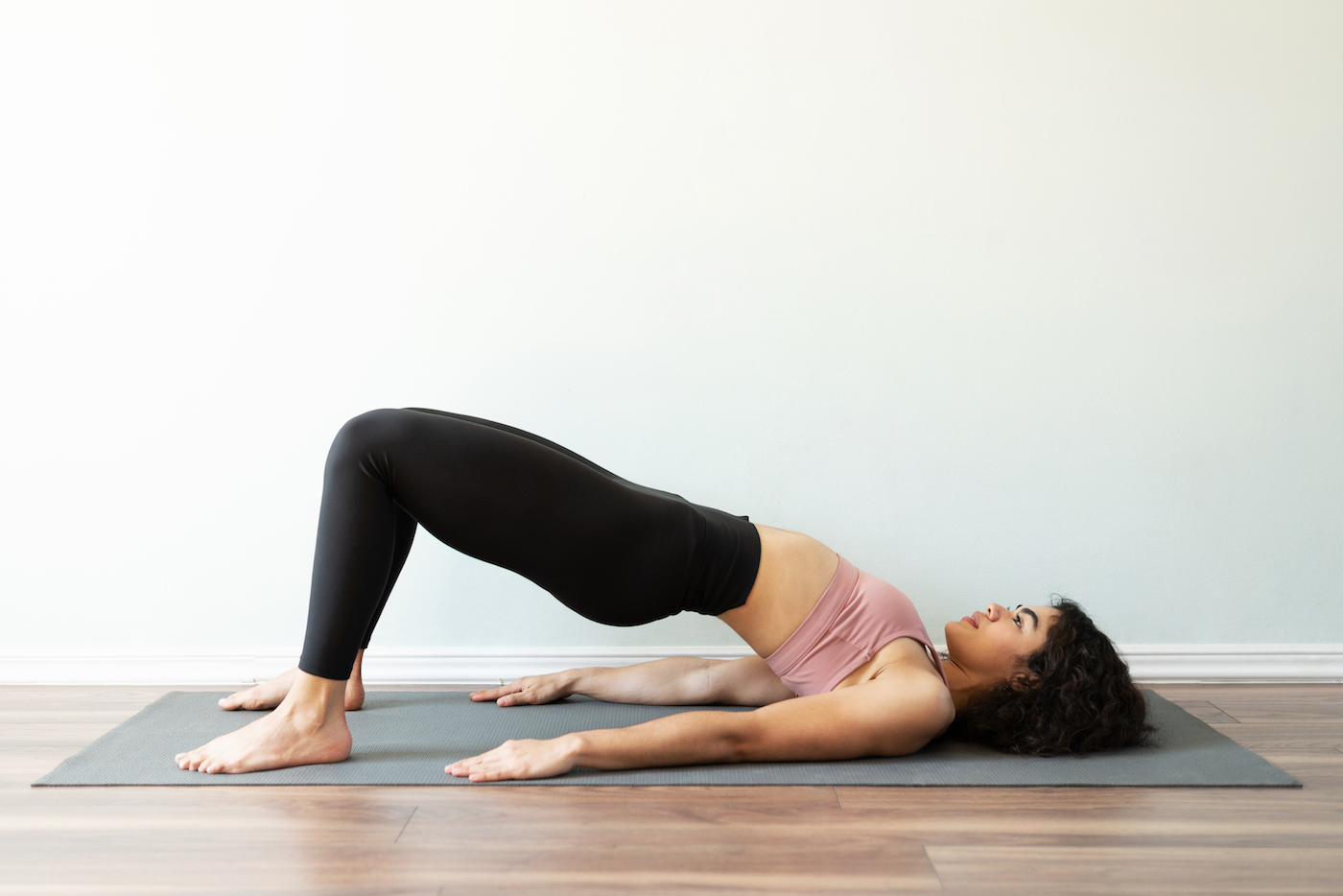
“Bridge pose is a one-stop shop for core strength,” says Esther Yaniv, MD, E-RYT 200, physical medicine and rehab physician and registered yoga teacher. “It engages the deep postural muscles, specifically the multifidus muscles, which are essential for spinal support.” Your multifidi are deep stabilizer muscles that run along either side of your spinal column.
This guide delves into the essence of bridge pose, demonstrating how to master the pose with grace and strength.
Benefits of bridge pose
Bridge pose, aka setu bandha sarvangasana, is more than just another yoga posture; it’s a gateway to enhanced well-being, offering a wealth of benefits that span the physical, mental, and emotional spectrum.
It primarily enhances spinal flexibility and opens the chest and heart area. This opening can lead to improved posture and respiratory function. Additionally, it strengthens the back, glutes, and hamstrings, and can stimulate the abdominal organs, potentially improving digestion.
This all sounds great, yes, but you may be wondering: Are there disadvantages of bridge pose? The answer is also yes. If not performed with proper alignment, bridge pose can cause strain to the neck and back. Incorrect technique can also lead to unnecessary pressure on the knees and shoulders. It’s crucial to engage the core throughout the pose to support the lower back and to ensure the knees don’t splay outward.
Physical benefits: a trio of strength, flexibility, and back health
- Core strength: In yoga, core strength is a cornerstone of the practice, and bridge pose is a champion in this arena. By engaging and fortifying the core muscles, this pose lays the foundation for overall body stability and strength.
- Spinal flexibility and chest opening: Regular practice of bridge pose can lead to remarkable improvements in spinal flexibility. As you lift and open up in the pose, it also stretches the chest and shoulders, countering the effects of prolonged sitting or bending forward.
- Alleviating backaches: For those who struggle with back pain, bridge pose can be a soothing balm. Dr. Yaniv says, “Bridge pose activates and strengthens the multifidus muscles, supporting the spinal column and promoting back health.” It gently strengthens the muscles of the back, helping in alleviating discomfort and improving posture.
Mental benefits: a sanctuary for relaxation and focus
- Stress relief and relaxation: In our fast-paced world, stress relief is not just a luxury but a necessity. Practicing yoga promotes relaxation and reduces symptoms of stress and anxiety.
- Enhanced focus and mindfulness: The practice of holding bridge pose demands concentration and mindfulness. This mental discipline cultivated on the mat can translate into improved focus and clarity in daily life.
Incorporating bridge pose into your yoga routine works wonders on various levels—from strengthening your core to offering a moment of mental peace. It’s an asana (or posture) that truly embodies the essence of a balanced yoga practice.
How to do bridge pose, step by step
Embarking on the journey of mastering bridge pose (setu bandha sarvangasana) involves understanding and executing each step with precision and mindfulness. Here’s a streamlined guide to help you realize this empowering pose.
- Start by lying on your back on a comfortable yoga mat.
- Bend your knees and place your feet flat on the floor, hip-width apart, ensuring they are close enough for your fingertips to touch your heels lightly when you extend your arms fully.
- Press firmly into your feet and arms to create a stable base.
- Engage your core muscles and lift your hips toward the ceiling, forming a straight line with your body from shoulders to knees. Keep your thighs and feet parallel to prevent any inward or outward movement.
- For more depth, clasp your hands underneath your back. Press down with your arms to lift your hips higher, while ensuring that your knees remain directly over your ankles and do not splay outward.
- Maintain a neutral spine (the natural curve of your spine) to avoid straining your lower back by overarching. Simultaneously, engage your core to support this alignment.
- Relax your neck and avoid straining it by over-lifting your chest.
Important alignment cues for proper form
- Neutral spine: Avoid overextending the lower back. Engage your core to maintain a neutral spine.
- Parallel thighs: Keep your thighs parallel to each other, preventing the knees from splaying outward.
- Relaxed neck: Keep your neck relaxed and avoid straining it by overly lifting your chest. “Avoid tucking the chin toward the chest or jutting the hips up excessively,” says Dr. Yaniv.
How long should I hold bridge pose?
The ideal duration for holding bridge pose varies based on your skill level and comfort. Generally, maintaining the pose for 30 seconds to one minute is beneficial. Often, counting breaths is best, so consider holding for five to 10 breath cycles. Most importantly, listen to your body and don’t overdo it, especially if you’re just starting the learn the pose.
When is the best time to practice bridge pose?
Bridge pose is versatile and can be practiced both at the beginning and end of a yoga session. At the start, it serves as an excellent warm-up for the spine and chest. Toward the end, it works well as a calming, restorative pose to wind down the practice.
How can I integrate bridge pose into my yoga routine?
Integrating bridge pose into your yoga routine can be done in various ways, depending on your practice’s focus. If your goal is to build strength and flexibility, include bridge pose in the core or middle part of your routine. For relaxation and stress relief, practice it toward the end. Remember, bridge pose is adaptable and can fit seamlessly into different parts of your routine, offering unique benefits at each stage.
Variations of bridge pose
Bridge pose offers a range of variations to cater to different skill levels and physical needs. These variations not only add diversity to your yoga practice but also help in targeting different muscle groups and addressing various health concerns. Most importantly for bridge pose, Dr. Yaniv recommends modifying the pose as needed, using props like blocks or straps to support your practice and enhance its benefits.
Gentle bridge
Ideal for beginners or those with back issues, this involves just a slight lift of the hips, keeping the back relatively flat. A yoga block can be placed under the sacrum for added support.
Restorative bridge
This variation involves lying on your back with a yoga block under the sacrum and a strap around the thighs for support, allowing a relaxing, nurturing experience that’s perfect for beginners, individuals with back issues, or anyone needing to de-stress or improve sleep.
Single-leg bridge
For an added challenge, lift one leg towards the ceiling while in bridge pose. This variation increases the intensity of the workout, particularly targeting the glutes and hamstrings of the supporting leg. Make sure to switch sides halfway through your breath cycles.
Bridge with chest expansion
Use a strap between your hands to help open the chest if you are unable to clasp your hands together underneath you. This opens up the chest more and is great for improving shoulder flexibility.
Full wheel pose
In a more advanced version, the practitioner places their hands next to their head and lifts into a full backbend. This should only be attempted by those with sufficient back flexibility and strength.
For those who practice Pilates, you may be curious to know: How is the bridge pose in yoga different from the bridge in Pilates?
In yoga, bridge pose primarily focuses on opening the chest and improving spinal flexibility while promoting relaxation and mental calmness. In contrast, bridges in Pilates emphasize core strengthening, particularly targeting the abdominal muscles, glutes, and hamstrings, with a greater focus on pelvic stability and alignment. While both practices involve lifting the hips off the ground, yoga often holds the pose for longer durations for stretch and relaxation, whereas Pilates uses more dynamic movements for muscle activation to strength building.
Modifications for bridge pose
Customizing bridge pose ensures it is both accessible and challenging for all practitioners. Here are essential modifications for different needs:
For neck discomfort
- Cushioning: Place a folded blanket or cushion under the shoulders to align the neck and reduce strain.
- Positioning: Keep the neck long and avoid turning the head to the side.
- Gentle approach: Focus on a comfortable lift height without overextending the neck.
For beginners
- Support with a yoga block: Place a yoga block under the sacrum for support, adjusting the height as needed.
- Alignment focus: Maintain knee and foot alignment, ensuring a strong and stable foundation.
For an additional challenge
- Stability ball: Use a stability ball under your feet to engage more core muscles and improve balance.
- Dynamic leg movements: Experiment with lifting one foot off the ball or extending a leg upwards to intensify the pose.
- Incremental progress: Start with shorter durations and gradually increase as strength and balance improve.
Common mistakes people make in bridge pose (and how to avoid them)
Awareness of common mistakes in bridge pose can significantly enhance its benefits and prevent injuries.
- Collapsing knees: It’s common to allow the knees to splay outwards, which can strain the knees and lower back. Focus on keeping the knees hip-width apart and parallel to each other.
- Overarching the lower back: Overextending the lower back can lead to discomfort and strain. Maintain a neutral spine by engaging your core and glutes.
- Forcing the hips too high: Dr. Yaniv says that it can be “jarring to the lower spine segments” if the hips are pushed up too high. Instead, she recommends “softening the hip creases while squeezing the glutes as the hips leave the ground.”
- Neglecting the neck: Putting too much pressure on the neck is a common error. Ensure your neck remains relaxed and the majority of the weight is supported by your shoulders and upper back.
- Rushing the pose: Moving too quickly into and out of the bridge pose can cause muscle strain. Enter and exit the pose slowly and with control.
- Ignoring breath: Breath is integral to yoga, and especially bridge pose since some tend to mistakenly compress the throat (and thus the airway!). Yani suggests inhaling on the way up, holding the pose for two to three breaths, and then exhaling on the release. Coupling breath with movement is where the magic of yoga happens.
