

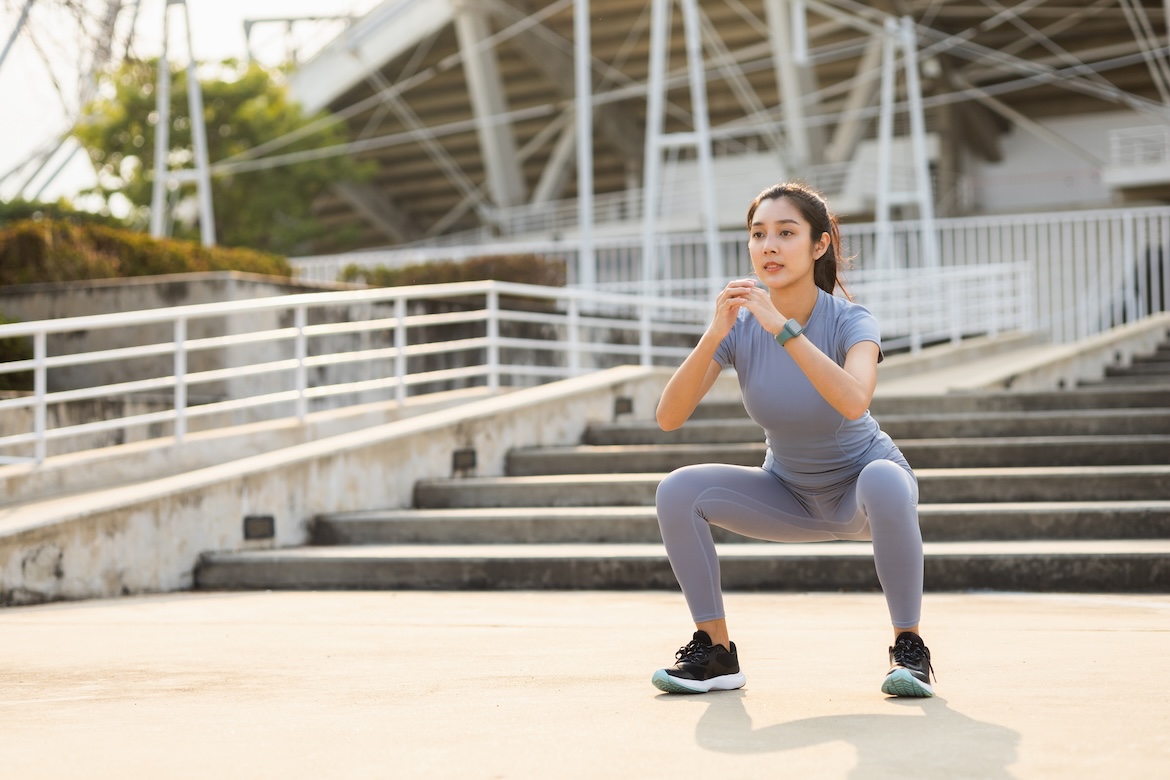
One potential solution: Power through your reps with your heels resting on a weight plate or two.
Ahead, learn why this simple squat modification might help you achieve a deeper squat—and the importance of squatting with full range of motion in the first place.
Experts In This Article
- Alyssa Parten, CSCS, certified strength and conditioning specialist and powerlifting coach
- Laura Su, CSCS, certified strength and conditioning specialist based in Seattle
How to do a squat with your heels elevated
Curious to see if elevating your heels enhances your squat range of motion? Follow the steps for this squat modification below, and check out the demonstration by Laura Su, CSCS, a certified strength and conditioning specialist based in Seattle.
- Stand holding a kettlebell in front of your chest with your feet hip-width apart, your heels resting on the edge of one large or two small weight plates, and your toes on the ground.
- Roll your shoulders down and back, engage your core, and gaze forward.
- On an inhale, sit back into your hips, then bend your knees to slowly lower into a squat. Keep your back flat and chest lifted. Continue lowering until your thighs are parallel to the floor, or as deep as comfortable.
- On an exhale, press through all four corners of your feet to straighten your legs and return to standing.
Why this squat modification works
The science behind this trick is pretty straightforward: Elevating your heels with a weight plate reduces the amount of ankle dorsiflexion (imagine pulling your toes toward your shin) required to complete a squat with full range of motion, Su explains.
Related Stories
To perform a deep squat with your feet flat on the floor, ankle dorsiflexion is about 23 to 26 degrees on average, according toa 2020 biomechanic analyses published in the Journal of Physical Therapy Science. When your heels are raised, however, there is greater ankle plantarflexion (imagine pointing your toes), decreasing the ankle dorsiflexion angle, per a small 2022 study published in Bioengineering.
In turn, you’re able to sink low into your squat even if your ankle mobility is limited.
“If you’re someone who has really tight ankles or simply struggles getting low enough on your back squats or front squats, [elevating the heels] can be a good way to help you get the most benefit out of that [movement],” Su says. (For the record, limited hip flexion range of motion may also hinder squat depth, but this hack doesn’t address those restrictions.)
This squat hack can be particularly valuable during front squats. On its own, the variation requires you to keep your torso more upright, Su says. Elevating your heels during barbell squats has been shown to minimize anterior trunk tilt, potentially making it easier to maintain that posture and keep the torso stacked over the hips, per the Bioengineering study. Your knees will also need to travel further forward in a front squat than they would in a back squat, requiring more ankle mobility, she notes.
“If you have tighter ankles, that’s just going to be a harder variation for you to do,” Su says. “A lot of people find that they feel more balanced and can stay more upright when you get rid of the ankle mobility factors.”
Folks who have particularly long femurs (the thigh bone) may also have an easier time reaching their goal depth by raising their heels, Su adds.
“If you have that longer femur, your knee has to travel a lot further forward and your hip has to travel a lot further back in order to hit depth or squat,” she explains. “It could just be that you actually do have sufficient ankle dorsiflexion but, because of your proportions, you just will struggle more than someone with a shorter femur to hit depth.”
Squatting with elevated heels also comes with the added perk of greater quad activation, Su says. So even if you can squat to parallel—or break it—without a hitch, this hack can be worth utilizing when you’re looking to target the muscle group.
While squatting with your heels on a weight plate can be helpful for the average person, serious squatters and powerlifters in need of a lift will want to use heel-elevated shoes (aka squat shoes) instead, says Alyssa Parten, CSCS, a certified strength and conditioning specialist and powerlifting coach. These sneakers are designed to raise your heel, reducing the angle of ankle dorsiflexion and increasing the quad activation, while keeping your whole foot glued to the floor, she explains.
“Due to that [contact], you’re able to exert greater forces,” she says. “If you’re lifting for strength or power, I would say that would be a better alternative. Whenever you have a plate that’s lifting your heels, there’s that middle region of your foot that doesn’t have contact with the floor, so it reduces the forces that you can exert with that position.”
“As long as you’re still hitting that movement pattern and continue to get strong in it, you’re going to be better off than not doing it at all.” —Laura Su, CSCS
The benefits of squatting with full range of motion
Unless you’re involved in powerlifting—which requires a squat depth below the height of your knee—a squat that ends with your thighs roughly parallel to the floor is considered full range of motion, according to the experts.
“If you’re wanting to then work on more functionality or hypertrophy of lower-body muscles, an inch or so beneath parallel is a good place to work up to,” Parten says.
And it’s important to build yourself up to that standard depth: Squatting through the complete range of motion allows you to train your leg musculature more fully, Su says. Specifically, the rectus femoris (a quad muscle) and biceps femoris (a hamstring muscle) activate the most when the knees are bent at 90 degrees during the eccentric portion of the squat (when you’re lowering). The gluteus maximus has the greatest activation at 90 degrees during both the eccentric and concentric (when you’re standing up out of your squat) portions of the movement, according to a small 2023 study in Muscles3.
There are functional benefits, too. In your everyday life, you’ll need to squat down to the floor to grab a laundry basket or stand up after sitting on the ground with your cat. If you haven’t been practicing and building strength in that full movement pattern in the gym, those basic actions may feel more challenging.
How to work up to squats without a weight plate beneath your heels
Squatting with elevated heels isn’t necessarily a bad thing, especially if it’s allowing you to perform the exercise with full range of motion. But you shouldn’t rely on this hack forever, according to the experts. Outside of squatting, you should prioritize ankle mobility exercises so you can ultimately progress to lifting without that elevation.
To determine if ankle mobility is the true cause of your struggle to hit depth, Parten recommends a simple test: the overhead squat assessment. You’ll perform a few bodyweight squats to about chair height with your arms extended overhead, your biceps in line with your ears. If you can’t keep your arms overhead, your knees cave in, or your heels lift off the ground, try performing the squats with your heels on a weight plate.
“If the compensations are eliminated at that point, that indicates the mobility issue or the muscles strength discrepancy issues are at the ankle and of the ankle complex,” Parten explains. “Then you know you need to address that complex to improve that squat movement pattern.”
If the plate doesn’t fix those compensations, other issues may be at play, according to the National Academy of Sports Medicine, such as hip mobility limitations and underactive or overactive muscles. When in doubt, consult a certified personal trainer for individualized guidance.
To wean yourself off the weight plate when limited ankle mobility is the driving issue, regularly practice movements such as ankle rocks, Su suggests. Start on the floor in a half-kneeling position, with one foot flat on the floor in front of you. Slowly drive your knee forward until you feel a big stretch in the back of your ankle and calf, then return to the start.
Performing ankle distractions before a round of squats is beneficial, too, Parten says. They’re similar to ankle rocks, only a resistance band will be pulling at your ankle joint from behind. The resulting exercise simultaneously stretches the tight muscle tissue that may be limiting mobility and works ankle complex mobility, she explains.
You’ll also want to get your body into a deep squat position as often as possible, Su says. Most people can do a goblet squat easily— even if they have tight ankles—as the weight in front of your chest serves as a counterbalance, she explains.
“I’ll have [clients] do a squat stretch where they hold onto a squat rack or something solid in front of them, then drop low into a squat position and rock back and forth to get into their ankles,” Su says. “Essentially, just exposing yourself to the movement and the range of motion that you need to get to is going to be the most helpful.”
While building up to that full range of motion is important, don’t beat yourself up if you need a little help.
“A lot of people get hung up on mobility; they feel like they can’t perform the movement if they can’t get full range of motion,” Su says. “I just want to encourage people that that’s not necessarily true. There are plenty of squat variations you can do even with limited mobility, even if your hips are tight or ankles are tight. Start at something as simple as a box squat or sit-to-stand. As long as you’re still hitting that movement pattern and continue to get strong in it, you’re going to be better off than not doing it at all.”
Well+Good articles reference scientific, reliable, recent, robust studies to back up the information we share. You can trust us along your wellness journey.
-
Endo Y, Miura M, Sakamoto M. The relationship between the deep squat movement and the hip, knee and ankle range of motion and muscle strength. J Phys Ther Sci. 2020 Jun;32(6):391-394. doi: 10.1589/jpts.32.391. Epub 2020 Jun 2. PMID: 32581431; PMCID: PMC7276781. -
Lu Z, Li X, Xuan R, Song Y, Bíró I, Liang M, Gu Y. Effect of Heel Lift Insoles on Lower Extremity Muscle Activation and Joint Work during Barbell Squats. Bioengineering (Basel). 2022 Jul 8;9(7):301. doi: 10.3390/bioengineering9070301. PMID: 35877352; PMCID: PMC9312299. -
Cabral LA, Lima LCR, Cabido CET, Fermino RC, Oliveira SFM, Medeiros AIA, Barbosa LF, Souza TMFd, Banja T, Assumpção CdO. Muscle Activation during the Squat Performed in Different Ranges of Motion by Women. Muscles. 2023; 2(1):12-22. https://doi.org/10.3390/muscles2010002
