

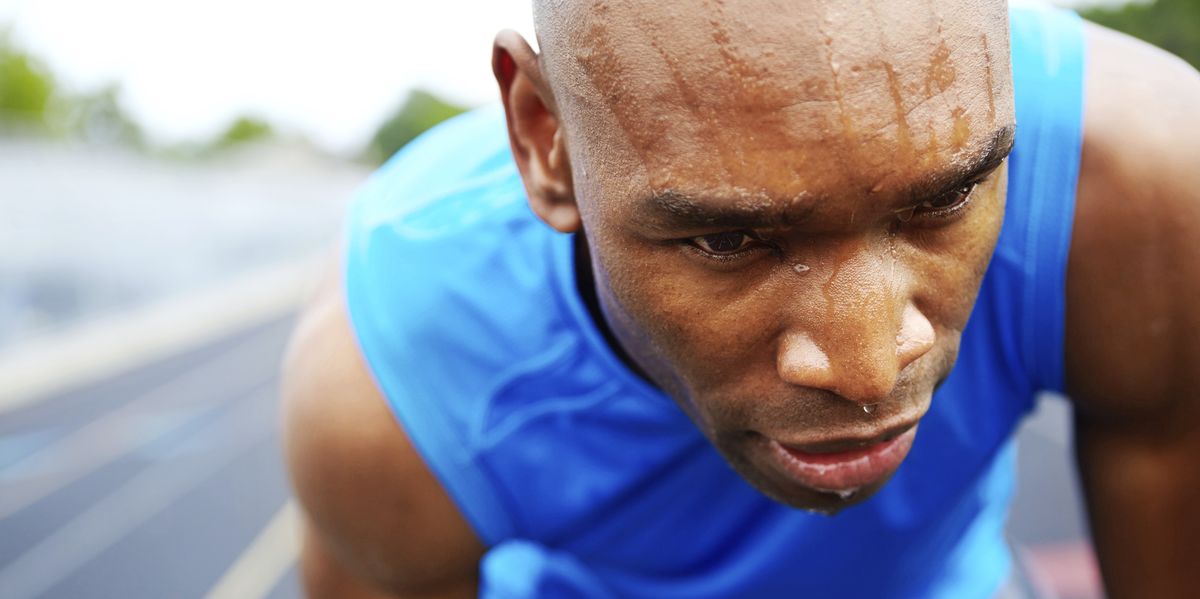
RYAN SWOBODA ALWAYS dreamed of playing collegiate football, but his career nearly ended the same week it began. On Monday, July 10, 2017, he showed up for the first day of training camp at the University of Virginia in a T-shirt and shorts and began a grueling series of conditioning drills.
The punishment of choice that day was “up-downs”—about 200 of them. It was hot and humid but nothing he hadn’t experienced growing up in Florida. So he hauled his six-foot-ten, 300-plus-pound frame up off the steamy turf, again and again, but then went back to his room feeling exhausted. His whole body felt hot. He couldn’t stop sweating and was sore all over. Everyone else is in the same boat, he thought—this is just part of the deal.
Swoboda came back for more the next day, determined to impress the coaches. The third day brought still more up-downs, followed by sled drills, and he felt hotter and hotter, no matter how much water he drank. The last thing he remembers is the coach’s whistle, signaling the end of his sled rep. Then everything went black.
He woke up in a hospital room. He couldn’t see very well, but a fuzzy male figure rushed over and gave Swoboda a big hug, saying, “I love you, man.” Swoboda assumed he was the coach. “I love you too, Coach.”
Actually, it was his father. Swoboda had been in a coma for three days.
Doctors told him he had suffered an exertional heatstroke, meaning his body temperature had risen to the point where he could no longer function—his body and brain simply shut down. Typically, heatstroke begins when someone’s core body temperature rises above 104 degrees Fahrenheit; Swoboda’s temperature had maxed at 109, putting him close to death.
If this story sounds familiar, it may be because of the invisible NFL lineman in the room. A little more than 20 years ago, Korey Stringer, a beloved offensive tackle for the Minnesota Vikings, collapsed during a training camp and died of the exact same thing. Stringer’s death at age 27 was a wake-up call for many about the dangers of exercising in the heat. And the increased awareness of the signs of heatstroke may have saved Ryan Swoboda’s life: Unlike Stringer, he was quickly transported to a hospital.
But while we know a lot more now about the dangers of heat—and about how we sweat during exercise in warm conditions—hundreds of athletes of all ages suffer heat-related illnesses and even death each summer. It’s not just athletes, either: Texas saw a record-high 279 heat-related deaths last summer, the third-hottest in U.S. history. In Western Europe, a massive heat wave in places like France, England, and Spain caused more than 20,000 heat-related deaths.
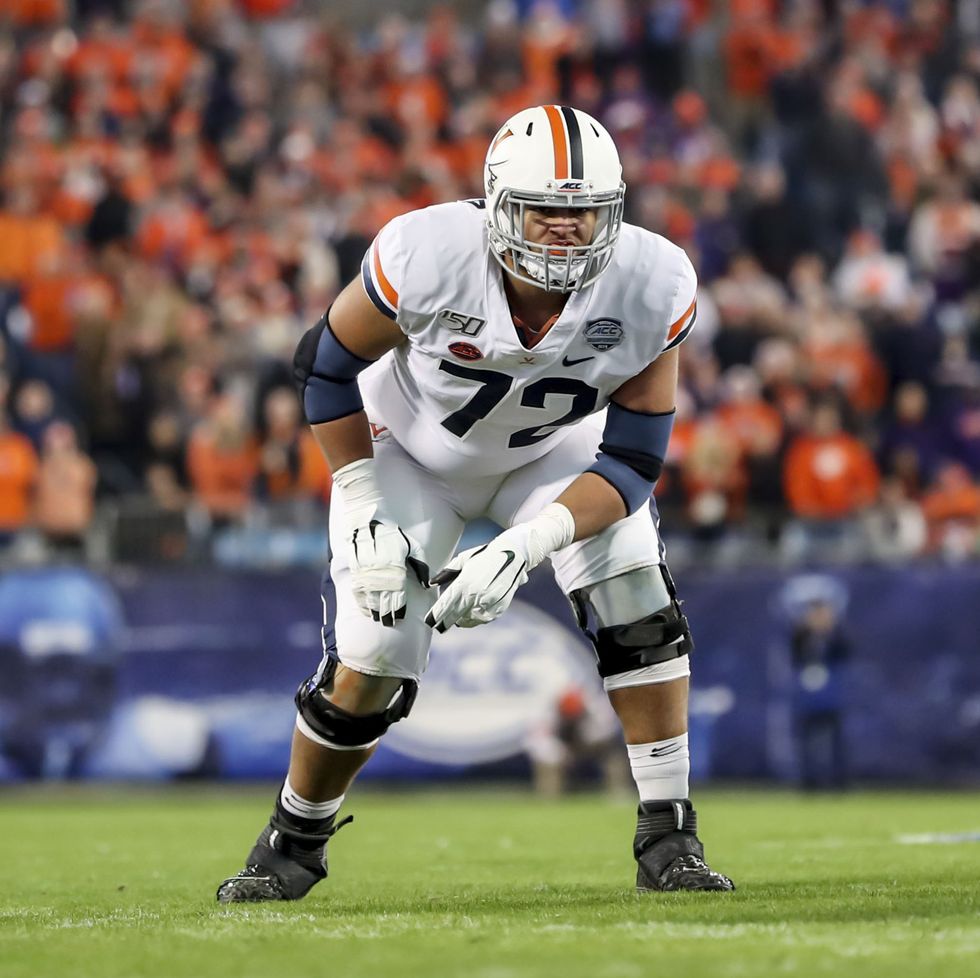
Ryan Swoboda represents UVA during the 2019 ACC championship.
Men are at particular risk, accounting for more than two-thirds of all heatstroke deaths in the U.S., according to the CDC. For many guys, it comes down to a cultural disconnect: We see sweating as a badge of honor, proof that we’re working hard, without thinking about the potential consequences—or knowing when to stop. As the world heats up around us, regular guys are also more vulnerable to heat-related illnesses, whether during an afternoon of pickup basketball or on the job. (The Biden administration has proposed new OSHA regulations to combat the spike in work-related heat illnesses over the past few years.)
Point is, you might not even recognize that you’re having a serious problem until it’s too late: “It can happen in a blink of an eye,” says Robert Huggins, Ph.D., a kinesiology professor and the president of research and athletic performance and safety at the Korey Stringer Institute, established at the University of Connecticut in 2010. “Someone can go from performing really well to being totally incapacitated, not knowing where they are, with dizziness, confusion, uncoordination of movements, to becoming unconscious. That’s how close they are to the edge.”
But here’s the twist: The thing that almost killed Swoboda that muggy July day—working out in the heat—ended up being the same thing that ultimately saved his career.
To his coaches’ surprise, he would eventually return to the UVA team, earning a starting spot as an offensive tackle. But he was only able to achieve that thanks to an intensive, monthslong rehabilitation program guided by top experts in heat adaptation—and a close study of how his own body handles extreme heat. Which means we can all reap the surprising benefits of hot-weather training, which can improve both our athletic performance and our overall health, if we do it right.

IT ALL BEGINS with sweat, our human superpower. When you and your dog go for a run on a warm summer morning, you will break into a sweat while your dog will begin to pant. Both serve the same function: cooling the body. The difference is that our sweating is much more efficient at the job. “Sweat is fantastic, and humans are the best sweating animals on the planet,” says Christopher Minson, Ph.D., a professor of physiology at the University of Oregon. “There is no animal that can beat us at sweating.”
Your dog does have sweat glands, like all mammals. The ones all over its body where its fur grows are called apocrine sweat glands, and we humans also have them in our armpits and other hairy zones. The waxy, oozy sweat they produce contains fats and proteins, which feed skin bacteria, causing body odor. “That’s the gross stuff,” says Andrew Best, Ph.D., a biological anthropologist at the Massachusetts College of Liberal Arts.
The glands on your dog’s paws and its nose are called eccrine glands, and all mammals have these, too. They pull water from blood plasma and pipe it to the surface of the skin, where it evaporates, taking heat with it. Now the cool part: About 1 million to 3 million years ago, says Best, our ancestors’ eccrine glands multiplied and spread all over the body, making us much more proficient at sweating.
We now have millions and millions of these eccrine sweat glands, with especially high concentrations on our forehead, hands, fingers, feet, and toes. This fancy new cooling system called sweating allowed our ancestors to hunt all day in the hot African sun, running down prey. “Dripping sweat does not help you,” says Minson. “It has to evaporate. That phase shift is what takes energy away in the form of heat.”
But it is also a double-edged sword, as Swoboda learned the hard way. We must sweat in order to cool ourselves. But if we sweat too much, we deplete water from our bodies, along with sodium and other critical electrolytes. Unless we replenish those correctly, bad things can happen. This is where it gets tricky.

AFTER RECOVERING FROM his heatstroke, Swoboda made his way to the Korey Stringer Institute to try and understand how his body responds to heat—and to try and make himself more heat resilient.
At KSI, he learned that how much we sweat varies greatly from person to person, depending on factors including body size, genetics, and—most crucially—how adapted we are to working out in the heat. One runner might lose a liter per hour during a marathon while another might sweat twice as much in the same event under the same conditions. Smaller, skinnier people need to sweat less than taller, heavier people because they have more surface area relative to their size, and thus their sweat evaporates better.
This is, in part, why men sweat more than women; we’re bigger, on average, and we generate more heat, says Minson. “We’re big chunks of meat, and when we start to exercise, about 25 percent of the energy we produce goes toward the actual work that we’re doing,” he says. “The other 75 percent is heat as a by-product of metabolism.”
Your sweat rate is related to your body size, and the bigger you are, the more heat your body will generate.
A football player like Swoboda will generate even more heat, not only because of his size but also because he will do his hardest preseason workouts in the heat of summer, encased in pads and a helmet that trap heat and prevent sweat from evaporating. “Football can be a recipe for disaster for heat illness,” says KSI’s Huggins, and the culture of the sport often encourages athletes to push past their limits.
Huggins put Swoboda through a series of test workouts in a special heat-controlled chamber and determined the obvious: Even for a big guy, he had a very limited ability to cool himself down. His body temperature, measured by a tiny wireless device that he swallowed like a pill, would rise as he exercised—and keep right on rising. That was what felled him that July afternoon in Virginia. “My body was unable to maintain temperature homeostasis,” Swoboda says.
The surprising cure: more exercise in the heat.
Working with scientists at KSI, as well as his UVA athletic trainer, Keith Thomson, Swoboda began a rigorous, controlled training program designed to help him cope with hot weather. Every morning at 4:45 a.m., he would swallow the temperature-sensing pill. Beginning at 3:00 or 4:00 in the afternoon, the hottest part of the day, he would work out on the team’s practice field, doing up-downs and running laps while Thomson monitored his core temperature. As soon as Swoboda’s body temp hit 102 degrees, Thomson would stop the workout so that he could go cool down.
At first Swoboda could last only about 25 minutes. But as the weeks went on, his body slowly adapted so he could exercise longer before hitting the safety threshold. His blood volume increased, meaning there was more liquid available to be turned into sweat. His hemoglobin count also grew, improving his ability to bring oxygen to his muscles. He worked on hydration as well, making sure he was taking in enough fluids and electrolytes to sustain his Niagara Falls–like sweat rate. “I’d wake up every morning and go, I have to go give myself heatstroke again,” he jokes.
After a month, Swoboda went back to the KSI heat chamber for a two-hour moderate workout in a room heated to 104 degrees. His temperature went up to 102 and kept rising. He flunked the test. It took him two more months of heat training before he finally passed—his body temperature rose but then plateaued and eventually cooled on its own. His body had finally learned to cope with the heat. And he was cleared to rejoin the team.
“I broke down crying in the locker room when I finally passed,” he says now. “I never thought I would play football again.”

THE BIGGEST PROBLEM with sweating—and the thing that makes it much more complicated than you’d think—is that most guys have no idea how much they sweat or what to do about it. Some of us sweat more quickly and copiously while others sweat less. To improve our sweat efficiency and body-heat management, we need to understand how much fluid we are really losing.
Swoboda underwent testing in state-of-the-art labs—but for the rest of us, fluid loss is actually easy to calculate, says Huggins. “The most important thing an athlete can do is get naked,” he says. Meaning: “Weigh yourself before the activity, with all the water bottles you plan on drinking, and then weigh yourself after the activity.” Whatever’s left in the bottles also goes on the scale. Your “sweat rate” is the change in total weight divided by the duration of the workout.
Now you know how much liquid you will lose per hour—during that activity, in those specific conditions. (Every two pounds equals about one liter lost.) Some guys will sweat as little as one liter per hour; others will lose two liters or more. Swoboda’s maximal sweat rate topped three and a half liters an hour.
“Knowing your sweat rate will allow you to determine whether you are getting enough fluids into your body in order to maintain your normal exercising body temperature,” Huggins says.

Meridith Cass’s experiences with distance running led to the creation of a new sweat-tracking wearable.
The more liquid we lose via sweat, the more we need to replenish, not only to maintain our ability to sweat more and cool our core but to keep our body—which is two-thirds water—performing. The problem is that many of us sweat out fluid more quickly than we can absorb it via the stomach. You might be losing two liters an hour, but most guys can drink only between 1.2 and 1.8 liters of fluid per hour, says Minson. The math just doesn’t add up.
If you’re running a deficit, you can go from feeling a little sluggish to downright cramped or light-headed pretty quickly. The liquid in our sweat comes from our blood, so the more we sweat, the less blood volume is left over to supply oxygen to the muscles. As this continues, our cells begin to surrender water to help keep us cool, says Minson. “You’re dehydrating your cells,” he says.
Which is a bad thing: Once we’ve lost 2 percent of our bodyweight in water, our aerobic performance begins to decline. If you go beyond that barrier, headaches, dizziness, or even delirium can set in.
“It’s therefore critical that athletes start the session hyperhydrated, then try to limit some of the losses by drinking through the game,” says Huggins. “And before the next day, replace 110 percent of whatever was lost. That’s what the goal is for any athlete.”
It sounds simple but in practice is never quite that easy. Very often, your own body’s signals can get you in trouble.

AS AN ILL-FATED freshman football recruit that summer of 2017, Ryan Swoboda had no clue that he was headed for disaster. He knew he was supposed to drink water, and he did—just not nearly enough. His body didn’t tell him that he was on a bad path.
But there are many ways in which hydration can go awry—and other tricks the body can play on us. It’s important to replace not only the water lost through sweat but also the crucial electrolytes in that sweat. Electrolyte losses vary as much as or more than fluid losses from person to person, but measuring them has been much more complex in the lab.
Entrepreneur and runner Meridith Cass discovered firsthand how dangerous it can be to get it wrong. In 2014, she started the Boston Marathon feeling anxious about the heat that day; it was in the mid-70s, warm for a marathon. So she made sure to drink lots of water. “I was overcompensating, I think, by prehydrating before the race,” she says.
As she made her way through the shadeless course, she kept drinking water, grabbing a cup at every aid station—choosing water over sports drinks because of their sugar content. She remembers feeling intensely thirsty, her mouth parched. “I could not get enough water in me,” she says. She began to feel dizzy and crampy, classic symptoms of dehydration. She drank more.
By the finish, she was wobbly and sick—not from dehydration, it turned out, but its opposite. As she was sweating, she was also losing electrolytes, such as sodium and potassium. Because she had not consumed any electrolytes in her drinks, her blood was dangerously diluted, a potentially fatal condition called hyponatremia (meaning too little sodium). A seminal 2005 study of blood samples from nearly 500 Boston runners found that 13 percent, one in eight, met the clinical definition of hyponatremia; a handful of runners have actually died from it.
This was Cass’s third marathon. Yet her body had still tricked her. “The scary thing is that you don’t have an indication of whether you’re hyponatremic or dehydrated,” she says. “You could be either way, because the symptoms feel the same.”
Even scarier: Giving someone the wrong treatment, for either condition, could potentially kill them. Luckily for her, a teammate threw her a bag of salty potato chips. But the experience got her thinking about this critical missing variable in the sweat equation: There’s no easy way to know how much liquid and electrolytes we actually need.
This ultimately led Cass to develop a wearable that measures both sweat loss and sweat composition during exercise, in real time. The device, called Nix, costs $129 and consists of a patch worn on the upper arm, attached to a small transmitter. Inside, there is a reservoir that collects your sweat and a sensor that measures the amount of liquid and the concentration of electrolytes, and it transmits the data to your phone.
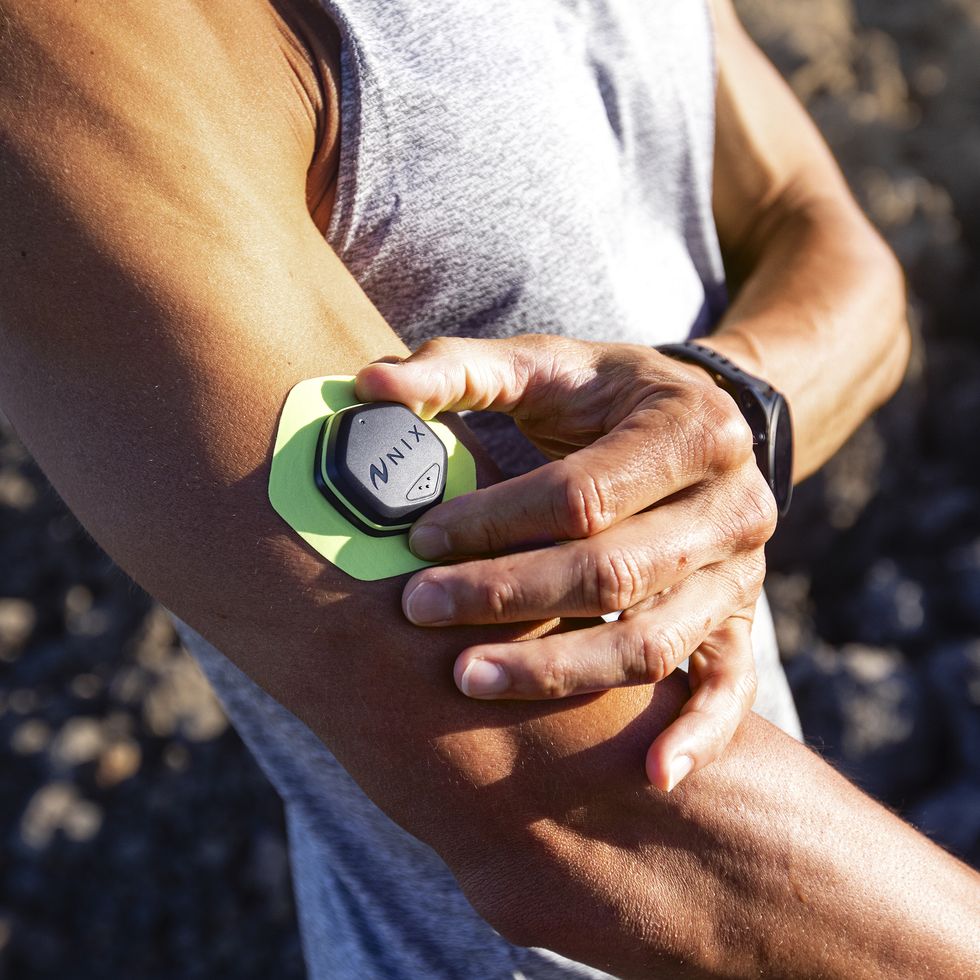
Nix’s sweat-tracking wearable helps you optimize your hydration.
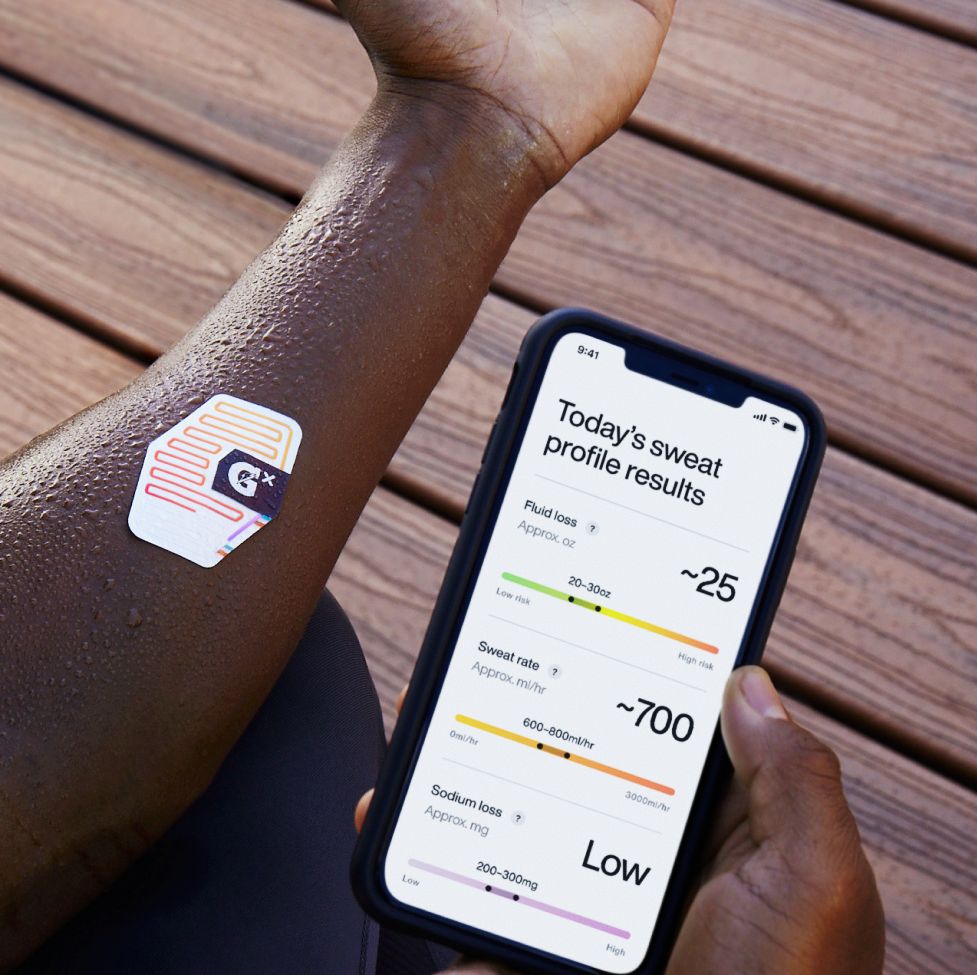
Gatorade’s sweat-measuring patch changes color as you sweat.
Once you’ve tracked your total sweat signature, the Nix app tells you how much liquid you need to replenish and, crucially, what you should be drinking. Depending on your rate of electrolyte loss, Nix will recommend different sports beverages based on their electrolyte content. (Gatorade recently introduced a less expensive disposable patch that’s worn on the forearm and changes color as you sweat. Scan the patch with your phone and the Gatorade Gx app tells you how quickly and saltily you’ve been sweating, with plenty of Gatorade-specific suggestions to optimize your hydration.)
Of course, there’s a lo-fi way to make better hydration choices, too. Minson recommends the DIY salt-stain test: “If after regular endurance exercise bouts your clothes have visible salt stains on them . . . you are likely a high-salt sweater,” he says, which means you should consider sports drinks with a higher electrolyte content, and possibly supplementing with salt capsules, to help maintain the salinity balance within your cells, fighting cramping and encouraging you to sweat more easily.
But the more precise approach to hydration has paid off for weekend warriors like Mark Donovan, a 55-year-old from Connecticut who has run 26 marathons—with varying results. “Usually by mile 21, I’m battling an upset stomach and I don’t want to see another cup of sugar-laden water,” he says. As he trained for the Chicago Marathon last fall, two long runs with Nix helped him understand exactly how much fluid and electrolytes he was losing in race-day conditions and how best to replace them. He went so far as to measure how much he was consuming with each gulp.
He came up with a race-day plan—essentially, pacing his own fluid intake—and ended up having what he calls the best marathon of his life; not his fastest time, but the best he’s ever felt. “I did what my body required, and my experience was completely different and more positive,” he says. “It was like this euphoric athletic moment.”

HAVING MISSED HIS freshman season, Swoboda decided to take a fifth year. Although he could have transferred to a school in a cooler climate, he chose the near-tropical University of Central Florida partly because of how he adapted during his journey inside the furnace.
It took him a full 12 months to recover from his heatstroke, but he’s trained himself to perform even better in hot conditions. Because it turns out that just as the body can adapt to living at high altitude, we can also adapt to the heat. Heat training just takes time and careful planning, especially if you’re not used to the environmental intensity.
“Every year, when springtime comes, I see how much everyone struggles for that three- or four-week period when they’re not heat acclimated but the weather is warming up and the humidity is increasing,” says Jon Fecik, a pro triathlete and coach in Connecticut. “Their performance suffers, and they think they are getting worse.”
Fecik can sympathize; he found that he struggled in hotter races, preferring cooler conditions. Unfortunately, the biggest triathlon events tend to take place in hotter climates like Kona, Hawaii, the traditional site of the Ironman World Championships.
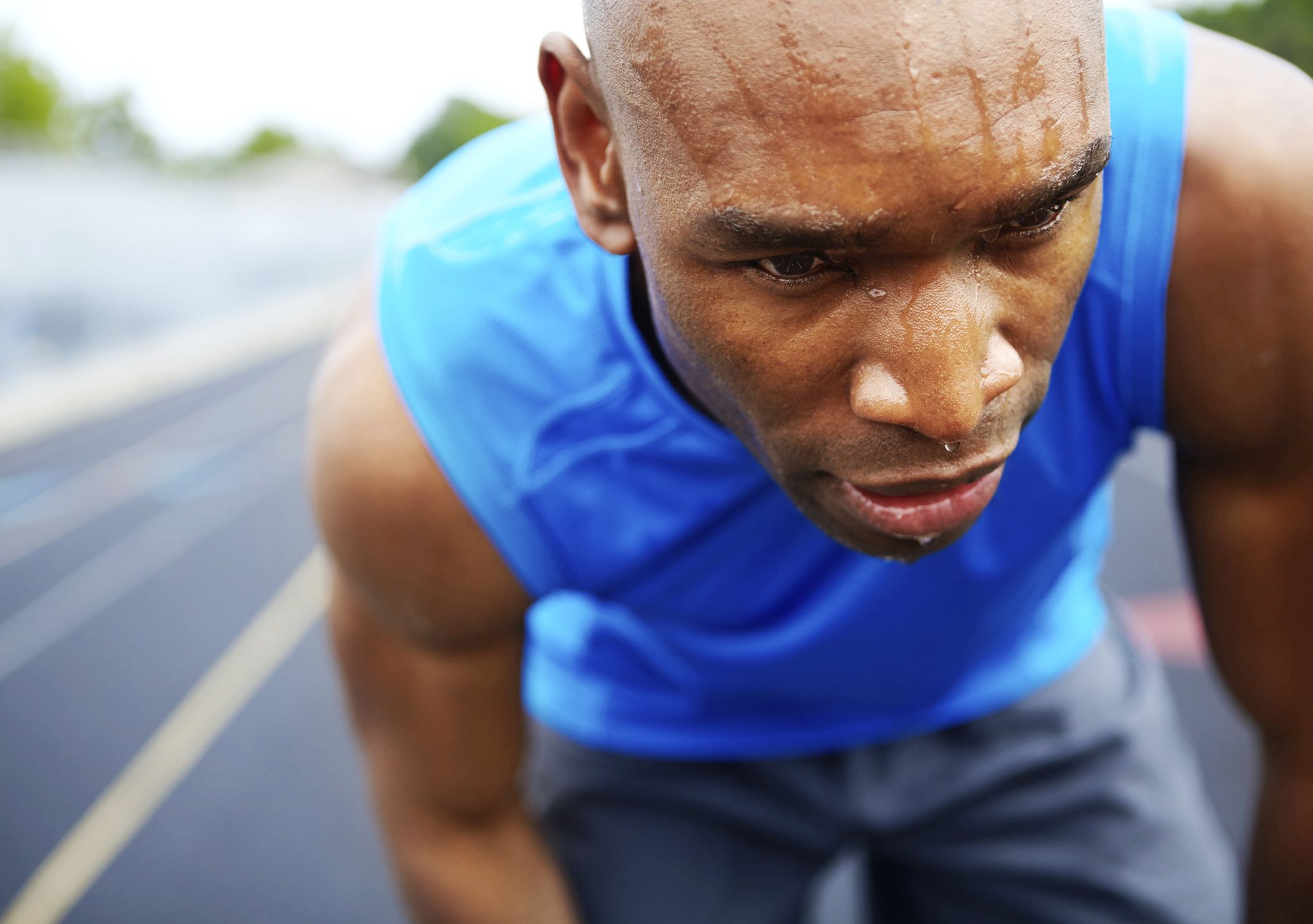
See our tips for sweating safely (“4 Smart Ways to Beat the Heat,” below) to fire up your performance.
Seeking help, he came to the heat-performance lab at KSI for testing in simulated race conditions: two hours on the bike at 90 degrees and 60 percent humidity. In a word, steamy. He gulped down six bottles of electrolyte drink, but he still had to stop the test after just 90 minutes because his body temperature had zoomed to a feverish 105.8 degrees. “At that point they pretty much pull you out and say, This is starting to get unsafe,” he says.
The researchers collected his sweat on a mat on the floor and squeegeed it into a bucket. “They analyzed it and said, Wow, you really sweat a lot,” he says. Which he knew; he lost more than three liters of fluid per hour, plus 4,000 milligrams of sodium and 5,400 milligrams of chloride, yet his body still couldn’t keep itself cool.
So the sports scientists at KSI developed a heat-adaptation plan. A few weeks before the event, Fecik would come in and train in the heat lab, riding an hour in 95 degree heat while scientists monitored his temperature. He would pace himself and drink fluids to keep his core temperature at 101 or 102. After five days of this, he could go longer and stay cooler.
The surprise is that heat training has also made him faster in less-hot conditions. This, Minson explains, is the altitudelike gain: Heat training raises blood-plasma volume to make more water available for sweating, and that in turn may cause the body to produce more red blood cells, which increases your ability to deliver oxygen to the muscles. “It’s like legalized blood doping,” says Huggins.
And it may be that the heat itself causes performance improvements. Minson has found that putting study subjects into “heat therapy” by dunking them in hot water over and over causes improvements in cardiovascular function, as well as in markers of metabolic health. “There’s this whole cascade of events that are very similar between repetitive bouts of heat stress and repetitive bouts of exercise,” he says, adding that a postworkout hot-tub or sauna session might extend those benefits even more. Again, people must be careful to avoid the negative effects of dehydration.
So the best way to beat the heat, it turns out, is to do what Ryan Swoboda did: embrace it. After a standout season at Central Florida, he set his sights on the NFL. He’s kept tabs on his hydration status, drinking water by the gallon and dry-scooping Gatorlyte packets; after especially hot workouts, he cools himself in a tub of ice water—the recommended treatment for anyone who is overheated. “Otherwise I keep on sweating all day,” he said in March while at a Training Haus Combine Prep Center in Minnesota.
His road to recovery, he believes, has made him a tougher player: “The challenges I faced recovering from heatstroke made the challenges of college football seem much easier. Nobody else on my team had gone through that.” And in late April, the Detroit Lions proved him right, signing Swoboda as an undrafted free agent. Whatever happens next, he feels ready for it. The heat can crush you, but it can also make you stronger.

Know Your Sweat Rate.
Weigh yourself—naked—before and after a long, hot workout, taking into account all the fluids you drank and water lost through urine. The weight difference divided by time is your sweat rate, the amount of liquid you should be drinking in those conditions. Sweat more than you drink? Be sure to pre- and post-hydrate.
Consider Adding Salt.
If you finish a long run with salt-crusted shorts, you should be drinking sports drinks (or adding salt caps to your water, if needed). To get specific, try using one of the electrolyte-measuring wearables out there, such as Nix or the Gatorade Gx sweat patch.
Take Your Temperature.
If 10 is the hottest you’ve ever felt and 0 is perfectly comfortable, shoot for a 6 or a 7 as you heat-train, says Minson. Beyond that? Hydrate more or slow down and take a break. Wearables like the Core body temperature sensor can offer more precision.
Pace Yourself.
As summer begins, don’t go all out. Introduce your body to the heat in short workouts over time until you feel comfortable. “I’ve seen more heatstroke cases in 10Ks than in marathons,” says Huggins, because a faster pace means higher exertion. The right balance will keep you sweaty but safe.

Writer
Bill Gifford is the coauthor of Outlive, with Peter Attia, M.D. A longtime contributor to Menʼs Health, he lives in Salt Lake City.
