

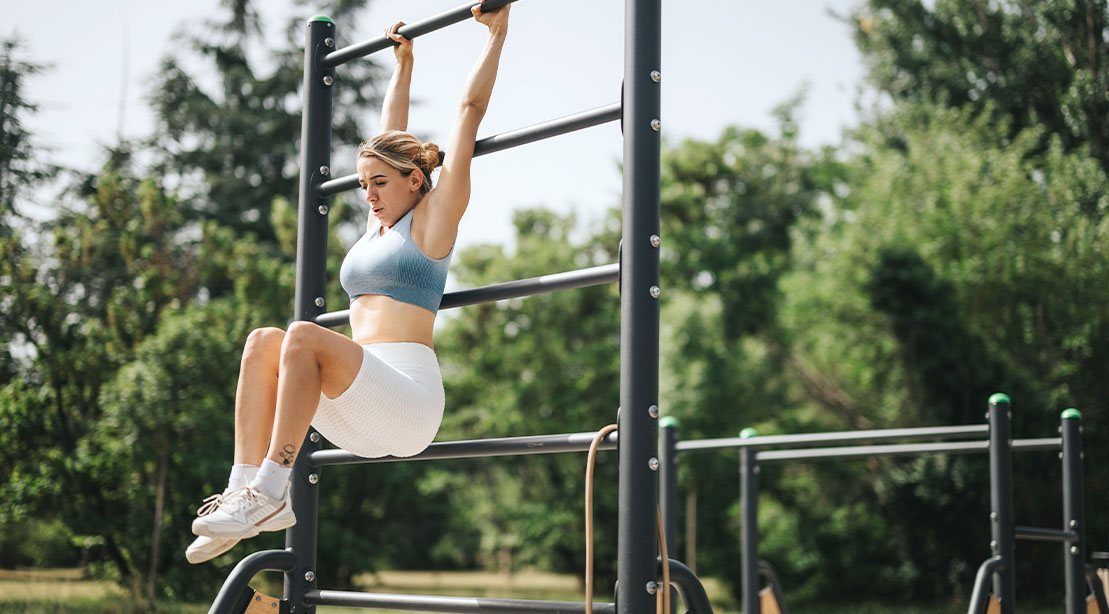
If your core training never leaves the floor, you’re missing out on gains. Pallof presses, planks, and bird dogs are great, but when you’re ready to step it up, it’s time to hang tough. Enter the Hanging Knee Raise.
The hanging knee raise is a test of strength, control, and toughness. You’re hanging from a bar, resisting the swing, and pulling your knees up with control. Your anterior core is begging for mercy, your grip is taxed, and your lats are on fire.
Doesn’t that all sound like fun? Then you’re in for a treat.
The hanging knee raise builds the foundation for stronger lifts, better posture, and that defined midsection everyone’s grinding for. It’s time to ditch the floor and take your core training vertical.
Are you ready?
What is the Hanging Knee Raise?
The hanging knee raise is a movement that requires you to raise your knees toward your chest while hanging from a pullup bar. But there is more than meets the eye, as this move is a full-body challenge that hits far more than just your abs.
While your anterior core flexes and stabilizes, your grip, shoulders, and lats are fully engaged to keep you steady.
This exercise targets both spinal flexion and hip flexion, all while resisting momentum. That makes it one of the most well-rounded core moves out there—perfect for lifters, athletes, and anyone ready to upgrade their core workouts from floor-bound to full-body.
Whether you’re training for stricter pullups, looking to bulletproof your midsection, or just trying to develop that chiseled, athletic look, the hanging knee raise delivers.
How To Do The Hanging Knee Raise
Performing the hanging knee raise requires that every rep be controlled and intentional. Here’s how to do it right.
- Grip a pullup bar with an overhead grip, slightly wider than shoulder width.
- Pull your shoulder blades down and back and brace your core.
- Keeping your legs together, drive your knees toward your chest using your abs and hip flexors.
- Aim to get your knees at least to hip level while staying steady.
- Slowly lower your legs back to the starting position without letting them drop or swing.
- Then reset and repeat.
Hanging Knee Raise Muscles Trained
Here’s what’s working during every rep:
- Rectus Abdominis: Drives spinal flexion to raise your knees.
- Obliques: Stabilize your upper body and help resist unwanted rotation.
- Hip Flexors: Lifts the knees toward the chest.
- Forearms & Hands: Maintain your hold on the bar and prevent slipping.
- Lats and Upper Back: Engage isometrically to support an active hang and prevent excessive swinging.
- Serratus Anterior: Assists scapular stability.
Benefits of Hanging Knee Raise
Here’s why this move earns its place in any serious training plan:
Develops a Well-Rounded Core
This exercise works both spinal flexion and hip flexion while resisting momentum. That makes it one of the most complete core moves—ideal for lifters, athletes, and anyone ready to move beyond basic crunches to full-body, functional training.
Enhances Grip Endurance
Just hanging around taxes your grip and forearms, building transferable strength that carries over to pull-ups, carries, deadlifts, and pretty much everything else involving grip.
Improves Body Control and Coordination
Keeping your torso still while your legs move forces your lats, abs, and shoulders to work together. Doing so enhances total-body stabilization, which carries over to heavy compound lifts and gymnastics-based progressions.
Trains Hip Flexor Power
Strong hip flexors aren’t just for looks—they’re crucial for sprinting, jumping, and powerful athletic moves. The Hanging Knee Raise effectively targets them, especially when tired, which is what happens in and out of the gym.
Whether your goal is strength, aesthetics, or performance, the hanging knee raise delivers. Next up are common mistakes to avoid.
Common Hanging Knee Raise Mistakes and Fixes
The hanging knee raise looks simple enough, but without solid technique, it can turn into a swinging, momentum-filled mess. Here is what to avoid to get the most out of this movement.
Using Momentum
Relying on swinging your legs rather than core control reduces tension, and your body will say, “No, thank you.”
The Fix: Start the movement with intention. If you’re swinging, you’re doing too much too soon. Slow down and reset between each rep, and let you and your core become one.
Passive Shoulders
Letting your shoulders hang loose and not engaging your upper back and lats puts unnecessary stress on your upper body joints and decreases its effectiveness.
The Fix: Engage an active hang by pulling your shoulder blades down and away from your ears. This action activates the lats and stabilizes your upper body.
Reduced Range of Motion
Raising your knees a few inches from the starting position doesn’t fully engage your anterior core and hip flexors.
The Fix: Drive your knees to at least hip height or higher on every rep. Full range means full benefit because quality defeats quantity every time.
Losing Control
A fast, uncontrolled descent of your legs overloads the lower back and disengages the core.
The Fix: Control the eccentric phase. Lower your legs slowly and under tension, as this protects your spine and maximizes muscle activation.
Next, let’s insert it into your program correctly.
Programming Suggestions
Whether you’re new to this exercise or an advanced lifter refining your core training, here’s how to plug it into your workout for maximum benefit.
When Should You Use Hanging Knee Raises
Insert the hanging knee raise as part of your warmup or core circuit before you hit the barbell. Or pair it with an exercise that doesn’t demand much grip strength, like a bench press or an overhead press.
Beginner Lifter Sets and Reps
- Sets & Reps: 2–3 sets of 6–8 reps.
- Tempo: Controlled up, slow on the way down.
- Rest: 60–90 seconds between sets.
Intermediate and Advanced Lifter Sets and Reps
- Sets & Reps: 3–4 sets of 10–12 reps.
- Tempo: Slightly faster up, 2–3 second eccentric down.
- Rest: 90 seconds between sets.
- Variations: Pause at the top, or add a controlled twist for obliques. Straighten the legs into a hanging leg raise, or add ankle weight or a med ball between your legs.
