


How many push-ups can you do? Here’s what your number means after 55.
“Being in shape” gets thrown around a lot, but it doesn’t really come down to a single number or one test. It shows up in how you move, how you recover, and how your body handles effort day to day. You feel it when you can get through a workout and still have something left, when your joints cooperate, and when basic movements don’t take extra thought.
That said, there are a few markers that give you a solid read on where you stand. Strength, endurance, and control tend to rise to the top. In most cases, a few well-chosen movements give you a clearer picture, especially when you’re moving your own bodyweight.
That’s where push-ups come in. They’re a relative strength movement, which means you’re working with your own body instead of an external load. That matters because it ties your strength directly to your size, your control, and your ability to coordinate everything at once. If you can move your body well through repeated reps, it usually indicates being in good overall shape.
Why Push-Ups Reflect Overall Fitness

Push-ups give you a lot of information in a short amount of time. Your chest, shoulders, and triceps drive the movement, but your core has to stay engaged so your body moves as one piece. If any part of that chain drops off, you feel it right away. That makes it a reliable way to gauge how well your body works together.
They also bring endurance into the mix. A single rep shows strength. Repeating that effort shows how long you can hold onto it. Your breathing settles into a rhythm, your muscles keep producing, and your form stays consistent as the set builds. That combination of strength and staying power is what people usually mean when they say someone is “in shape.”
Push-ups also highlight relative strength. You’re not just moving weight. You’re moving yourself. That connection matters, especially as you get older. Being able to control your body through space carries over into daily movement, whether that’s getting up off the floor, catching yourself, or handling physical tasks without hesitation.
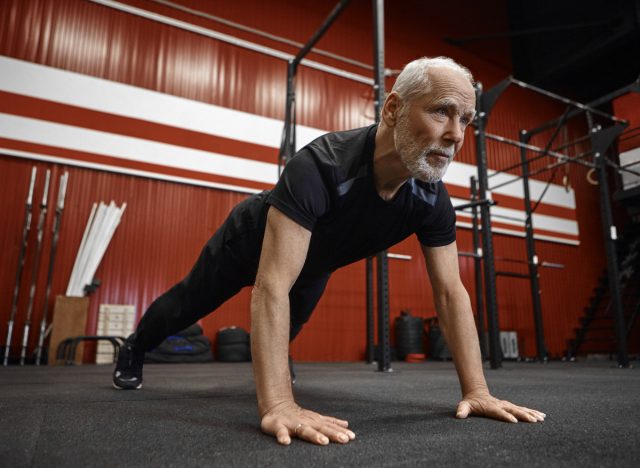
How to Perform Push-Ups With Consistent Form
The setup determines how effective each rep is. When your position stays consistent, your reps reflect your actual strength.
How to Do It:
- Place your hands on the floor slightly wider than shoulder-width apart.
- Extend your legs behind you so your body forms a straight line.
- Brace your core and squeeze your glutes to hold that position.
- Lower your chest toward the floor under control.
- Press through your hands to return to the starting position.
- Repeat each rep at a steady pace.
A quick note on the movement standard. Lower until your elbows reach at least 90 degrees while keeping your body in a straight line. If you’re working toward that depth, use an incline or another modification to stay consistent.
Best Variations: Incline Push-Ups, Tempo Push-Ups, Decline Push-Ups, Close-Grip Push-Ups, Pause Push-Ups.
Push-Up Benchmarks After 55

Your number matters most when each rep looks the same: full range, steady control, and consistent pace.
- Under 8 reps: You’re building your base. Each set adds strength and helps dial in your positioning.
- 8 to 15 reps: This is a solid range. Your upper body supports repeated effort and stays controlled.
- 15 to 25 reps: You’re in good shape. Your strength and endurance work together to keep your reps consistent.
- 25+ reps: This is excellent. Your upper body keeps producing, your core stays engaged, and your movement stays smooth.
How to Build Push-Up Strength That Carries Over
Building push-up strength comes down to developing control that you can repeat. This is where most of the progress happens. It’s not about one big set. It’s about stacking quality reps over time and letting your strength build in a way that sticks. When your body learns to stay tight, move smoothly, and keep producing effort, your numbers follow.
Push-ups also tend to improve quickly when the right pieces are in place. Strength in the chest and shoulders matters, but so does how well your core supports the movement. When everything works together, each rep becomes more efficient, and longer sets start to feel more manageable.
- Practice push-ups regularly: A few focused sets a couple times per week build steady progress.
- Focus on full-body tension: Keep your core and glutes engaged so your body moves as one piece.
- Train through a full range of motion: Working toward that 90-degree elbow position builds strength where it counts.
- Use modifications when needed: Incline push-ups help you stay consistent while building strength.
- Build supporting strength: Rows, presses, and carries round out upper-body development.
- Use shorter, controlled sets: Multiple quality sets build toward longer efforts.
- Control your tempo: Slowing things down builds strength and better movement.
- Stay consistent over time: Progress comes from repeated exposure and steady effort.
If you can move through 15 to 25 clean push-ups after 55, you’re in a strong place. That level of relative strength shows up in how you move, how you support yourself, and how your body handles everyday demands.
References
- Wang, Yucong, and Kalaiselvan Ashokan. “Physical Exercise: An Overview of Benefits From Psychological Level to Genetics and Beyond.” Frontiers in physiology vol. 12 731858. 12 Aug. 2021, doi:10.3389/fphys.2021.731858
- Yang, Justin et al. “Association Between Push-up Exercise Capacity and Future Cardiovascular Events Among Active Adult Men.” JAMA network open vol. 2,2 e188341. 1 Feb. 2019, doi:10.1001/jamanetworkopen.2018.8341
Jarrod Nobbe, MA, CSCS
