

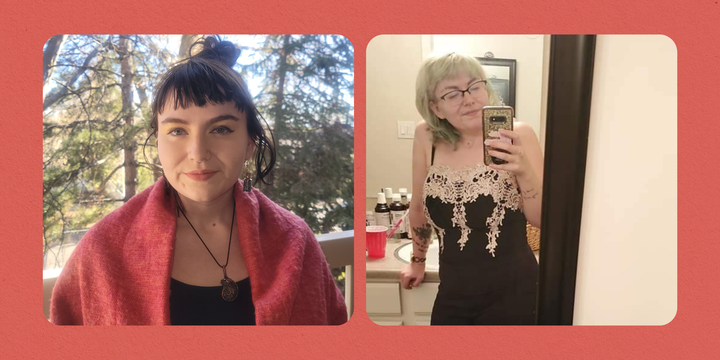
Minnie Hatch, 29, from Salt Lake City, had painful stomach cramps, and other symptoms for months before finding out she had Clostridioides difficile, or C. diff. These bacteria can grow out of control after a course of antibiotics, causing bloody diarrhea and sometimes serious damage to the intestines. Since 2015, she has had dozens of debilitating and life-threatening recurrences, and needed three fecal transplants, which involves receiving poop from a donor via colonoscopy to help restore healthy bacteria in the colon. Here’s her story, as told to senior health writer Katie Camero.
My symptoms started about 10 years ago. I was 19 years old and working with an ob-gyn at the time who was helping me deal with stomach cramps, abnormal uterine bleeding, diarrhea, and vomiting. My symptoms kept being chalked up to polycystic ovary syndrome (which I was diagnosed with at age 13), but I started to feel much worse, so she referred me to a GI specialist. We worked through the basic stuff: Don’t eat so much sugar, drink less caffeine, get more sleep. But none of these things helped the fact that I truly felt like I was dying; I couldn’t get out of bed and frequently had to call out of work. This went on for months, until my doctor eventually looked at me and said, “I think I know what it is, but you’re just so young.” So he finally ordered a test and his suspicions were correct: I had C. diff.
I took two different types of antibiotics (the typical treatment for C. diff), with no success, before my insurance agreed to pay for a new one that had just come onto the market. That medication was life changing. I actually went back to work and got married that year. But that’s when things took a turn for the worse.
I’ve been prone to infections my whole life, which meant I grew up taking an usual amount of antibiotics for UTIs, ear infections, sinus infections, you name it—and still do. There have only been three times in a decade, all of them in the last year, that I’ve taken antibiotics that did not result in me getting C. diff. Like many other health conditions, C. diff doesn’t discriminate. It doesn’t care how old you are, what you look like, or what you’re planning for your future. There’s so many things that theoretically go into the classic why me, but at the end of the day, it is me. This is my life and this is what I have to deal with.
I ended up needing my first fecal microbiota transplant (FMT) in 2016. It was such a new procedure at the time that the FDA still considered it entirely experimental. I had to find my own donor and bring a blender (yes, it’s what you’re thinking) because the hospital couldn’t risk using their own equipment and spreading the infection. Not to mention my doctor was one of only two in my state who even knew how to perform a FMT at the time. Unfortunately, the procedure only gave me relief for about two months. I eventually lost my job and was just struggling to keep my head above water.
