


A veteran trainer reveals why short workouts outperform long gym sessions after 60
After 35 years as a personal trainer — the last 20 spent training other PTs through TRAINFITNESS — the single biggest frustration I hear from clients over 60 is this: “I’m doing everything right, but I’m not building any muscle.” The truth is, most traditional gym programmes aren’t designed for bodies over 60, and that’s why they fail. But there’s a smarter approach: a focused 7-minute dumbbell routine that delivers real muscle-building stimulus without destroying your recovery. These four exercises can help you rebuild functional strength without stepping foot in a gym.
Why Traditional Gym Workouts Fail After 60
Once we’re over 60, we can’t train like we did when we were 30 or 40. The most significant reason is anabolic resistance — our muscles just don’t respond as well to growth signals as they used to. Testosterone and growth hormone levels are lower. Muscle protein synthesis rates are lower. We take longer to recover. Our joints aren’t as resilient. Doing the typical gym workout designed for a 25-year-old is going to leave you exhausted, sore, and without the results you want.
Most traditional gym programmes are volume-based: 3 sets of this, 4 sets of that, multiple exercises per muscle group. This creates way too much inflammation in someone over 60, and your body can’t recover quickly enough. You’re just spinning your wheels while you’re constantly sore.
The other big problem is intensity. So many older people are told to “not push it” and to “just use lighter weights and do more reps.” This isn’t how it works. You need to challenge your muscles. 20 reps with a light weight will leave you winded, but it’s not going to be enough to stimulate a strength response. What does work is putting real effort into shorter sessions, then recovering properly. That’s how you get results.
Why Dumbbells Are the Best Tool After 60

Machines lock you into fixed movement patterns. When you’re 60 or older, your joints don’t all move the same way they did when you were younger. Your right shoulder might have a slightly different range of motion than your left. Your hips might be tighter on one side. Machines don’t account for this, and that’s how you end up with pain or injury.
Dumbbells let you move naturally. Your body finds the path that works for your joints — and this matters more as we age, because our bodies have decades of compensation patterns built in. Dumbbells work with those patterns instead of fighting against them.
Bodyweight training has its place, but there’s a limit to how much resistance you can create. For muscle growth, you need progressive overload — gradually increasing the challenge. With bodyweight alone, progression gets complicated. You need to learn more difficult movement variations, which often require better mobility or balance than most people over 60 have.
Dumbbells make progression simple. Start with 2kg. Move to 3kg. Then 4kg. No complex movement patterns to learn, no mobility requirements you might not meet. They also force stability work — when you press a dumbbell overhead, your core has to stabilise and the smaller muscles around your shoulder have to work. Machines do this for you, which means those muscles don’t develop. Over 60, those stabilising muscles are exactly what keep you functional and injury-free.
Why 7 Minutes Beats a Longer Session

Recovery is the limiting factor after 60, not your ability to do work. A 45-minute gym session might feel productive, but if it takes you three days to recover, you can’t train frequently enough to build muscle. You end up training twice a week at best, and that’s not enough stimulus.
A 7-minute routine done with genuine effort creates the muscle-building stimulus you need without overwhelming your recovery capacity. You can do this four or five times per week because you’re not destroying yourself each session. More frequent training means more growth signals sent to your muscles across the week.
Longer sessions also mean more exercises, and more exercises mean more room for poor form when you’re tired. Form breakdown is how people get injured. A short routine keeps you fresh — every rep is quality, every set is done with control.
The psychological aspect matters too. Seven minutes is doable. You don’t need to psyche yourself up for it or block out half your morning. You just do it. That consistency compounds. Most people fail not because they can’t do a hard workout — they fail because they can’t sustain the habit.
Goblet Squat
This targets your quads, glutes, and core — the muscles that keep you mobile and independent. After 60, leg strength determines whether you can get up from a chair without using your hands, whether stairs feel manageable, whether you feel stable when you walk.
Muscles Trained: Quads, glutes, core
How to Do It:
- Hold one dumbbell vertically at chest height with both hands underneath the top weight plate
- Stand with feet shoulder-width apart
- Keep your chest up and core tight
- Sit back and down as if sitting into a chair, going as low as your mobility allows without your lower back rounding
- Push through your whole foot to stand back up
- Breathe in as you lower, breathe out as you stand
Modifications:
- For knee pain: don’t go as deep — a quarter or half squat still works the muscles
- For hip tightness: widen your stance and turn your toes out slightly
- For balance issues: hold a sturdy surface with one hand and hold the dumbbell in the other
Avoid These Mistakes:
- Don’t let your knees cave inward — push them out in line with your toes throughout the movement
- Don’t round your lower back at the bottom — only go as deep as you can while keeping your back flat
Recommended Sets and Reps: 3 sets of 8–10 reps (2 minutes)
Form Tip: Start with 4–6kg. If you can easily do 15 reps, go heavier. If you can’t complete 8 reps with good form, go lighter. Progress by adding 1–2kg once you can do 3 sets of 10 comfortably.
Dumbbell Romanian Deadlift
This builds your hamstrings, glutes, and lower back — the posterior chain. These muscles are underworked in most people over 60 because we spend too much time sitting. Strengthening them improves posture, reduces back pain, and makes bending down to pick things up safer.
Muscles Trained: Hamstrings, glutes, lower back
How to Do It:
- Hold a dumbbell in each hand in front of your thighs
- Stand with feet hip-width apart, knees slightly bent
- Hinge at your hips by pushing them back, lowering the dumbbells down the front of your legs
- Keep your back flat and core tight throughout
- Go down until you feel a stretch in your hamstrings
- Drive your hips forward to stand back up, keeping the dumbbells close to your legs the entire time
Modifications:
- For lower back sensitivity: reduce the range of motion — you don’t need to go below knee height
- For tight hamstrings: don’t worry about how low you go — the stretch you feel is the point
- For grip strength issues: use wrist straps, or hold one heavier dumbbell with both hands instead of two lighter ones
Avoid These Mistakes:
- Don’t round your back — keep your chest up and shoulder blades pulled back
- Don’t bend the knees too much — this becomes a squat rather than a hip hinge, so keep your knees in roughly the same position throughout
Recommended Sets and Reps: 3 sets of 8–10 reps (2 minutes)
Form Tip: Start with 3–5kg in each hand. Progress when you can complete all sets with control and still feel challenged by the last few reps.
Dumbbell Shoulder Press
This targets your shoulders and triceps. Strong shoulders mean you can lift things overhead, put items on high shelves, and maintain good posture. After 60, shoulder weakness leads to that forward-rounded posture that makes you look and feel older.
Muscles Trained: Shoulders, triceps
How to Do It:
- Hold a dumbbell in each hand at shoulder height, palms facing forward
- Stand with feet hip-width apart, core engaged
- Press both dumbbells straight up until your arms are fully extended overhead
- Lower them back down under control to shoulder height
- Don’t let your lower back arch as you press up
Modifications:
- For shoulder pain: reduce the range of motion — press only halfway up if that’s pain-free
- For limited mobility: use a seated position with back support
- If pressing overhead hurts: substitute with a front raise to shoulder height instead
Avoid These Mistakes:
- Don’t arch your lower back to help press the weight up — keep your core tight and ribs down
- Don’t shrug your shoulders up toward your ears — keep your shoulder blades down and back throughout the movement
Recommended Sets and Reps: 3 sets of 8–10 reps (2 minutes)
Form Tip: Start with 2–4kg in each hand. Shoulders are more prone to injury than legs, so be conservative with weight at first and progress slowly.
Dumbbell Bent-Over Row
This builds your upper back and biceps. A strong back pulls your shoulders back and down, counteracting the forward slump from sitting. It also improves grip strength, which predicts longevity better than almost any other fitness marker.
Muscles Trained: Upper back, biceps
How to Do It:
- Hold a dumbbell in each hand and hinge forward at the hips with a flat back, knees slightly bent
- Let the dumbbells hang straight down
- Pull both dumbbells up to your ribs by driving your elbows back
- Squeeze your shoulder blades together at the top
- Lower under control — your torso stays still, only your arms move
Modifications:
- For lower back issues: support yourself with one hand on a bench or chair and row one arm at a time
- For grip problems: use straps
- For shoulder discomfort: don’t pull as high — rowing to your hips instead of your ribs is fine
Avoid These Mistakes:
- Don’t use momentum or swing the weights up — the movement should be controlled throughout
- Don’t round your lower back — keep your back flat for the entire set
Recommended Sets and Reps: 2 sets of 10–12 reps (1 minute)
Form Tip: Start with 3–5kg in each hand. Progress when the last few reps of each set feel challenging but you can still maintain form.
How To Structure Your Week
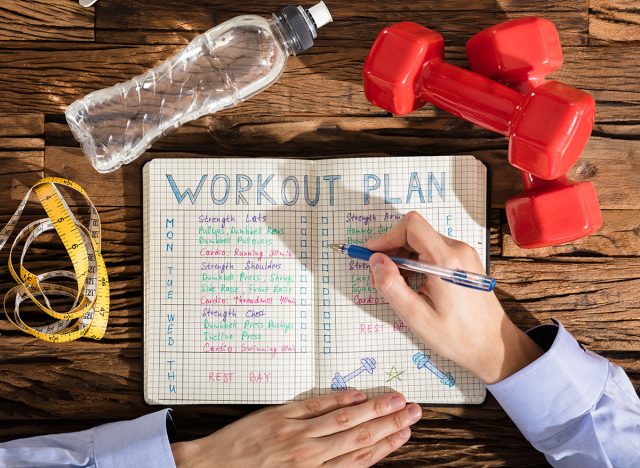
Four days per week is the target. Monday, Tuesday, Thursday, Friday works well — this gives you frequent stimulus without overdoing it. Three days is the minimum for muscle growth after 60. Five days is fine if you’re recovering well, but four is the sweet spot for most people.
Time of day matters less than consistency. Morning works well because it’s done before life gets in the way — your body warms up during the routine, so you don’t need to be fully awake. Evening works if you prefer it, but don’t train within two hours of bed, as it can interfere with sleep.
What matters more is training at the same time each day. Your body adapts to perform at whatever time you consistently train. Pick a time that fits your schedule and stick to it.
What To Eat Before and After

Before training, you don’t need anything special. If you train first thing in the morning, training fasted is fine. If you prefer to eat something, a piece of fruit or a slice of toast 30 minutes before is enough. The goal is to not feel hungry or sluggish — nothing more complicated than that.
After training is where nutrition matters. Within an hour of finishing, eat 25–30 grams of protein. This could be two eggs and some Greek yoghurt, a protein shake, or a small piece of chicken or fish. After 60, your muscles are less responsive to protein, so you need more of it to trigger muscle growth.
Across the whole day, aim for 1.6 grams of protein per kilogram of body weight. For a 70kg person, that’s roughly 110 grams of protein per day. Spread it across three or four meals — breakfast, lunch, dinner, and maybe a snack. Don’t worry about complicated timing strategies or specific foods. Just get enough protein consistently, and your muscles will have what they need to grow.
What To Expect in 4 to 6 Weeks
During the first two weeks, you’ll notice nothing in the mirror. You will notice things feeling easier — standing up from a chair, climbing stairs, better posture without consciously trying. This is neural adaptation: you’re getting better at using the muscle mass you already have.
By week four, small changes start to appear. Your legs look slightly more defined. Your shoulders look slightly wider. Clothes fit slightly differently — looser around the abdomen, tighter in the legs and shoulders. Other people notice you look a bit healthier. Other people ask if you’ve lost weight, despite the number on the scale not changing at all.
By week six, the strength gains are undeniable. You’re using heavier dumbbells than when you started. Movements that were difficult at first now feel normal. You feel more confident because you can feel yourself getting stronger.
On an everyday level, you’ll notice things like:
- Carrying shopping bags seems easier
- You can lift a suitcase into an overhead plane compartment without asking for help
- You can stand up from a low chair without pushing off with your hands
These are subtle differences, but they make a huge difference in how capable you feel. The most important thing you’ll notice after six weeks is that training is now a habit. You don’t need to motivate yourself to do it. It’s just something you do. That’s when the real long-term changes begin.
