

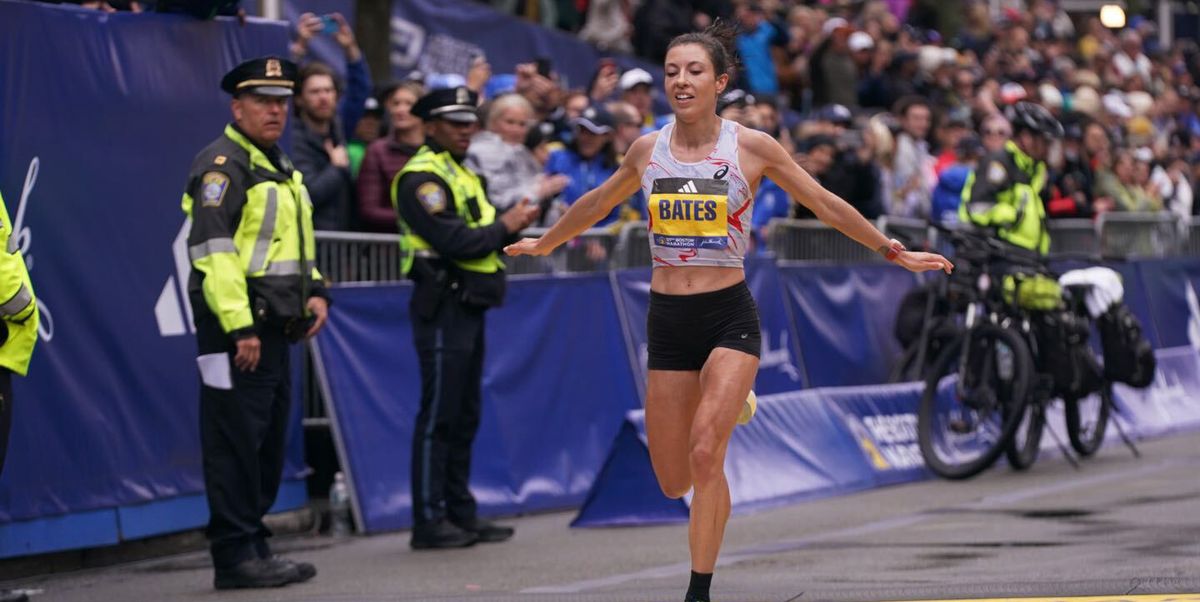
As she’s climbed through the ranks of American marathoning, Emma Bates has employed a trademark strategy.
She starts calmly, then runs her own race, with what her coach Joe Bosshard calls “methodical patience.” Then, quietly—when hardly anyone is watching—she works her way through the competition, finishing with impressive strength (second on a hot day in the 2021 Chicago Marathon, say, or seventh in a then-personal-best 2:23:18 at the 2022 World Championships).
But the Boulder-based 30-year-old arrived in Hopkinton on Monday planning a different approach: Start fast, and stay that way.
More From Runner’s World
The switch resulted in an impressive fifth-place finish in Boston today. She crossed the line in 2:22:10—5:26 pace, a personal best by more than a minute, and just 8 seconds off Shalane Flanagan’s American course record of 2:22:02, set in 2014. She takes home $18,000 in prize money for the feat.
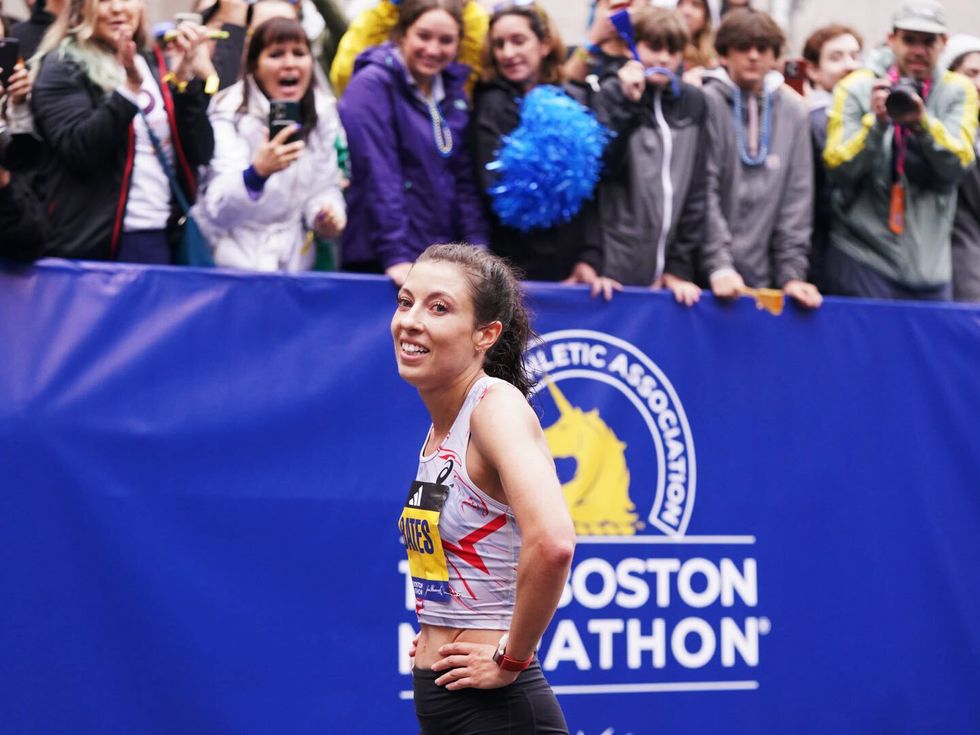
It marks a bit of a homecoming for Bates, who trained with the BAA elite team early in her professional career before moving to Boise, then Boulder. She ran the back half the course frequently, but those years were challenging for her. At the time, “I never saw myself in this position … I didn’t really see a future in my running career, to be at this level,” she said. “I’m very proud of myself for having my second-fastest time out there, especially starting off so slow. It was really good day.”
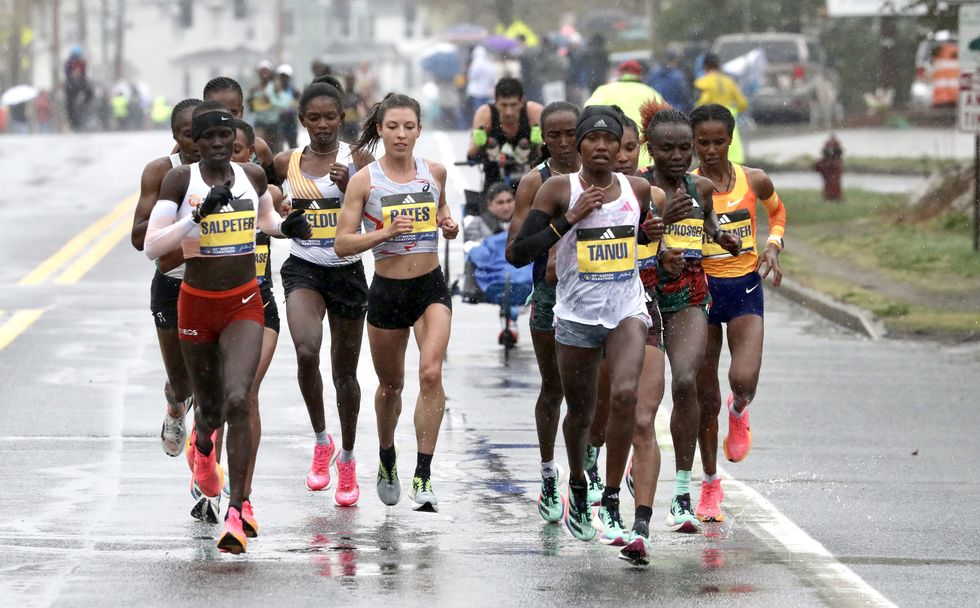
Indeed, the race started conservatively, with a large lead pack covering the first 10K in 34:46, a 5:36 pace. (For a stretch around the 5K mark, serial marathoner Maegan Krifchin led, in a cheetah-print singlet and pink sweatband.)
A 5:08 mile at mile 7, in Framingham, thinned the leaders’ ranks to about eight, with all the Americans left behind. But Bates, who said before the race she believed she was in the best shape of her life, remained determined not to let them escape. By mile 10, she’d worked her way back up.
At times, the surging pace felt like a fartlek, Bates said. But she remained in the lead pack—and often, in the front of it, looking relaxed and composed—for about the next 13 miles. In training, Bosshard had mapped out a course that mimicked Boston’s hills, which Bates believes served her well (and also helped her teammate Scott Fauble, whose 2:09:44 finish made him first American on the men’s side).
“What helped me the most was the downhill, just to be able to make sure the quads could take that beating, and then be able to hit those uphills like we did,” she said.
Although she planned to race aggressively, she didn’t intend to lead—in fact, Bosshard had specifically instructed her not to. But though she kept expecting the effort to feel harder, it never did. At mile 20, she saw Bosshard. “I’m like, ‘I guess I’m in the front,’” she said. His response? To go for it, Bates reported. “It just felt right today,” she said.
Between 22 and 23, the four other leaders—eventual winner Hellen Obiri of Kenya, Ethiopia’s Amane Beriso and Ababel Yeshaneh, and Israel’s Lonah Salpeter—clocked a 5:05 mile that left Bates several strides behind. She finished 32 seconds behind Obiri’s 2:21:38 and 10 seconds behind Yeshaneh, who finished third despite a fall around mile 23.
Behind her, 2020 US Olympic Team Trials champion Aliphine Tuliamuk, 34, finished 11th in 2:24:37—a personal best by more than 2 minutes. Nell Rojas, the first American here in Boston in 2021 and 2022, ran the course about a minute faster than last year. However, this year, her new personal-best 2:24:51 left her in 14th place.
Among other notable Americans, Sara Hall—returning after a lengthy injury—finished 17th in 2:25:48 (and, because she turned 40 two days before the race, first in the masters division). The 2018 Boston champion Des Linden, 39, finished 18th in 2:27:18. Krifchin placed 25th in 2:32:46.
As for Bates, her immediate plan including rehydrating with a Modelo—especially critical, since she uses only gels, no liquids, on the course—then heading to London to cheer on her teammate Dominique Scott in her marathon debut.
She’ll take a week off of training, then look to the future—including, potentially, an American record attempt in the fall—with even more optimism than before. “I feel like I’m in a great place now and a lot of momentum now, leading into the fall races and into the Olympic Trials,” she said.

Contributing Writer
Cindy is a freelance health and fitness writer, author, and podcaster who’s contributed regularly to Runner’s World since 2013. She’s the coauthor of both Breakthrough Women’s Running: Dream Big and Train Smart and Rebound: Train Your Mind to Bounce Back Stronger from Sports Injuries, a book about the psychology of sports injury from Bloomsbury Sport. Cindy specializes in covering injury prevention and recovery, everyday athletes accomplishing extraordinary things, and the active community in her beloved Chicago, where winter forges deep bonds between those brave enough to train through it.
