

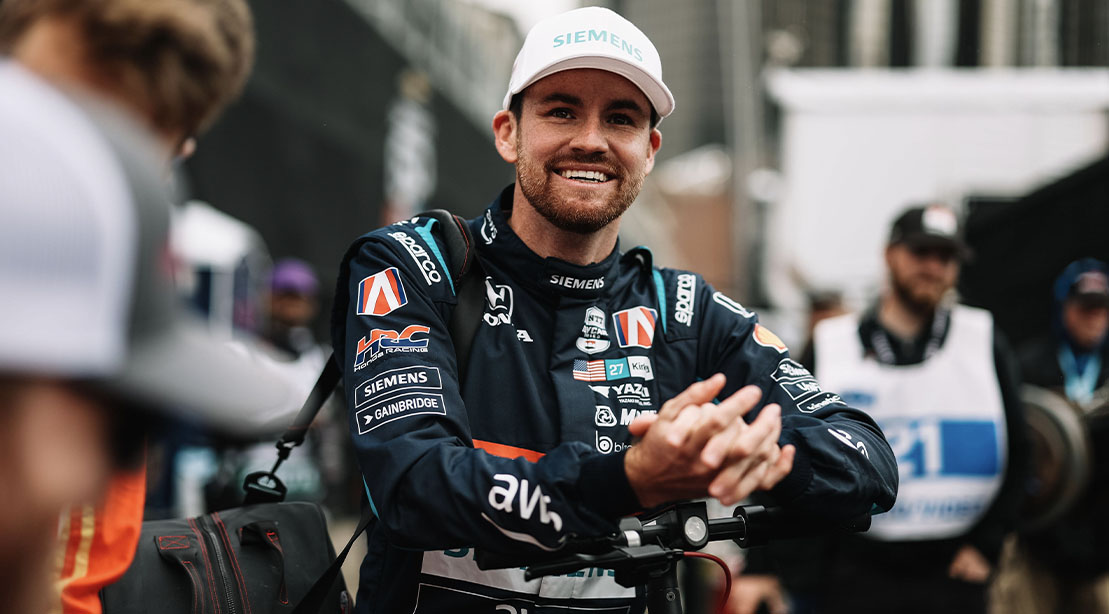
It’s easy to admire IndyCar from the outside: The speed across both street courses and ovals, and the lightning-quick reflexes of the drivers. What most don’t see is the work happening inside the cockpit, which is a battle against heat, gravity, and the limited of physical endurance over the course of two grueling hours.
There’s no power steering, airflow, or break in intensity. In a lot of ways, it’s not just racing—it’s survival. For Kyle Kirkwood, one of the sport’s rising stars, preparation for that kind of suffering doesn’t begin at the track. It starts in the gym, the kitchen, and even weeks in advance of the next race.
Jeff Richter knows this terrain well. As the strength and conditioning coach for 2024 Indy 500 champion Josef Newgarden, he’s seen firsthand how the extreme demands of IndyCar tailor the training for the drivers to be hybrid athletes—ones who can lift, sprint, endure, while remaining mentally sharp in searing heat for hours. His gym, located in Indianapolis, operates without air conditioning by design. When the temps climb into the 90s and the humidity sets in, that’s when the real work begins. “Sweat equity,” Richter says, is more than a mindset—it’s a prerequisite to performing at a high level.
Both Kirkwood and Richter approach the sport from different roles, they share the same mission: to build and maintain elite physical output when cockpit temperatures soar above 120 degrees and every tenth of a second matters. Whether it’s race simulation in a heated room, building cognitive resilience under stress, or managing recovery between back-to-back IndyCar race weekends, they’ve developed systems to push the limits while recovering from them immediately and smartly.
Whether you’re an athlete chasing the next milestone or simply looking to train smarter this summer, there’s plenty to learn from the paddock. M&F caught up with both Kirkwood and Richter to learn how they train to beat the heat while staying sharp when every second matters.
Acclimating to the Heat
When cockpit temps hit 120 degrees and the race stretches past the two-hour mark, IndyCar drivers don’t get a water break, let alone a timeout. That reality shapes how Richter approaches training with Newgarden. His gym doesn’t just tolerate heat—it utlizes it. Located in the heart of Indy, the space is kept deliberately uncooled for training. “We actually do believe in both the physiological and mental adaptations that can take place from undergoing a training environment that has a high degree of heat,” Richter says. “They’re making a physiological adaptation that they’re going to be able to cool their bodies better because they’ve trained in this.”
Drivers do complain at first, but eventually, they become accustomed to the sweat. Just like the conditions they face during a hot race, there’s nothing they can do to change the circumstances. “You do have the mental side as well,” says Richter. The two are interconnected. If you physiologically are acclimated to the heat, you’re gonna have a better mental outlook and they learn to fight.”
Kirkwood agrees with this sentiment. While he’s not training with Richter, the Florida-based Andretti driver builds heat exposure directly into his weekly prep—especially during the summer stretch of the IndyCar calendar. “I’ll do a couple of hours a week in a heat room around 120 degrees, usually staying in that Zone 3 or 4 range,” he says. “Being outside in 95- to 100-degree temperatures with the humidity, that’s almost plenty enough to just train outdoors for a couple of days a week.” For both Richter and Kirkwood, these training sessions are controlled discomfort with the purpose of making the heat a setting they perform in rather than a deterrent when it comes time to race.
Both coach and athlete agree that you can’t half step that level of conditioning, especially when you add in the fact that drivers also have to wear fire-resistant racing suits made of Nomex that are designed with multiple layers of fire-retardant material. “If you’re just training in 60-degree temps every day of the week, it’s not going to be sufficient enough,” says Kirkwood. Whether it’s the weightroom or on a road course, training where you sweat can literally help your body adapt, raise your mental conditioning to make race day feel less like a shock and more like second nature.
Both athlete and coach agree on this: You can’t fake this kind of conditioning. There’s no supplement, sauna session, or cold plunge that can fully prepare you to perform in extreme environments without consistent exposure. “If you train in 60 degrees every day, you’ll melt when it’s 90,” says Kirkwood. “It’s that simple.” Whether it’s in the weightroom or on a road course, training where you sweat—literally—helps your body adapt, raises your mental ceiling, and makes race-day feel less like a shock and more like second nature.
The Importance of Hydration
For IndyCar drivers, the cost of under-fueling is more than just a bad workout. It can also cost them a chance at a podium finish or worse. That’s why hydration is more than just a habit—it’s a strategy. Richter approaches it like a math equation. Drivers can lose up to eight pounds of body weight in sweat during a race, making fluid loss less theoretical and more measurable. “If they drink every drop of their in-car hydration system, that’s about 3.3 pounds of fluid. But if they’re losing eight, there’s a gap,” Richter says. “And once they lose more than two percent of body weight, we know performance drops. That’s when mental errors creep in.”
Richter’s approach to bridging this gap is data driven. There are pre and post-session weigh-ins, electrolyte balance, and pre-race fluid loading. Alcohol is something most, if not all, drivers flag during the season because of its diuretic effects. Even a few casual drinks to celebrate a victory can create a hydration deficit that lingers into preparing for the next race. “These are grown men that have to make grown choices to be able to be at the top of the level,” he says.
Kirkwood takes a similarly disciplined approach that is built around consistency and personalization. Hydration often starts a full week before race day, with a combination of water, electrolytes, and sweat testing. “Everyone’s different,” he says. “I use a electrolyte mix called The Right Stuff to preload early in the week, then I’ll switch to Liquid IV or DripDrop two hours before the race for added glucose.” Kirkwood knows that once the race begins, it’s too late to fix a hydration issue.
Rehydration doesn’t stop when the checkered flag waves. Kirkwood doubles down post-race with tart cherry packets, protein shakes, and electrolyte blends—not just to bounce back, but to stay ahead of the next grueling stint. “Even when you feel like you’re rehydrated, your body is still catching up,” he says. “Eating is also critical. Just as many of the right calories as you can intake post-event is crucial.” For drivers and gym goers alike, the less is the same: hydration isn’t just about the bottle in your hand, it’s about knowing your needs, and building your recovery just as you do your weekly workouts.
How to Stay Sharp When It Gets Hot
The physical toll of IndyCar racing is only half the equation. With speeds reaching past 230 mph, a lapse in focus isn’t just costly— it can be catastrophic. That’s why Richter doesn’t just train the body, he tests the brain under stress. Newgarden has to be able to do more than just hit a power number on a machine, he has to be able to react at a moment’s notice when his heart rate is elevated and his core temperature is spiking. Richter builds in cognitive drills—reaction lights, color-coded catches, and decision-making games—after brutal intervals on the rower or assault bike. This helps simulate the same high-stress, overheated chaos of a race.
Kirkwood backs this approach. From experience, he knows the real cognitive breakdowns come after the physical fatigue sets in. “You’re in a fire suit, pulling four G’s into corners, and you’re trying to stay mentally perfect,” he says. To replicate that pressure, Kirkwood also incorporates mentally taxing drills into his heat training, such as reaction games, hand-eye coordination drills, and screen-based cognitive tasks when his heart rate is in zone four and five. “You’re physically and mentally exhausted, and trying to stay sharp is important. So doing a combination of those things while you’re physically exerted is crucial for a sport like this.”
The pairing of physical strain and mental sharpness creates a hybrid approach that everyday athletes can adapt, too. Whether it’s running circuits in the heat and testing reflexes mid-rep, or tracking how your focus shifts as fatigue builds, mental toughness isn’t built in comfort. It’s forged when your body is working overtime. If you want to own your heat training, you need to be just as precise between the ears as you are under the bar.

Recovery Starts Before the Workout Ends
Waiting until the workout is over to think about recovery usually puts you behind. For the IndyCar athletes Richter trains, recovery begins before the first set even begins. “Training is just the stimulus,” he says. “The training is the deposit that you put into your body’s account. You’re not going to realize the ROI until you take care of yourself by eating a good meal afterwards, by rehydrating yourself, and sleep. That’s when the progress happens.” He helps lay a foundation of the recovery protocol should be just as dialed-in as the training plan.
This is also a week to week reality for Kirkwood. After the checkered flag, he’s dialed in on recalibrating his body. That begins with structured eating, rest, and sticking to his routine that helps him bounce back for the next event. “You pretty much beat yourself down to nothing,” he says. “Then you’re right back into another event the following weekend.” For IndyCar athletes, the stress of a race weekend taxes every system of their body in a way that the regular everyday person will never experience. A driver’s recovery plan has to match the flight or fight state stress that is placed on each race day. “They got to be able to recover because in training, if we’re just going focusing on maintaining what we have,” Richter says. “Unfortunately, when they get in the race car, they’re compromised before it starts.”
For the rest of us, the lesson is simple: the recovery has to match your effort. Don’t just chase intensity—support it. Whether you’re pushing through an outdoor HIIT workout in 95-degree heat or grinding reps in the gym, what you do immediately after the session will either help build momentum or burn you out. In the heat, recovery isn’t options—it’s necessary.
Follow Kyle Kirkwood on Instagram @kyle_kirkwood
Follow Jeff Richter on Instagram @richterstrength
