

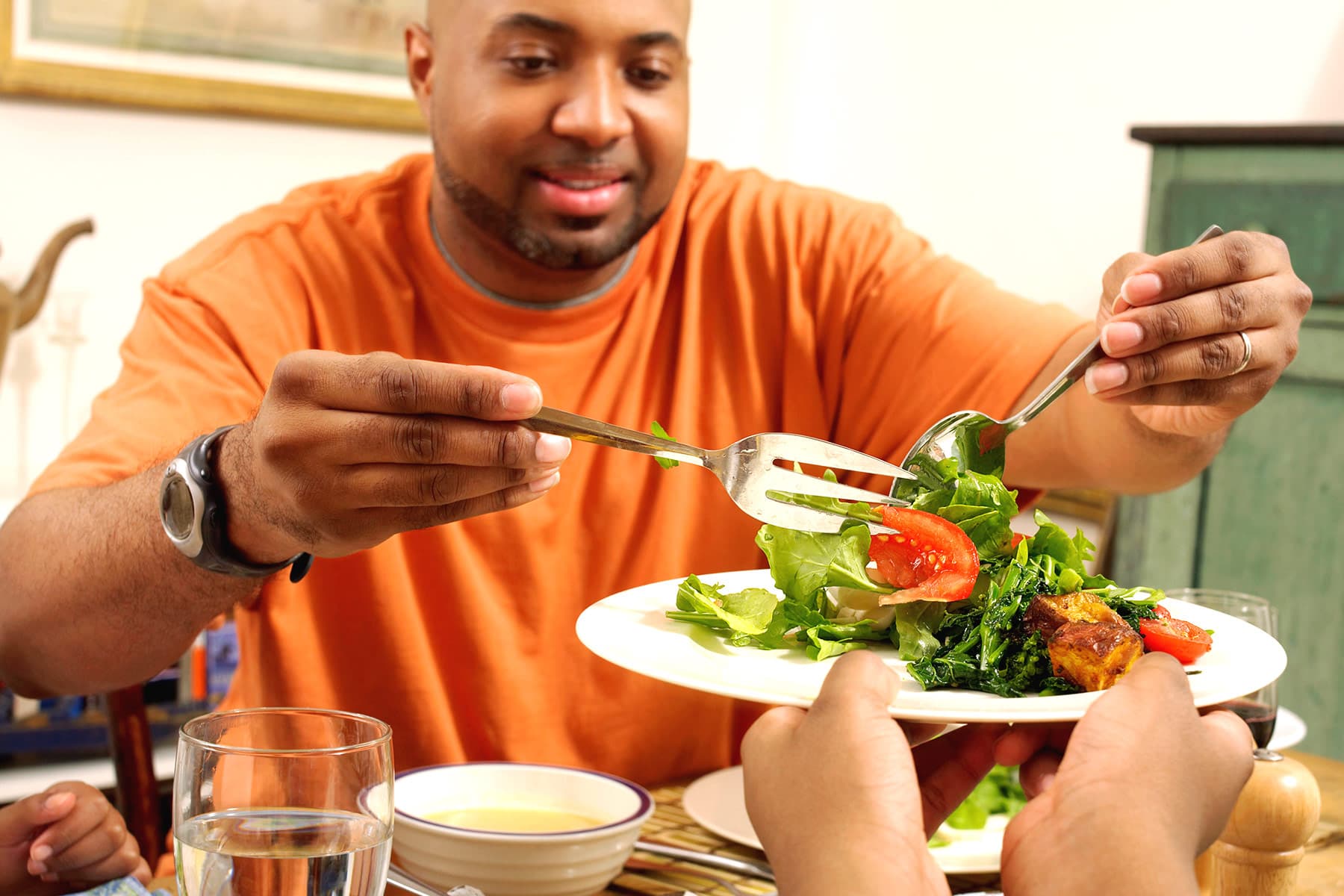
April 19, 2023 — Deborah Schranz, a 34-year-old librarian in Teaneck, NJ, has dinner with her family — including her 3- and 6-year-old sons — several nights a week, as well as Saturday lunch. Based on her Orthodox Jewish practice, Sabbath lunch is also a formal meal. Friday night and Saturday lunch meals tend to be longer than ordinary weeknight meals.
“I start Sabbath lunch off with a salad,” Schranz said. “It helps my children to eat more vegetables when they sit down hungry and the first food item they encounter is a vegetable.”
The longer Friday night and Sabbath meals also afford the children some extra time to eat healthier foods. A new study suggests that even slightly longer meals can promote healthy eating in kids.
A team of German scientists studied 50 parent-child duos who were invited to a video laboratory for two free evening meals, offered under different conditions. The children ranged from 6 to 11 years old. Participants were aware that they were being filmed, but not that the researchers were going to measure how much fruit and vegetables they ate.
Both meals consisted of cold cuts (cheese and meat) as well as bite-sized pieces of fruits and vegetables. At the end of the meal, participants were offered desserts of chocolate pudding or fruit yogurt and cookies. Parents had filled out questionnaires prior to participation, so all foods were selected based on the child’s preferences.
One meal was defined as a “regular family mealtime duration” of 20 minutes, while the other meal lasted 10 minutes longer (30 minutes). Which meal condition would be completed first was determined randomly.
The researchers found that the children ate significantly more pieces of fruits and vegetables when the family meals lasted 10 minutes longer than usual, without a similar increase in other, less-healthy foods.
The Cradle of Eating Behavior
Senior investigator Jutta Mata, PhD, professor of health psychology at the University Mannheim in Germany, said she and her colleagues started the study because about 8 years ago, they asked themselves “why psychological interventions to change nutrition and eating behaviors were not as successful as hoped for.”
One possible explanation they came up with was that “eating is often seen as the result of individual behavior — a person’s individual knowledge, motivation, or willpower determine what and how much they eat — yet eating is a social behavior,” she said. “Most people regularly eat in company. In fact, the word ‘companion’ stems from the Latin words ‘with bread’ — the company you’re ‘breaking bread’ with — and eating has been shown to be the bonding kit between people.”
She said eating together is “particularly important for children because not only are parents the nutritional ‘gatekeepers’ of their children (they determine what the child eats), but they frequently eat together with their children.”
In fact, family meals have been called the “cradle of eating behavior,” she said, adding that some anthropologists have even called such joint meals the “cradle of civilization.”
Mata’s group already looked at studies that showed family meals were associated with healthier nutrition in children. They also identified mealtime practices (including longer mealtimes) that, when used during family meals, were associated with healthier nutrition in kids.
But those studies were based on parents’ reporting the information. The researchers wanted to directly observe the family meals to test specifically whether the duration of the meal could contribute to kids eating more fruits and vegetables.
Creative Ways to Increase Healthy Eating in Kids
The current study showed that children ate seven more pieces of fruits and vegetables, which translates to about one portion per meal, during the longer mealtimes.
“This outcome has practical importance for public health because 1 additional daily portion reduces the risk of cardiometabolic disease by 6{1293bd4ef25ca86a622f6d9512ec3310653175851a143bae989351f0db04aea4} to 7{1293bd4ef25ca86a622f6d9512ec3310653175851a143bae989351f0db04aea4},” the authors wrote.
Longer family meals were also tied with a slower eating rate, increased sense of fullness, and a lower risk of obesity — “possibly because increases in satiety played a role in reduced snacking between meals.”
Beyond the increased length of the meal, the researchers think that cutting up the fruits and vegetables might have helped, although that still “needs to be tested by empirical research,” Mata said.
“One way to think about eating healthy is as the result of opportunities to do so,” she said. “In the case of our study, we provided the time — extra time in the prolonged condition; the food — fruits and vegetables that the child liked were on the table; and an easy-to-eat format: fruits and vegetables cut into bite-size pieces.”
The authors suggested that families can establish new routines with longer mealtimes, including focusing on the mealtime most likely to succeed (not breakfast, when everyone is in a rush); accommodating children’s preferences (for example, playing background music that they have chosen); and setting “transparent rules” (for example, everyone stays at the table for a certain length of time).
“These strategies may not always work,” the authors said. “Habit change takes effort.”
Schranz has “transparent rules” to introduce healthy eating into her children’s diets. For example, “the children have to try a piece of everything that I serve,” she said. “They don’t have to like it, and they don’t have to finish it if they don’t like it, but they do have to try everything that comes to the table.” That includes fruits and vegetables.
An Opportunity for Positive Parenting
“This study was elegantly simple and creates a potential low-cost solution to a common problem — how to get your kid to eat more fruits and veggies,” said Ellen Rome, MD, MPH, head of the Center for Adolescent Medicine at Cleveland Clinic Children’s Hospital and professor of pediatrics at Cleveland Clinic Lerner College of Medicine.
“The key finding is not surprising and hopefully is reproducible at home,” Rome said. “Even 10 more minutes of a non-rushed meal allowed a few more bites of available food on their plates in, which can help a kid feel more full, cutting down on the need to snack as much later on likely more energy-dense foods.”
An important takeaway “is that family mealtimes are a chance to do positive parenting and increase the opportunity for your child to get the right foods in, in the right balance,” Rome said.
“It is also a time to role model how to have a conversation, how to check in, how to share the memorable events of the day, both sad and glad, and how to laugh together,” she said. “Worthy goals all around!”
