

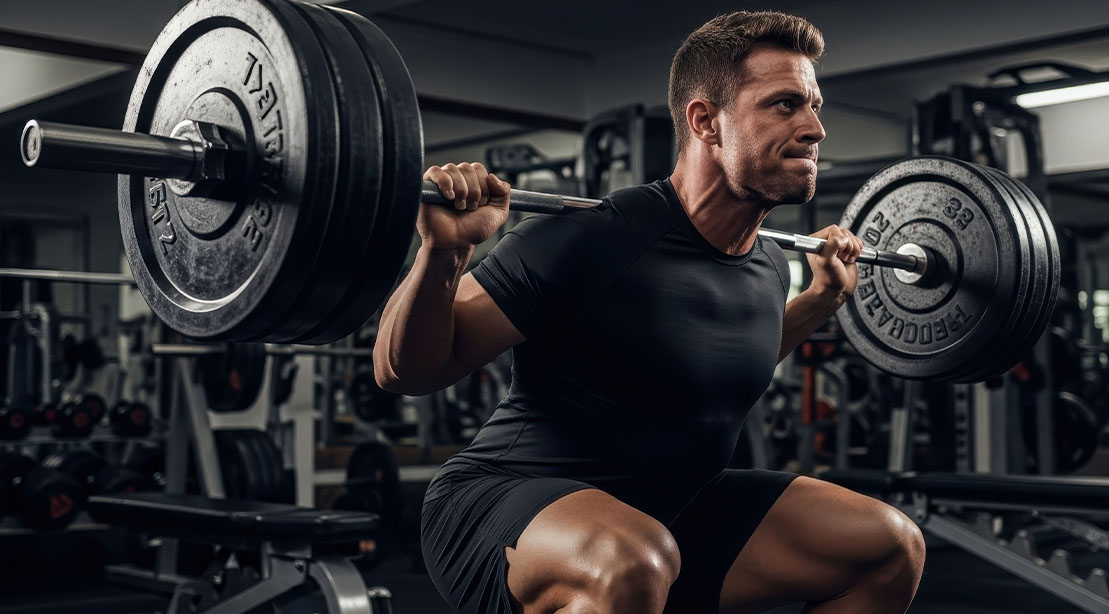
Admit it at one time, you judged someone else’s squat depth.
Are you on the “ass-to-grass, or it doesn’t count” side, or are you a “parallel is good” member? But somewhere in the middle are everyone else, wondering how low they need to squat to build muscle.
Why does it matter? Because squat depth changes the game.
Go shallower, and you can use more load. Go deeper and recruit more muscle, especially the glutes and adductors. But depth doesn’t mean a thing if you lose position, dump tension, or force your body into a range it can’t handle.
Here, I’m cutting through the squat-depth dogma to focus on what matters for muscle growth. Here I’ll break down, with some help from Greg Nuckols, powerlifting coach, researcher, and writer, what different depths do, what the research says about quads vs. glutes, and common mistakes, such as forcing a range you don’t own.
First up, why squat depth matters for muscle.
Why Squat Depth Matters for Muscles
No matter your squat depth, these are the factors that matter for muscle growth.
Range of Motion Drives the Stimulus
Squat depth changes how much work your muscles do. The deeper you squat, the farther the bar travels, increasing time under tension and total mechanical work per rep. That added range recruits and challenges more muscle fibers.
Depth Changes Muscle Emphasis
Squat depth determines which muscles do the work. Shallower squats allow heavier loads but involve less knee flexion, resulting in less direct quad stimulus. Around parallel (roughly 90 degrees of knee flexion), quad involvement increases. Go deeper, and the glutes and adductors come to the party, sharing the load and increasing overall lower-body development.
Stretch Under Load Is Gold
A powerful trigger for muscle growth is loading a muscle while it’s lengthened. Deeper squats increase hip and knee flexion, placing the quads, glutes, and adductors under greater stretch. This loaded stretch is a key signal for hypertrophy, which is why deeper squats often lead to enhanced leg strength and muscle.
Main Takeaway: The deeper you can squat with control, the more muscle you can build. But that only holds if you maintain proper positioning, tension, and joint control.
Which Muscles Work at Different Squat Depths?
Here are the three main squat depths and what happens at each.
Above Parallel
Muscles Worked: Overload and strength in limited ranges to break plateaus and sticking points
Partial squats shorten the range of motion, allowing you to use more weight. But the trade-off is reduced knee flexion and less total muscle involvement—especially for the quads. You’re doing less work per rep, spending less time under tension, and skipping the phase where much of the muscle growth occurs.
That doesn’t make partial squats bad. “They can help with overload and build strength in specific ranges,” says Nuckols. “I started doing many of my rep maxes above parallel, and the experiment has paid off in spades because my rep maxes still track very well with my 1RM squat.”
Parallel Squats
Muscles Worked: Teardrop quads
Squatting to parallel gives you solid quad engagement and strikes a strong middle ground, letting you still go heavy while getting a decent growth stimulus. Research suggests (more on that below) that once you reach about 90–100° of knee flexion, you’re close to maximizing quad engagement. That makes parallel squats a reliable way to build size.
Below Parallel & Ass To Grass
Muscles Worked: More glute & dductor involvement
Go deeper, and the game changes.
As you move past parallel, you increase both knee and hip flexion. That means:
- More glute involvement
- More adductor contribution
- Greater stretch under load
While quad growth may not increase beyond parallel, glute and adductor hypertrophy often benefit from the added depth. You’re training more muscle over a longer range, which can lead to more complete lower-body development. But wait, there’s more. “The full squat is the safest for the knees,” explains Nuckols. “With increased hamstring activation, you counter the stress on your knees.”
Main takeaway: Squat depth isn’t a matter of picking sides, but one that aligns with your goal while owning the range of motion.
Science Backed Pros and Cons of Squat Depth
There’s bro science, and then there’s actual science. When you strip away opinions and half-truths, a clear pattern emerges: squat depth influences muscle growth—but not always as people assume.
Quadriceps Growth Has a Cap
Studies by Bloomquist and McMahon compared shallow squats (around 50–60 degrees of knee flexion) to deeper squats (100–120 degrees or more ), consistently finding greater quadriceps hypertrophy with deeper squats—but only up to a point. Once lifters reached roughly 90–100 degrees of knee flexion, quad growth leveled off.
What does that mean for you: If you’re squatting above parallel, you’re likely leaving quad gains on the table, but if you’re squatting parallel or slightly below, your quads will thank you.
Glutes and Adductors Benefit From Going Deeper
The deeper you go, the harder your glutes and adductors have to work for you to squat out of the hole. That’s where deeper squats stand apart from partial and parallel squats. Research comparing half squats (~90 degrees) to full squats (~140 degrees) found that those who squatted deeper experienced greater engagement in glute and adductor muscles.
That’s a big deal because most squat-depth debates focus only on quads, yet the research shows that quads don’t need an extended ROM to grow, while the glutes and adductors love it. But be careful. Those deep squats will have you walking funny the next day.
Do Squats Build Hamstrings?
Across multiple studies, one thing stays consistent: Squats are not an effective hamstring builder. Increasing squat depth doesn’t change that fact because the hamstrings don’t move through a large ROM during a squat—they’re more stabilizers than prime movers.
Main takeaway: Going deeper has a neutral-to-positive effect on muscle growth—as long as you maintain control and tension. Squats have never been a hamstring exercise. Anyone who tells you otherwise is not telling the truth.
What Limits Your Squat Depth?
Depth only works if you can control it because there’s no extra muscle points for going deeper, but then your squat breaks down.
Your ability to squat deep is determined by:
- Ankle mobility
- Hip structure and mobility
- Thoracic spine positioning
If any of these are limited, your body will find a way to compensate—and that’s where problems start.
- Limited ankle mobility: Excessive forward lean
- Tight hip flexors: Restricted depth and lower back discomfort
- No upper back tension: You’ll turn the squat into a good morning
Then, squatting deeper isn’t the solution, but improving your mobility while squatting through a full range of motion without compensation is. Squat depth isn’t something you force, but something you earn.
That means:
- Improving mobility over time
- Adjusting stance to fit your structure
- Using a range of motion, you can control
Main takeaway: The best squat depth is the deepest position you can maintain without compensation.
The ‘Muscle Sweet Spot’ for Squats
After all the debate, research, and analysis, the answer comes down to something simple: The best squat depth for muscle growth is the deepest position you can control with tension.
For most of us, no matter the squat variation and stance, that means:
- Slightly below parallel
- Stable spine
- Controlled eccentric
That’s the muscle sweet spot where you’re getting enough ROM to drive growth without getting into ATG debate, or a 90-degree knee angle is king. The middle ground between the two is where the gains live.
Common Squat Depth Mistakes (and Fixes)
You know by now that squat depth only matters if you have the mobility and control to get there. But what goes wrong if depth is forced or you stop short? Here’s the lowdown.
Cutting Depth Short
Unless you are performing a partial squat variation like the Pin or quarter squat to boost performance, loading the bar for no good reason and stopping high might boost your numbers. Still, it shortchanges your quads and limits total muscle stimulus.
Fix:
- Drop the weight
- Aim for at least parallel
- Use a consistent depth marker like a box, camera, or training partner
- Prioritize range over load until you can control both
Chasing Depth Without Consequence
Forcing “ass to grass” without the mobility or strength to own it leads to compensation—hips shifting, knees collapsing, or your lower back rounding. It might look cool on Instagram, but your body won’t think so.
Fix:
- Squat only as deep as you can maintain a neutral spine
- Use goblet squats to groove depth and positioning
- Elevate your heels with plates or lifting shoes to improve mechanics
Relaxing at the Bottom
You get all the way to the bottom without compensations, but then you lose tension, and it turns a powerful stretch into a passive position—and kills hypertrophy.
Fix:
- Stay tight through your core and upper back
- Control the eccentric
- Think: “sit into tension,” not “drop into depth.”
- Pause briefly without relaxing to reinforce control
Losing Tension
Squats are all about creating tension in the right places: feet, upper back, and core, so that the prime movers can go to work. But when that doesn’t happen, issues like knees caving in, chest collapsing, and hips shooting up shift tension away from the lower body.
Fix:
- Keep your foot rooted and knees tracking over your toes
- Pull the bar into your upper back and keep your chest “proud” with your ribs down
- Brace before every rep as if you’re about to take a punch
Does Squatting Deeper Build More Muscle?
Deeper squats can build more muscle, but only when your form backs it up. Going below parallel places the quads, glutes, and adductors under greater stretch—one of the key drivers of hypertrophy. Living in that zone, away from the depth debate, is a good thing.
But depth only matters if you have the strength and mobility to own the bottom position. If you’re losing position, relaxing at the bottom, or forcing a range of motion your body cannot handle, the stimulus shifts away from the target muscles and into compensation.
The goal is not to squat as deeply as possible, but to squat as deeply as you can while maintaining tension, control, and proper positioning. That’s where the muscle-building magic happens. Squat depth is a tool, not a rule. Use it to match your structure, mobility, and goals—not someone else’s standard.
Then let the gains begin.
