

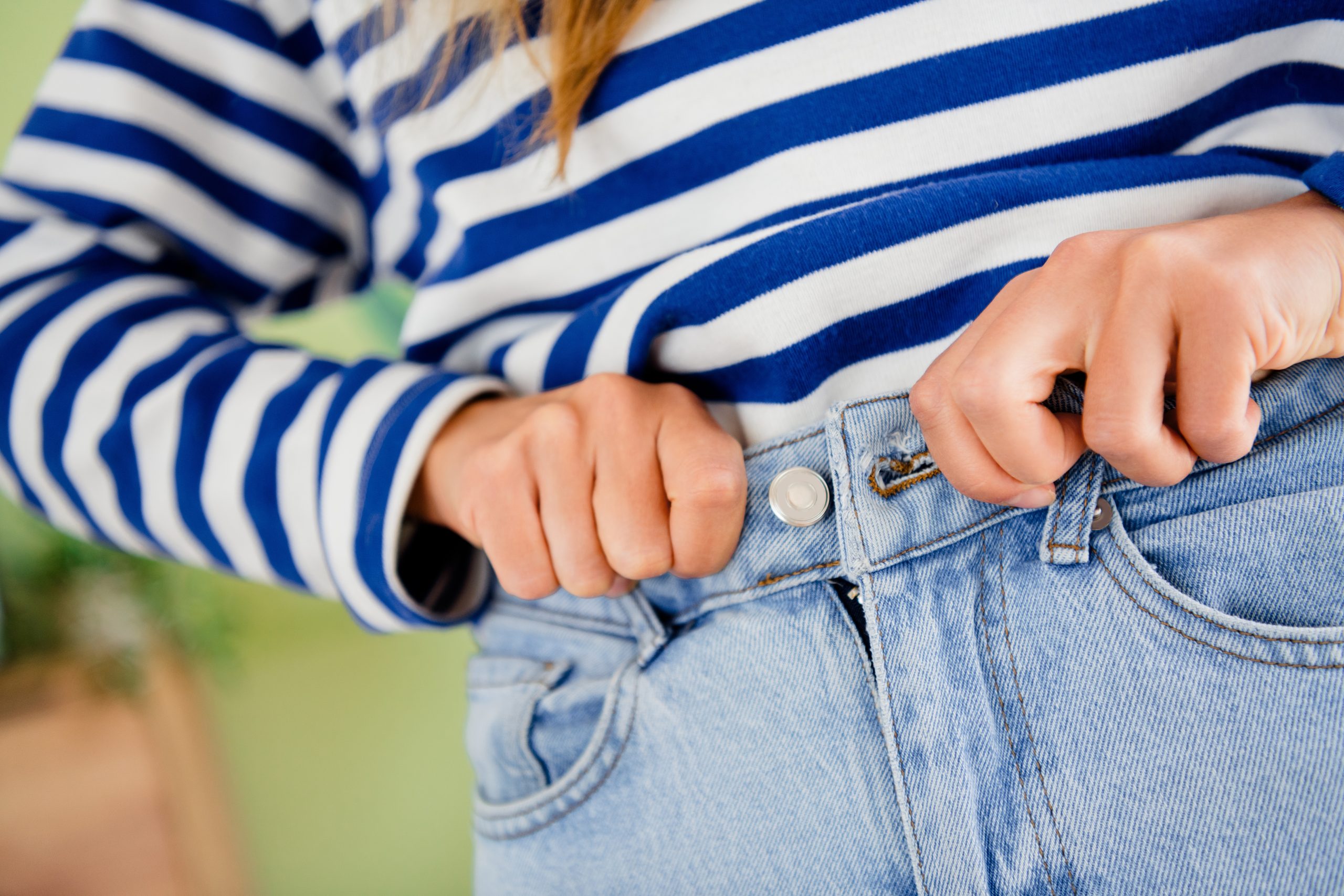

If you ask the average woman going through perimenopause what she is most concerned about, you’ll probably find a few things near the top of the list: hot flashes, for sure. Vaginal dryness, definitely. Mood swings, irritability, and incandescent rage at the incompetence of men? Highly likely. You’ll even hear a lot about chin hairs and good grief, why are we afflicted with them, along with all of the other perimenopause nonsense.
But the thing that tends to be at the very top of the list is actually none of these things. The thing many women in perimenopause are most distressed about is something known colloquially as “meno belly.”
What People Mean When They Talk About “Meno Belly”
When people talk about meno belly, they are frequently referring to two distinct physical experiences that are often lumped into one.
The first is general weight gain during perimenopause. Often, women notice that they have gained weight in midlife and attribute this to perimenopause because they don’t see any other obvious causes.
The second is the tendency for women in perimenopause to experience an increase in abdominal fat. This type of weight gain is more specific because it is located in the belly and it’s a different type of fat, known as visceral fat, which both feels and looks different than how they might have carried weight in their body before.
While these two experiences can sometimes happen at the same time, they are different from one another — and only one is marginally linked to perimenopause.
Weight Gain Is Not Automatically a Problem to Fix
Before we get into the differences between these two types of weight gain in perimenopause, it’s important to be really clear about the fact that gaining weight isn’t necessarily a problem you need to fix.
Our bodies change over the course of our lives for all sorts of reasons. Gaining weight is not inherently a bad thing in the same way that losing weight is not inherently a good thing.
Women worry about weight gain during perimenopause because we’ve been trained to worry about weight gain for our entire lives.
Diet culture has told us that gaining weight is bad, that being fat is something we should avoid, and that being in a larger body is fundamentally unhealthy.
The truth is considerably more nuanced than that.
Both gaining and losing weight can be positive or negative depending on the circumstances that led to it. Being fat isn’t a character flaw or an indication of laziness. Fat is simply a physical descriptor and shouldn’t have a negative connotation.
And lastly, the physical shape of someone’s body doesn’t indicate their relative health — or lack of health. Someone can be in a larger body and be in fantastic physical health, while someone in a thin body might be very ill. You simply cannot know just by looking at a body.
The Difference Between Weight Gain and Visceral Fat
One more important piece to this conversation is that while fat itself isn’t necessarily bad, there are certain types of fat that are more frequently linked to health outcomes we want to avoid.
This is why the conversation is so nuanced. You can both say that all bodies are good bodies and that good health can exist in all shapes and sizes while also acknowledging that visceral fat is associated with certain health risks.
It’s just not as simple as saying, “You must lose weight in order to be healthy,” because that is factually inaccurate and lacks the subtlety this conversation requires.
Is Perimenopause Actually Causing Weight Gain?
Let’s get back to those two distinct versions of what influencers refer to as meno belly.
The first is the idea that women gain weight because of perimenopause. What typically happens is that women notice their clothes fitting a little tighter and think, “Where did this weight come from?” Because they can’t identify an obvious cause, hormones often get blamed.
And to be fair, women’s health is historically understudied and underfunded, which has led to a lot of unanswered questions about perimenopause. That uncertainty has created the belief that every strange thing we experience in midlife must be hormonal.
But according to current research, the symptoms of perimenopause that are directly tied to hormones are things like hot flashes, night sweats, vaginal dryness, and discomfort during sex. Achy joints, mood swings, irritability, brain fog, decreases in muscle mass, and thinning hair? A lot of that is simply aging.
Both women and men tend to gain weight as they get older, and it largely has to do with lifestyle factors — not hormones.
As we age, we often move a little less and eat a little more.
The Midlife Lifestyle Shift Nobody Talks About
Oftentimes, people insist that nothing has changed lifestyle-wise. But the truth is that things tend to shift slowly over time.
Maybe you had children. Maybe your career became more demanding. Maybe you took on caregiving responsibilities or moved to a new city. Life gradually asks for more of your time and energy.
That often means we move our bodies less or spend more time sitting than we did when we were younger.
Even if calorie intake doesn’t radically change, decreased physical activity changes how much energy we burn — and that can contribute to weight gain.
This is true across genders. Humans gain weight when physical activity decreases and calorie consumption stays the same or increases.
Even menopause hormone therapy (MHT) shows mixed results when it comes to weight loss. Some women lose weight after starting MHT, but many do not. In some cases, improved sleep from reduced hot flashes simply gives women more energy to move their bodies again.
All of this suggests that general weight gain is more closely related to aging and lifestyle shifts than to perimenopause itself.
What Is Visceral Fat — and Why Does It Matter?
The second type of meno belly is more complicated.
Before perimenopause, women typically carry more fat in their hips and thighs. This is largely subcutaneous fat, which sits just beneath the skin and serves protective functions like cushioning organs and storing energy.
But during perimenopause, things begin to shift.
As estrogen declines, we don’t build muscle as easily. Combined with lower activity levels, stress, and changes in eating patterns, researchers have noticed that women begin storing more visceral fat instead of subcutaneous fat.
Unlike subcutaneous fat, visceral fat sits deeper in the abdominal cavity and wraps around vital organs. It’s metabolically active and produces hormones of its own, which complicates how it interacts with the body.
Visceral fat is also associated with increased risk for conditions like type 2 diabetes, cardiovascular disease, breast cancer, and Alzheimer’s disease.
The Menopause Metabolism “Hackers” Are Full of It
Now, it’s important to note that the decline in estrogen and progesterone is not the direct cause of belly fat — but hormonal fluctuations likely contribute to changes in fat distribution.
Researchers still don’t fully understand why this happens.
In her substack, The Vajenda, Dr. Jen Gunter explains all of the complexity and conundrums surrounding meno belly, including why this is less about menopause and more about age.
“There is no weight gain over the menopause transition. What we do see is a shift in how fat is deposited and many women start to put their fat on around their waist instead of around their hips. So while you are not gaining weight, your body shape is changing and your clothes may not fit as they once did. So why does this happen? No one really knows. There are some theories that high levels of the hormone FSH may be involved or it may be from the drop in estradiol. Or both. Estradiol is involved with the control of food intake, energy expenditure, regulation of fat storage, and metabolism. Although interestingly, metabolism does not change significantly in menopause.”
And importantly, even MHT does not appear to prevent this redistribution of fat.
As Dr. Gunter bluntly puts it, anyone claiming they can help you “hack” your menopausal metabolism is “full of shit.” Honestly? She’s right.
What Actually Helps With “Meno Belly”
So if the solution isn’t detox tea, supplements, or expensive influencer protocols, what does help?
Most of the strategies that support both general health and reductions in visceral fat are rooted in the boring basics — the things that consistently improve overall health and resilience.
Prioritize Sleep
Aim for 7–8 hours of sleep whenever possible. Easier said than done during perimenopause, of course, but sleep lays the foundation for pretty much everything else.
Move Your Body More
You don’t need to start with punishing workouts. Start small. Build consistency first. Once movement becomes habitual, you can increase intensity if you want.
Strength Train Regularly
Strength training supports muscle mass, bone density, metabolism, resilience, and overall physical function as you age. It also helps your body use fat for energy while preserving muscle.
Focus on Nutrient-Dense Foods
This is not a call for restriction. Please eat the brownies and cookies and foods that bring you joy. But also make sure you’re getting enough fiber, protein, complex carbs, fruits, and vegetables.
Many people don’t eat enough fiber — aim for 25-30g per day. And protein becomes increasingly important as you age if you want to support muscle maintenance and growth.
Understand That Fat Loss Requires a Calorie Deficit
If fat loss is important to you, a temporary calorie deficit is required. But it should not be permanent, and ideally should be done with professional support so it’s sustainable and doesn’t wreck your relationship with food.
Reduce Chronic Stress
Chronic stress can impact insulin resistance, inflammation, appetite regulation, and overall metabolic health. High stress often drives cravings for salty and sugary foods — not because those foods are “bad,” but because the body is looking for quick energy and comfort.
Stress itself isn’t the enemy. But when stress is driving the bus all the time, the body eventually starts waving red flags.
You Do Not Need to Fear Your Changing Body
So should you be afraid of meno belly? No.
Changes in your body are normal, especially during chaotic and demanding phases of life. And the things that benefit us the most are often the least sexy solutions imaginable: sleep, movement, strength training, nutrition, and stress reduction.
Those boring basics are still the foundation of health — regardless of what your belly looks like. —Naomi
