

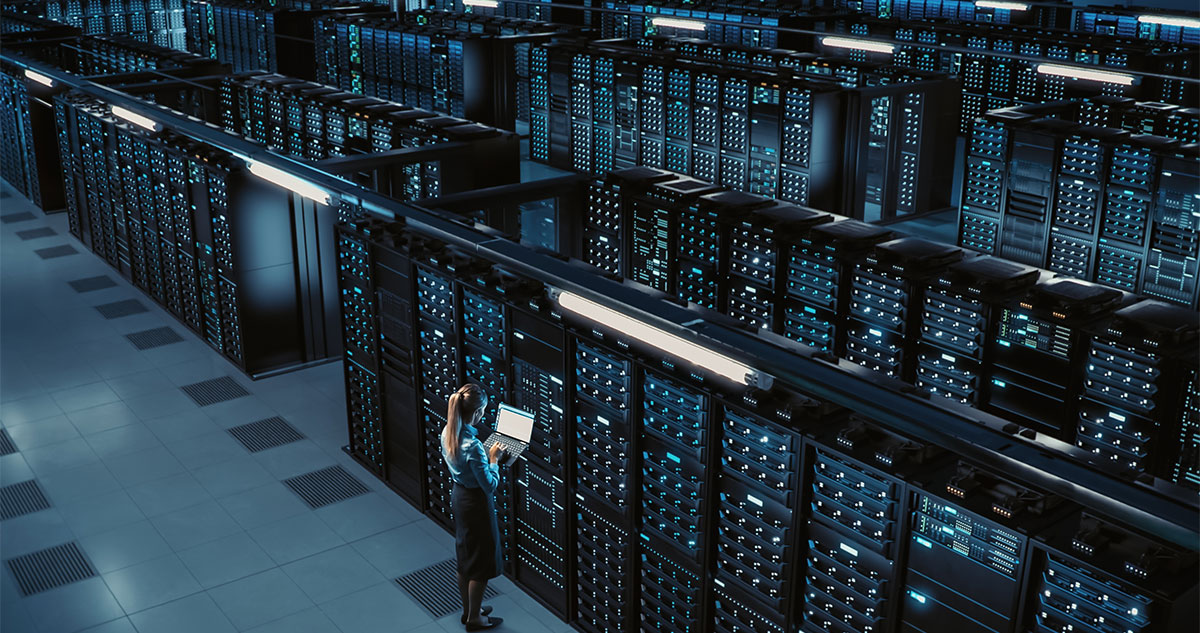
Behind every AI assistant, generated image and predictive model is a physical engine driving it all: the data center. These vast, energy-hungry sites have become the backbone of artificial intelligence, housing the chips, power and storage needed to train and run advanced systems.
Microsoft, Amazon, Google, Meta and OpenAI are now pouring billions into these futuristic centers, all competing to control the foundation of next-generation computing.
Let’s examine where these tech giants stand in the race to build AI data centers.
Amazon
Amazon may not be the first name that springs to mind when it comes to cutting-edge AI interfaces or conversational chatbots, but its role in the AI revolution runs far deeper than many realize. Through Amazon Web Services (AWS), the company is one of the world’s largest providers of cloud infrastructure, powering the backend of countless AI applications. It is investing tens of billions of dollars in data centers, custom silicon chips and high-performance computing to meet the surging global demand for AI workloads.
Amazon Web Services is spearheading Project Rainier, an ambitious AI data center initiative designed to meet the soaring demands of cutting-edge AI workloads. With over $100 billion planned for investment in 2025 alone, Project Rainier is set to supercharge advanced AI models like Anthropic’s Claude by dramatically boosting computational power.
The project spans multiple U.S. locations, including a massive campus in Indiana made up of 30 data centers that together consume more than 2.2 gigawatts of energy—enough to power a small city. What’s powering this network is hundreds of thousands of Trainium2 chips, all linked up with Amazon’s cutting-edge NeuronLink and EFAv3 high-speed networking tech.
Anthropic, Amazon’s $8 billion AI partner, is the primary user of Project Rainier’s resources. They’re using the platform to train their Claude models, which demand five times the computing power of their previous setups.
Microsoft & OpenAI
Microsoft is gearing up for one of the biggest infrastructure investments in tech history, planning to pour $80 billion into AI development in 2025 alone. At the heart of this push is the $500 billion Stargate Project, a flagship initiative built in partnership with OpenAI, Oracle and SoftBank.
What sets Stargate apart is its use of closed-loop liquid-cooled superclusters, specially designed to handle the massive computing power needed for cutting-edge AI models. These custom-built clusters are fine-tuned to support intense AI workloads, powering everything from training to real-time inference for the next generation of large language models.
Construction is now well underway, with major sites in Texas and Ohio progressing and others in the pipeline. If fully built out, Stargate could become one of the largest AI training complexes on the planet, with a footprint spanning millions of square feet and consuming gigawatts of electricity. Although current AI systems like GPT-4 rely on Azure’s existing infrastructure, Stargate is expected to take over once operational, offering the scale needed for the next leap in model complexity.
Initiatives such as Stargate matter not only to tech giants like Google and OpenAI but to the broader advancement of the United States in AI. With their enormous potential, projects of this scale could propel the U.S. to the very top of AI innovation worldwide. About 16 U.S. states have expressed interest in hosting data centers for Microsoft and OpenAI’s Stargate project.
Instead of chasing GPUs on the open market, Google has been building its own. Its custom Tensor Processing Units (TPUs), now in their fifth generation, are at the heart of the company’s data center strategy. Combined with hyperscale, AI-first facilities fine-tuned at every level, Google’s infrastructure isn’t just vast, it’s purpose-built. That vertical integration gives it something rivals don’t have: full control from chip to software.
Google has already rolled out AI-optimized data centers across the U.S., Europe and Asia. Recent expansions, including some in the UK, are being designed specifically for workloads like its Gemini models—a huge language system that requires far more power than your average cloud task.
Google’s builds are among the greenest in the industry. According to Google’s latest environmental report, nearly 96% of the company’s electricity consumption in 2024 was attributed to its data centers—a figure that’s rapidly increasing. The company’s electricity use more than doubled from 14.4 million megawatt-hours in 2020 to 30.8 million in 2024. Google customizes its cooling systems at each campus by assessing local energy and water availability, prioritizing carbon-free power and eco-friendly water alternatives to limit climate impact today and tomorrow.
Meta’s approach to AI infrastructure is uniquely shaped by its focus on building the metaverse and highly interactive AI experiences. Unlike companies primarily training large language models, Meta’s AI workloads often involve massive real-time data streams—think virtual reality environments and personalized content recommendations—which require highly distributed computing power.
To support this, Meta has developed its own specialized data centers known as Tents. These modular, flexible structures are designed for rapid deployment and scalability, allowing Meta to expand AI capacity where it’s needed most quickly.
Meta’s Ohio facility, Prometheus, is scheduled to go online in 2026 as one of the largest AI training hubs globally, featuring server tents and targeting a power draw exceeding 1 gigawatt. Meanwhile, Meta’s Hyperion project in Louisiana is in early stages but promises to be even bigger, expected to consume up to 2 gigawatts by 2030, with room to grow to 5. Spanning over 4 million square feet and nearly 3 square miles, Hyperion’s scale will rival many small cities.
Where do these companies stand in the AI data center race?
In the race to build the future of AI infrastructure, Microsoft and Amazon are clearly leading, not just in investment but in ambition. Amazon has committed over $100 billion through Project Rainier, while Microsoft, backing OpenAI, is advancing with its massive and unparalleled $500 billion Stargate initiative. This isn’t just capital deployment, it’s a bid to control the operating core of AI innovation. Both benefit from an unparalleled level of expansion and technological horsepower rooted in data and infrastructure capabilities that were established long before the AI era.
But winning this race is not just about spending. Google, with its vertically integrated stack, from custom TPUs to hyperscale, and environmentally-optimized facilities, may actually operate more AI compute than any other company, even if it remains quieter in the headlines. Meta, while investing less than its peers and targeting specific market gaps, offers unique strengths through its modular “Tents” and focus on real-time AI tailored to immersive and personalized experiences.
The AI data center race is not just about who gets there first or makes the most noise. It is about who can build for what comes next with the clearest eye. The true winners will be those who can scale wisely, act quickly, and do more than just pump in more cash.
Photo by Gorodenkoff/Shutterstock
