

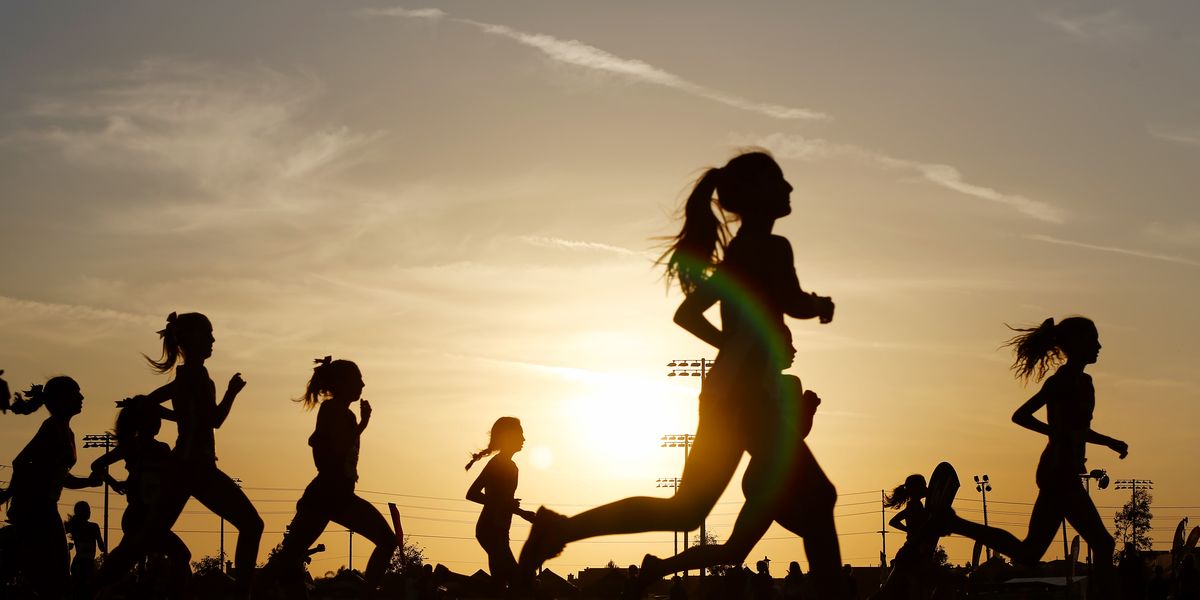
You’re probably aware of the mental health benefits running brings to your life. For me, there is nothing quite like that feeling of soaking up the sun’s rays this time of year, working up a good sweat, traversing wooded paths, and finishing a run feeling like I can tackle whatever life throws at me—at least the rest of the day.
As a mother of two daughters, I want my girls to know the benefits of movement for their mental health, too. But I also want them to be equipped with the knowledge to approach exercise and their body image in a healthy manner throughout their lives. They’ve both begun participating in sports competitively: My 14-year-old competes in cross-country and track and field, while my 11-year-old is excited for her first season of middle school cross-country this fall. So I know it’s becoming increasingly important to keep the dialogue open about what being healthy—both mentally and physically—means.
I’m not naive to the fact that we live in a culture that places a lot of value on our children’s performance in sports. And then there are messages and images surrounding body images our daughters are bombarded with on social media.
More From Runner’s World
So I set out to talk with a professor of sports psychology and a practicing psychologist who works with athletes and asked them some of your questions as well.
What are the benefits of exercise for children and young adults?
Like grown-ups, children and young adults benefit from running not only physically but also in terms of their mental health. Exercise is a great way for young people to understand how their bodies move, and that trust in their own movement develops a sense of confidence which, in turn, makes it easier for them to take on new activities, says Dr. Lindsay Blom, professor of sport and exercise psychology in the school of kinesiology at Ball State University.
And there are also the social benefits for young people who are involved in physical activity and the enjoyment of the endorphin release that even young people experience, Blom adds.
Here are ways we can empower our daughters to have a positive relationship with exercise and their bodies:
Learn to own your body
The more we talk to our daughters about owning who they are, the more they’ll understand their personal strengths and weaknesses, what their goals are, and where they’re in their developmental process, Blom says. It will get them to think about themselves and not compare themselves to others. In the end, they’ll feel more confident to make good choices for themselves.
Empowering female athletes to own their bodies can best equip them to advocate for what they need. “Oftentimes, women in general just assume that the coach is the authority and then [women] just take what they suggest and do it rather than ask questions about it or say, ‘No, this is how I feel when I do this,’” Bloms says.
Having a relationship with a coach or trainer where it’s normal to talk about how their body is feeling can maximize their goals in a healthy way. If we teach our daughters to speak up, we’re teaching them more than to be strong athletes: We’re teaching them the importance of setting boundaries around their physical and mental health throughout their lives.
Focus on the process, not the outcome
Paces, places, and PRs are not always the most important things in sports. “When we focus too much on the outcome, you can put a lot of pressure on yourself and kind of lose sight of the joy in the sport,” says Dr. Holly Serrao, a licensed psychologist in Clifton Park, New York who works with athletes and has taught undergraduate sport psychology.
Focusing too much on the outcome can lead to stress, anxiety, burnout, and even eating disorders, Serrao adds. Instead, she recommends encouraging young athletes to focus on the process and asking children questions like:
- How does it feel when you’re out there running?
- What do you get out of being on a team like this?
- What relationships and experiences as a result of your team are you grateful for?
These questions can encourage them to think about the process and the positive effect enjoying the process can have on their overall mental health.
Serrao encourages patients she counsels to leave their watch at home sometimes and just enjoy a recovery run with no pace or distance in mind. She reminds them that this won’t make them slower runners but will rather increase their health and longevity in the sport.
Control media consumption
We’ve all been guilty at one time or another of mindlessly scrolling through Instagram or other social apps. Unfortunately, this behavior may lead to poorer mental health, especially among adolescents as a review published in Psychology Research and Behavior Management that tracked young adults’ perceptions of viewing other’s selfies on social media suggests.
Blom encourages parents to talk to their children about controlling their intake of media and educating them that not all images they’re viewing are real in the way they’re presented.
Better yet, Blom suggests helping your daughter find positive role models in their sports. While we can’t always control the unhealthy images our children may see, we can have conversations with them about who we believe are positive role models and athletes.
Eat intuitively and mindfully
One RW+ member asked a question about how we should talk about eating healthy without it being related to weight. “Teach your children, for example, what protein and carbohydrates do for our body,” Serrao says. She recommends introducing some mindful and intuitive eating practices, such as asking the question “How do I feel when I eat this?” or how to be present in that moment when simply enjoying ice cream.
I personally love asking my daughters why they love certain foods and what it tastes like to them. I also enjoy teaching them the health benefits of the foods we prepare.
In a team culture your child may be exposed to unhealthy food behaviors from other teammates, Blom warns. Have conversations with your children about what eating healthy means for them and encourage them to discuss with you or their coaches, if they notice a teammate might exhibit the signs of disordered eating or body image.
Finally, Blom discourages parents from discussing weight and scales on a regular basis. “Parents are modeling behaviors for their kids all the time,” Blom says. Routinely ask yourself, what messages your behavior is communicating to your children.
Other questions from RW+ members
How should we encourage movement in young adults and children who aren’t inclined?
There are three reasons why sometimes we aren’t motivated to do something, Blom says.
- We don’t feel competent in it.
- It’s tiresome, hurts, or we don’t feel like we have a choice around it.
- We’re not doing it with people we can connect with.
Look for opportunities to build in movement. For example, walking the dog is an activity that is built into a daily routine, and not exercise per se. Blom for example takes a ball with her while at her older daughter’s soccer games so that her younger son has the option to move around.
Be mindful of clothing that promotes natural movement, like sneakers and athletic wear, thus reducing barriers to moving more, Blom adds.
How do we explain the difference between joyfully moving and training past fatigue?
Tell young adults that sometimes, as an athlete, they’ll be pushing past the pain—and it can be a healthy thing—but you shouldn’t be pushing yourself all the time in every activity, Serrao says.
“That’s why rest days and easy days are built in,” she says.
Learn to love running beyond the physical aspect
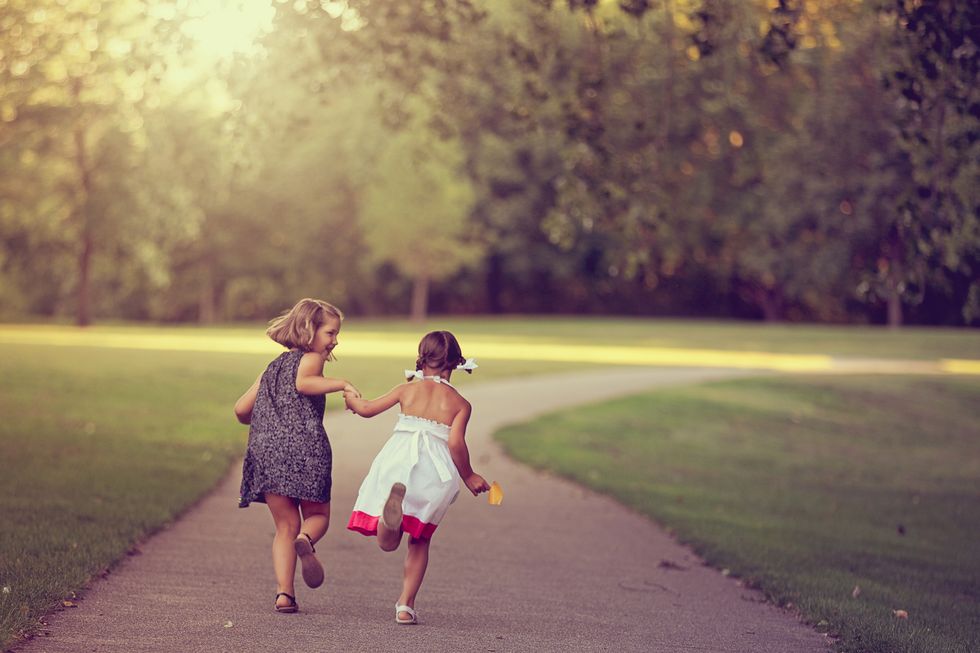
As for my family, I want my daughters to know that while I run for the physical benefits, like maintaining a healthy heart or staying strong, the real benefit for me is what running gives me mentally and spiritually. I want my daughters to know that when I run, I’m seeking to feel a connection to the world with all of my senses. I feel most alive when I’m moving my body through space, and fully present with my breath and thoughts. When I run, time slows down.
I will tell my daughters the story again and again of how I began running with my father, their late grandfather, through the woods when I was their age, and I never stopped because I found it to be the most magical experience, and I hope they too will experience that wonderment too.
Jennifer Acker joined the editorial staff of Runner’s World and Bicycling in January 2022. A former freelancer writer and NCAA runner, she started running as a kid and basically never stopped. She also loves outdoor adventures, like hiking, skiing, and mountain biking.
