


Some things you can’t debate, such as whether it’s a crime to hide a raisin cookie in a batch of chocolate chips. Other acts are a little less certain. And, when it comes to exercise movement, there’s no shortage of disagreement about what movements are safe and which should be limited.
Squats are one of the most controversial exercises. Some people suggest they are the best movement (period), whereas others – most notably, respected coach Mike Boyle – suggest they are oftentimes abused and unnecessary.
At Born Fitness, we work with our online coaching clients to determine what movement is best for them. We love squats, but not everyone needs to do them. Blanket recommendations are dangerous. One person’s path to better performance can be another person’s path to injury.
And, if you do, it certainly doesn’t have to be on two legs (you can do 1-leg variations) or with a barbell on your back.
Let’s assume you want to squat (remember, it’s still a primary movement). All you need to do is figure out how deep you should go, and what is dangerous for your body.
Many people will suggest any type of “butt wink” – a rounding of your lower back – is dangerous.
It’s not quite that simple, but we can offer an easy way to help you figure out what’s best for your body.
Is The Butt Wink Bad?
Some coaches want you to squat ass to grass (ATG). While others, notably Dr. Joel Seedman (screenshot from https://www.advancedhumanperformance.com/blog/squats-truths below), claim that you should stop your squat around 90 degrees.
The two camps primarily disagree about what is dangerous for your spine. And, the movement most often in question is the “butt wink.”
As you lower into a squat, there’s a moment when you get so deep that your lower back (lumber spine) starts to round.
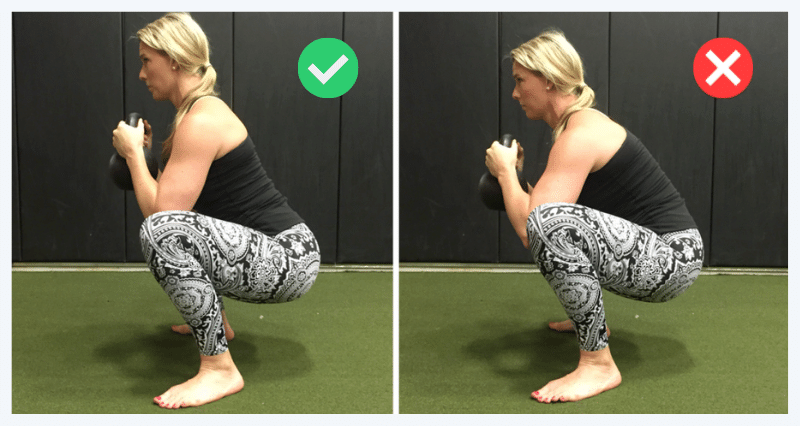
If you want to see what this looks like on your own body, find a mirror and it’s easy to assess. Turn sideways to the mirror and then slowly lower into a bodyweight squat. As you reach the bottom of the squat, watch your lower back. If you’re like most people, you’ll see this area slowly “wink” as you go deeper.
This rounding of the spine, called spinal flexion, isn’t inherently dangerous. Our spines are made to flex, extend, and rotate as human beings. That’s why you likely don’t need to worry about this rounding during movements like that bodyweight squat.
So, what’s the big deal? Rounding with no weight on your back is not much of a problem. But, once you start adding flexion with weight on your back – and doing it for many reps – such as during a heavy back squat, that’s when the story changes.
Most spine experts consider rounding your low back with load (such as a barbell) to be a risk for your lumbar spine, which means you’re at higher risk of disk injury and back pain.
Here’s why: Between each bone segment (the vertebrae) of your spine is a gel-filled disk that helps absorb shock. This means when there’s weight on your back, you can transfer it safely throughout your spine.
When you load your spine, you create a compression force that pushes the vertebrae together and squeezes the intervertebral disks. This isn’t dangerous if you have a healthy spine. (Fun fact: your spine is quite resilient to compression.)
The issue is when you compress and flex your spine at the same time. This combination of load and flexion increases another force (shear) on your spine. And shear plus compression could increase your chance of injury.
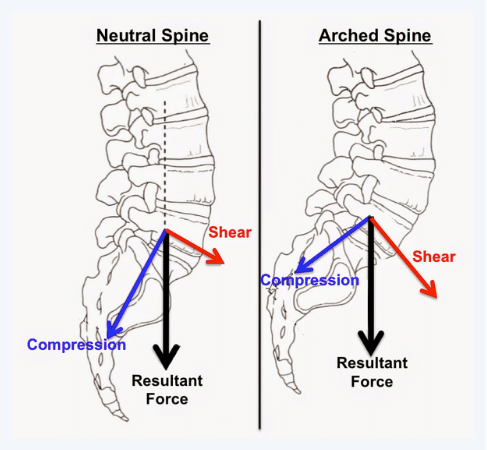
We all have different anatomy, so for you, that injury might not happen for years. But, flex your spine under load for rep after rep, and eventually, you might have a problem on your hands.
That’s why a butt wink while squatting under load isn’t a good idea for the vast majority of us.
What causes butt wink?
People love to blame “tight hamstrings” for difficulty squatting. It’s likely not the cause of the butt wink, so stretching them out before your lifts isn’t going to help you avoid it.
As Dr. Aaron Horshig breaks down in this video, your hamstrings attach to both your pelvis and your knee, which means they don’t actually lengthen much during your squat.
Try this: Lay on your back with your legs straight. Now, lock your knees out and slowly lift one leg up.
I’m guessing you didn’t get very high? That’s because with your leg straight, you are lengthening your hamstring, and eventually, you hit your end range.
Do it again, but allow your knee to bend 90 degrees as you lift your leg up.
Feel the difference? You have more range of motion because as you flex your hip (lengthening the hamstring), you also bend the knee (shortening the hamstring). Your entire muscle stays relatively the same length, just like during a squat.
Instead, the butt wink often comes down to your squat stance and ankle mobility. And to know about both, it’s time to analyze how you move.
Shakira would be proud, but your hips don’t lie.

Each of us has a unique angle that our femur (the big bone in your thigh) fits into our hip socket. And this angle determines your squat stance.
Suppose your stance is too narrow or wide (based on your individual hip genetics). In that case, you’ll run out of room in your hip socket when you drive your legs into hip flexion (lowering into the squat).
When you try to force range of motion, your body compensates. As you run out of room in your hips at the bottom of the squat, your pelvis tilts backward (called posterior pelvic tilt), and your lower back rounds. Hey, butt wink.
You got to the bottom, but was it really worth it? (more on this in a moment).
Butt wink can also be caused by ankle mobility issues. If you lack the range of motion at your ankle, your body can’t drive your knees forwards as you sit into the squat. Just like when you run out of room in your hips, your body has to find the range of motion somewhere else and prefers your lower back.
How To Fix Butt Wink
Before we show you how to fix butt wink, we need to talk about the neutral spine. Since that sounds painfully boring, just think of this as your “safe to squat” zone. (Or STS Zone)
When we refer to your STS (aka neutral spine), we’re referring to the position of your lower back during movement. For most, this means a slight curve in your lower back.
Most coaches and physical therapists encourage finding your STS because it offers the most protection to your spine during loaded movement. But, and this is important, it does not entirely reduce the risk of injury. You’ll still need to leave your ego at the door and be smart with progressively overloading your movements.
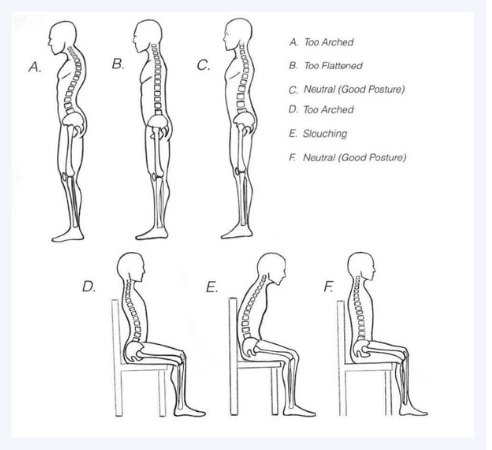
Your spine moves a small degree during exercises, even if you’re in your STS zone. Things become dangerous when you stray too far out of this zone. In other words, that’s when the butt wink becomes more aggressive.
Our goal is to squat as deep as possible without your lower back rounding too much. You’ll need to find the right squat stance for you to do this.
Here’s how to do this:
- Sit into a bodyweight squat. Don’t worry about your back rounding; just drop to the bottom.
- Play around with your squat width and the angle of your feet until you find what feels most comfortable.
- Keep this stance and do a couple of squats to see how the full range of motion feels.
Sitting into the bottom of the squat like this won’t be comfortable for some. Feel free to grab on to a support. Want to see this process in action? Check out our Instagram post here.
You’ll also want to experiment with different squat variations. Unless you’re a powerlifter, there’s no rule that you have to back squat.
If you love the back squats, try to slide small plates (like 2.5 or 5 pounds) underneath your heels, or stand on a wedge. This changes the angle of your hips and allows you to get deeper into a squat without worrying about the wink.
If you’re looking for squat alternatives, the goblet squat is a better fit for most. This is a variation of the front squat, which helps activate your core and maintain that neutral spine. Once you’re comfortable with the goblet squat, you can also do the more traditional version of the front squat.
You can also try any endless variations of single-leg movements, such as split-squats or Bulgarian split squats, which help reduce the likelihood of the butt wink.
No matter what, your best guide is usually comfort and pain. If something feels off, don’t force the movement. Find a way to move pain-free, and then add load to make it harder.
READ MORE
- Why Do Squats Hurt? (And How To Fix The Problems)
- Valsalva Maneuver: A Technique That Can Save You From Back Pain
- The Mystery of Squat Form: How Low Should You Go, Really?

B.J. holds a B.S. in Health and Human Performance and multiple certifications, including Precision Nutrition Level 1 and BioForce Certified Conditioning Coach. Over his 14-year coaching career, he’s been fortunate enough to coach a wide range of clients. From online clients looking to get in great shape to CEO Nate Checketts (Rhone) and CEO Marcelo Claure (Softbank), and professional skateboarder Sean Malto. Before beginning his training career, he was a sports science lab research assistant.
