

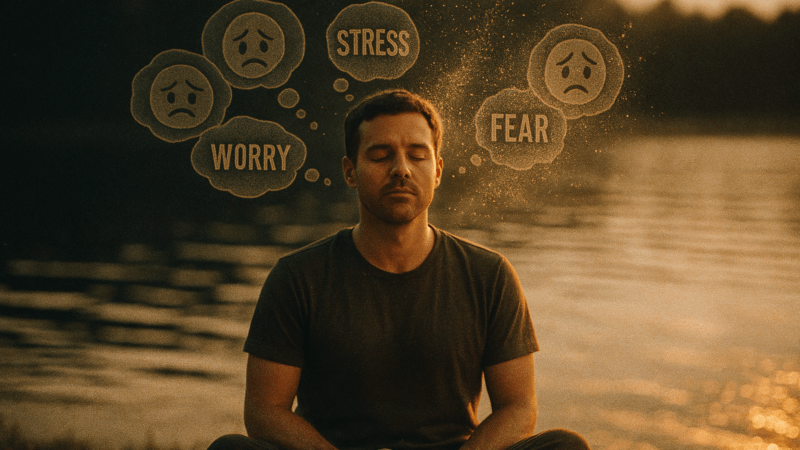
Learning how to stop negative thinking can completely change your mental health, relationships, and daily life. Sarah sits in her car after a work presentation, replaying every stumble, every pause, every moment she felt less than perfect. “I’m such an idiot,” she thinks. “Everyone could tell I had no idea what I was talking about.”
Meanwhile, her colleagues are already discussing lunch plans, having barely noticed the minor hiccups that now consume her thoughts.
If you’ve ever found yourself trapped in a similar spiral of self-criticism, harsh judgments, or endless comparisons, you’re experiencing something psychologists call the “negativity bias,” and you’re certainly not alone.
Why Your Brain Struggles to Stop Negative Thinking
Our minds are evolutionary marvels designed to keep us alive, but this same survival mechanism can become our greatest source of suffering. Research by Baumeister et al (2001) demonstrates that negative events have roughly five times the psychological impact of positive ones. This negativity bias served our ancestors well, as quickly spotting danger and remembering threats leads to improved odds of survival.
But in our modern world, this ancient wiring backfires. Instead of scanning for saber-tooth tigers, our brains scan for social threats, performance failures, and reasons we might not measure up.
The result? A constant stream of “what’s wrong” attention that keeps us stuck in cycles of worry, self-doubt, and emotional exhaustion. Neuroscientist Dr. Rick Hanson describes this as our brains being “like Velcro for negative experiences and Teflon for positive ones.”
The good news? Neuroscience shows us that mindfulness training can replace these patterns with new ones, strengthening areas of the brain associated with emotional regulation while weakening the circuits that drive rumination.
Mindfulness: The Key to How to Stop Negative Thinking
Mindfulness is a scientifically-validated approach to changing how we relate to our thoughts. A comprehensive meta-analysis by Khoury et al. (2013) examining over 200 studies found that mindfulness-based interventions significantly reduce anxiety, depression, and psychological distress while improving overall well-being.
The core insight? You can have a healthier relationship with your thoughts. You don’t have to believe everything you think.
Jon Kabat-Zinn defines mindfulness as:
“Paying attention on purpose, in the present moment, and non-judgmentally.”
This simple shift, from being caught in our thoughts to observing them, creates what psychologists call “metacognitive awareness,” or the ability to think about thinking.
We can learn to observe with greater awareness and openness that we are thinking and notice how we respond to our thoughts—ultimately realizing that thoughts are simply thoughts.
3 Mindfulness Techniques to Stop Negative Thinking
1. Cognitive Defusion – See Thoughts as Mental Events, Not Facts
I often tell clients that thoughts are like uninvited guests at a party. You don’t have to serve them dinner and give them a place to sleep, but you can acknowledge them politely and let them move on. In doing this, we are practicing cognitive defusion.
One of the most effective ways to learn how to stop negative thinking is through cognitive defusion, which is one of the most powerful techniques from Acceptance and Commitment Therapy (ACT) that can help us with this. We can learn to step back from thoughts rather than getting tangled in them. Instead of seeing thoughts as absolute truths, we learn to view them as passing mental events, like clouds drifting across the sky.
The Science Behind It: Neuroimaging studies show that when we practice defusion, activity decreases in the default mode network—the brain region associated with rumination and self-referential thinking—while increasing in areas linked to present-moment awareness.
Exercise: The Leaves on a Stream Visualization
This classic exercise helps you practice the skill of letting thoughts pass without getting hooked:
- Settle into a comfortable position and close your eyes.
- Imagine sitting beside a gently flowing stream with leaves floating on the surface.
- When a thought arises—whether it’s worry, judgment, or criticism—imagine placing it on a leaf and watching it float downstream.
- Don’t force thoughts away or analyze them. Simply observe them drifting past, making room for whatever comes next.
- If you get caught up in a thought, gently notice this and return to watching the stream.
Practice this for 5-10 minutes daily. Over time, you’ll develop the ability to let thoughts pass naturally rather than getting swept away by them.
2. Mindful Noting: Label Your Thinking to Create Distance
Mark, a software engineer, used to spiral into self-criticism after every team meeting. Through the noting practice, he learned to catch these patterns early: “There’s that ‘I said something stupid’ story again.” This simple recognition helped him break the cycle before it consumed his entire afternoon.
When caught in negative thinking spirals, we often become so identified with our thoughts that we can’t see them clearly. Noting is a simple technique, adapted from Buddhist mindfulness traditions, that helps create objective distance by simply labeling what’s happening in the mind.
The Research: Studies on mindful attention show that the simple act of labeling emotions and thoughts activates the prefrontal cortex (our rational brain) while calming the amygdala (our alarm system). This is why noting feels immediately soothing.
How to Practice Noting in Daily Life
Instead of getting swept away by thoughts like “I’m not good enough,” try noting them as:
-
- “Judging” (when you notice self-criticism)
- “Comparing” (when measuring yourself against others)
- “Worrying” (when anticipating future problems)
- “Planning” (when your mind races ahead)
The Practice:
- Notice when you’re caught in negative thinking
- Gently label the type of thinking: “Ah, there’s judging again” or “I notice worrying”
- Take a conscious breath and remind yourself: “This is just a thought, not a fact”
- Gently redirect attention to the present moment
Research shows that this practice of “managing moods through mindfulness” can help even out emotional extremes and create more stability in our mental state.
Read more on how mindful noting helps heal rejection.
3. Anchoring – A Simple Way for How to Stop Negative Thinking
When lost in negative thinking, we need concrete ways to return to the here and now. Anchors are sensory experiences that ground us in physical reality, interrupting the mental spiral and creating space for clearer thinking.
The Neuroscience: Focusing on sensory input activates the parasympathetic nervous system, our body’s natural relaxation response, while simultaneously engaging present-moment awareness circuits in the brain.
Practical Anchoring Techniques
Physical Anchors:
- Breath: Place one hand on your chest, one on your belly, and feel the rhythm of breathing
- Touch: Hold a textured object, feel your feet on the ground, or press your fingertips together
- Movement: Take five mindful steps, stretch your arms overhead, or roll your shoulders
Sensory Anchors:
- Sound: Listen to ambient noise, focus on a calming playlist, or tune into your own breathing
- Sight: Look out a window, focus on colors and shapes, or practice “soft gaze” meditation
- Smell: Keep a small bottle of essential oil handy, or notice natural scents around you
Quick Anchoring Practice: The 5-4-3-2-1 Technique
The next time you notice negative thinking, try this grounding exercise:
- 5 things you can see
- 4 things you can touch
- 3 things you can hear
- 2 things you can smell
- 1 thing you can taste
This rapidly shifts your brain from rumination mode to present-moment awareness.
More grounding tools can be found in this mindfulness exercise guide.
Building Cognitive Flexibility to Prevent Negative Thinking
The ultimate goal isn’t to eliminate negative thoughts, but to develop cognitive flexibility, the ability to think about situations from multiple perspectives. Research by Kashdan & Rottenberg (2010) shows that psychological flexibility is one of the strongest predictors of mental health and life satisfaction.
Exercise: The Cartoon Voice Technique
This playful exercise helps reduce the emotional intensity of negative thoughts:
- Identify a recurring negative thought, like “I always mess things up”
- Imagine hearing this thought in a silly cartoon voice (try Mickey Mouse, Darth Vader, or your favorite animated character)
- Notice how it feels less serious and more like a passing mental event
- Now reframe with a balanced perspective:
- Instead of “I always mess things up” → “I make mistakes sometimes, and that’s how I learn”
- Instead of “I’ll never be good at this” → “I’m developing this skill, and progress takes time”
The Path Forward: Integration and Daily Practice
Transforming your relationship with negative thinking isn’t about perfection. It’s about developing the habit to practice these ideas. Research by Harvard Medical School shows that even small, consistent practices create lasting changes in brain structure and function within just eight weeks.
Your Daily Mindfulness Toolkit:
- Morning: 5 minutes of leaves-on-a-stream visualization
- Throughout the day: Practice noting when you catch negative thoughts
- During stress: Use anchoring techniques to return to the present
- Evening: Reflect on moments when you successfully stepped back from difficult thoughts
The Ripple Effect: As you develop these skills, you’ll likely notice improvements in relationships, work performance, and overall life satisfaction. When we’re less caught up in internal criticism, we have more energy for what truly matters.
Research shows that mindfulness-based interventions can significantly reduce anxiety, depression, and psychological distress while improving overall well-being.
Frequently Asked Questions About How to Stop Negative Thinking
How long does it take to see results from mindfulness practice?
Harvard research shows that measurable changes in brain structure can occur within eight weeks of consistent mindfulness practice. However, many people notice improvements in mood and stress levels within the first few weeks of regular practice.
Can mindfulness replace therapy for negative thinking?
While mindfulness is a powerful tool, research suggests that mindfulness-based cognitive therapy can be as effective as medication for depression. For persistent negative thinking patterns, combining mindfulness with professional therapy often provides the most comprehensive support.
What’s the difference between mindfulness and meditation?
Mindfulness refers to the practice of developing awareness of what’s happening in one’s mind and body from moment to moment, while meditation is one of several techniques used to cultivate mindfulness.
How often should I practice these techniques?
Start with 5-10 minutes daily and gradually increase. Consistency is more important than duration—regular practice, even for short periods, creates more lasting change than longer, infrequent sessions.
What if my negative thoughts feel too overwhelming?
If negative thinking significantly impacts your daily life, consider seeking support from a mental health professional who specializes in mindfulness-based approaches. Find qualified therapists in your area
Conclusion: A New Relationship with Your Mind
You don’t have to be at war with your thoughts. The path forward isn’t about forcing positivity or suppressing difficult emotions. It’s about developing a wiser, more compassionate relationship with your mental experience.
The next time you find yourself caught in self-judgment or comparison, remember Sarah from our opening story. What if, instead of replaying every imperfection, she had taken a breath, noted “there’s the voice of self-criticism,” and gently returned her attention to the present moment?
This isn’t just wishful thinking. It’s a learnable skill backed by decades of scientific research from institutions like Harvard Medical School and Massachusetts General Hospital.
So take a deep breath. Right here, right now, you have everything you need to begin this transformation. Your thoughts will continue to come and go, but you don’t have to go with them.
As the mindfulness teacher Tara Brach reminds us: “The boundary to what we can accept is the boundary to our freedom.” Today, you can begin expanding those boundaries, one mindful moment at a time.
Mastering how to stop negative thinking isn’t about forcing yourself to be positive, it’s about building skills that let you meet your thoughts with clarity and choice.

The preceding article was solely written by the author named above. Any views and opinions expressed are not necessarily shared by GoodTherapy.org. Questions or concerns about the preceding article can be directed to the author or posted as a comment below.
